
IBD in Society

Shaping the Blank Pages of Us: IBD & Society

by Beamlak Alebel (Addis Ababa, Ethiopia)

A hand gracefully reaching out towards a setting sun amidst a calm, leafy background.

There must be a life catalyst in every person’s journey, something that stirs us, shapes us, and pushes us forward. For many people living with chronic illnesses like Inflammatory Bowel Disease, that catalyst is not only the condition itself but also the society around them.

Whether we recognize it or not, society plays a deep and lasting role in how IBD patients see the world and how they see themselves. From our earliest days, we learn what people consider “normal,” what is acceptable to talk about, and what should be hidden. For someone with IBD—a disease that is often invisible, stigmatized, and misunderstood—society’s voice can either be healing or deeply hurtful.

IBD teaches us that education doesn’t only begin in the classroom; it begins in the spaces between people. It starts in whether communities choose empathy over judgment when someone struggles with pain, fatigue, or multiple hospital visits. It begins with whether people understand that “You don’t look sick” is not kindness—and that invisible illnesses are real and heavy.

Every person is born as a white page—blank, pure, ready to be written with experiences, lessons, and love. But for someone with IBD, society often writes the first words: misunderstanding, stigma, or silence. That is why it matters so deeply what kind of world we create around chronic illness. A supportive, kind, and educated environment can be the difference between a patient who suffers in silence and one who lives with dignity, confidence, and hope.

Being a good person costs nothing. We lose nothing by choosing kindness toward those living with IBD. A little understanding when someone cancels plans, a bit of patience when they are too tired to continue, or simple respect for their medical journey—these things truly matter. They lighten the emotional burden that is often heavier than the disease itself.

If only society remembered that. If goodness and awareness came as naturally as breathing, people with IBD wouldn’t have to hide their pain or feel ashamed of their scars, surgeries, or symptoms. A smile, a word of encouragement, a willingness to learn, these small acts can be a lifeline for someone navigating an illness that affects every part of their life.

Let us be the catalyst. Let us be the people who make IBD visible, who break the silence, who show that being human means supporting one another beyond our comfort zones. It means listening to the stories of IBD warriors, respecting their challenges, and standing beside them in their fight.

In the end, it’s not wealth or fame that defines a society—it’s how we treat the most vulnerable. May we choose to be a society that uplifts those living with IBD, a society that listens, understands, and helps shape lives not through judgment but through compassion. Because when society chooses kindness, an IBD warrior’s blank page becomes a story of courage—and that changes everything.

Photo credit goes to: https://stockcake.com/i/sunset-in-hand_1221433_547021 
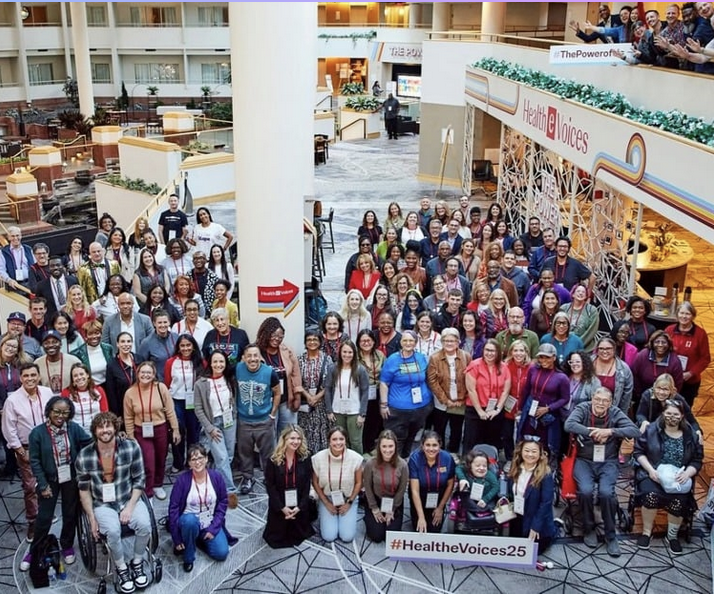
HealtheVoices 2025: Feeling Beautifully at Home with my IBD

by Michelle Garber (California, U.S.A.)

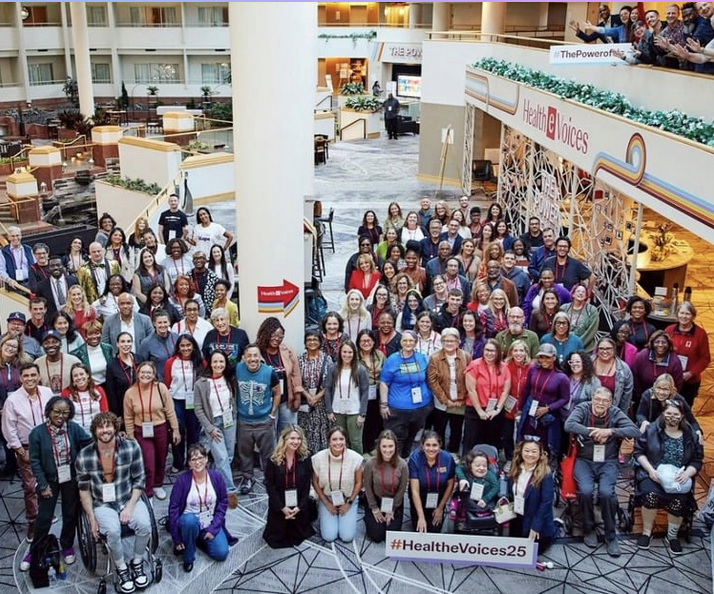
A photograph from the HealtheVoices 2025 conference, showing a group of attendees gathered together.

Disclaimer from Michelle: Johnson & Johnson paid for my travel expenses to attend HealtheVoices, but all thoughts and opinions expressed here are my own. This conference was not attended as a part of the CCYAN fellowship.

From November 6th through November 9th, 2025, I stepped into a space that I had never experienced before. HealtheVoices 2025 was more than a conference for advocates like me. HealtheVoices became a place where my body, story, and heart finally felt understood. I walked in as an Inflammatory Bowel Disease (IBD) and mental health advocate, but I walked out feeling like I had reclaimed parts of myself that IBD had slowly worn down. 

IBD affects so much more than the digestive system. My life is shaped by symptoms that are unpredictable and exhausting, with my mental health experiences running parallel to this journey and adding additional weight. IBD ultimately shapes the way that I move through the world, my energy, my confidence, and even the level of honesty that I bring to conversations. Daily life can feel even more heavy and lonely because it is rare for me to be in a room filled with people who truly understand what chronic illness feels like, and vulnerability about illness does not always land well with people who cannot relate. At HealtheVoices, that weight softened the very moment that I arrived. The environment made me feel safe before I even realized that I had been holding my breath for so long. 

I met people living with many types of chronic conditions, from visible disabilities to more silent illnesses like mine. I met caregivers who understood illness from the position of love and exhaustion. I met people who shared my diagnosis of IBD and people who shared my mental health struggles as well. In turn, I finally did not feel like the odd one out or like the only person in the room fighting a battle that no one else could see. For one weekend, I felt truly seen, understood, and supported. It felt like everyone there spoke a language that I always knew but rarely had spoken back to me. It was a rare and profound reminder that community, safety, and understanding can change the way a chronically ill body feels because, to put it simply, I finally felt normal

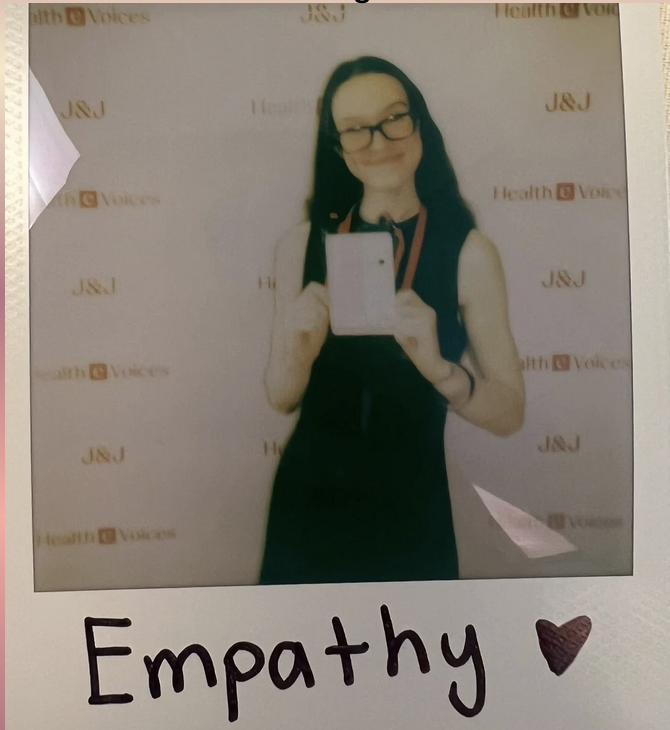
A polaroid of Michelle, a white woman with long brown hair, dark framed glasses, and a black dress. She is holding up her conference badge and smiling. At the bottom of the photo, the word “empathy” is handwritten, next to a heart.

While I cannot speak for all of the attendees, I know that I felt this way for a variety of reasons, and I am going to try my best to put it into words. 

For starters, I could tell that the conference itself was intentionally designed with us in mind, and that intention showed in every detail. Organizers checked-in on us often, encouraged rest, and made it clear that nothing was mandatory. They understood that rest is both a need and a responsibility. They understood that pushing too hard could cause flare ups, particularly for those of us with IBD or conditions that involve fatigue, pain, and unpredictable symptoms. Even travel was supported as I received reminders and check-ins to make sure that I made it to my flight safely. This took the emotional labor out of the small things that usually drain me, and their help and accommodations were never made to feel like favors. Plus, everything was optional, yet everything was thoughtfully provided. It was all offered with genuine care, and that is something that I rarely feel in spaces outside the chronic illness community. I truly felt taken care of at every moment. I never felt pressured to show up to an event, and I never felt like a burden or a "waste of an attendee" if I did not. I felt valued simply because of who I am, IBD and all. Typically, I am made to feel as though my IBD devalues me throughout many domains of life, but I felt the opposite way while at HealtheVoices. I also felt considered and looked out for without being pitied or restricted. In other words, I felt empowered to take care of myself and to be the advocate I want to be, while also realizing that there is power in accepting help and care—there is the "power of us." 

Regarding this "power of us," I was able to witness and experience how chronic illness can foster unity, even when diagnoses and symptoms may differ. This was exhibited right off-the-bat at the very first dinner of the conference when attendees were grouped based on their health condition, and I accidentally sat with the mental health and pulmonary hypertension group instead of the immunology group. What started as an awkward mistake due to my brain fog after a long day of traveling ended up turning into a gift. At this dinner, I connected with people who understood my mental health story in ways that felt grounding and familiar. Some even worked in the mental health field like I do, which felt incredibly validating. Therefore, even though not a single individual there had IBD, our emotional landscapes were still strikingly similar. We each shared our stories of career challenges, burnout, medical dismissal, discrimination, chronic pain, hospital admissions, fatigue, chosen family, the exhaustion of being misunderstood, and the emotional toll of navigating life and relationships with an unpredictable body and/or mind. We also connected over experiences specific to gender, such as being dismissed in medical settings until a male caregiver shows up. 

These discussions reminded me that chronic illness is not defined only by biology. It is shaped by stigma, gender, identity, socioeconomic realities, and the emotional toll of constantly having to justify our experiences. Even people whose conditions had nothing in common with mine understood the same nuances of fatigue, pain, fear, and perseverance. Our hearts carried extremely similar stories, and the overlap was both comforting and heart-wrenching at the same time. 

After that realization, I made a conscious effort for the rest of the weekend to approach people without looking at their badges. I did not want to lead with diagnoses anymore since I understood that a diagnosis was not the only thing that could foster deep connections. I wanted to understand people for who they were rather than for what condition they advocated for, even though I understood that advocacy often played a large role in the attendees' identities. 

Despite it being an advocacy conference, my goal was not to advocate or educate that weekend. I simply wanted honest connection. I wanted to feel safe being myself. I wanted to meet people who would understand both the heaviness and the humor that come with living in a body that needs extra care and requires constant negotiation, without limiting myself by my diagnosis. My IBD has limited me enough already, and I was not going to let it stop me from making the meaningful connections that I have been seeking just because of a label. As it is, living with IBD and mental health challenges is incredibly isolating, especially when daily experiences and honesty are treated as oversharing. Everyone, including myself, preaches vulnerability, but it is difficult to be vulnerable when people do not know how to respond or cannot relate to your daily reality. That is why having the space to openly share about your day-to-day life—without the sugarcoating—is essential, and I found that space with each and every attendee carrying all of the diagnoses under the sun. It did not matter if they had IBD, a different chronic illness, or if they were a caregiver since we could all relate to one another in some way. 

This was an incredible phenomenon that attendees and I noticed since at HealtheVoices, we did not have to explain the basics. Each conversation started with an innate understanding of one another. This understanding was not just based in compassion and shared experiences as it was oftentimes also based in shared medical knowledge/terminology, tips and tricks for navigating the healthcare system, etc. This is because everyone there lived some version of the same complexity. For example, many of the attendees understood Prednisone's mental and emotional side effects, sometimes even making light of it nonchalantly during conversations. Outside of the chronic illness space, these jokes and statements would have to be explained or given some background information, which can become exhausting over time, especially as you meet more people throughout your life. Having people who just "get" certain things—without needing to pause the conversation to explain and without having to worry about how it might be taken—is a breath of fresh air. 

A photograph from the HealtheVoices 2025 conference, showing a group of attendees gathered together.

I did not have to soften the truth or worry about being labeled as "dramatic" or "negative." I did not have to explain why I left an event early or arrived late, nor did I have to explain why I did not finish the food on my plate. People just got it. This conference felt like a safe haven where I did not have to justify my needs or my existence as someone living with IBD. Even when we were not familiar with aspects of each other's health condition(s), we approached one another with curiosity rather than making assumptions, offering unsolicited medical advice or "natural remedies" that we have likely already tried/been advised to try countless times, or making remarks along the lines of, "everything happens for a reason" and "at least it's not cancer."  

Conversations were honest but never forced, and I found that our weekend did not revolve entirely around illness. Sure, we cried a lot, but we also laughed a lot. We talked about hobbies, goals, spirituality, tarot, and things that were not centered in our diagnoses. It felt balanced in a way that my everyday life rarely does since either my whole world feels tied to my IBD, or I attempt to live in denial of its existence. At HealtheVoices, I did not have to shrink or edit my truth. 

Yet, there was a moment very early into the weekend when I felt myself growing emotionally tired. While there were those intriguing conversations outside of chronic illness, most conversations were still deep and personal in nature. As a result, I felt an unexpected countertransference building inside of me, as if I had automatically tried to become the "listener" and "helper." Hearing such heavy stories that mirrored my own felt draining at first because I empathized deeply, and I wanted to hold people's burdens for them for as long as I could. That is what I am used to doing for others, and that is what I honestly enjoy doing. I see it as a privilege to be trusted with such personal information and stories of deep pain. Thus, I wanted to show my gratitude for this privilege, which expressed itself as me unconsciously attempting to relieve some of their burdens. It was as if I had naturally tried to step into the role of "therapist" instead of simply being myself. It is a habit that comes naturally to me, especially since I am entering the mental health field as a therapist and hope to work with people who have chronic illnesses. 

I also initially experienced some imposter syndrome early into the conference. I was surrounded by these incredible advocates, many of whom have been advocating for decades. Some were even making a career out of their advocacy journeys. Even though it feels like IBD has been a part of my identity for my whole life, I was only diagnosed 4.5 years ago. Similarly, even though I feel as though I have been advocating for years, I really have only been actively advocating and becoming involved in the IBD community this past year. This made me begin to question why I was selected to attend the conference. What the heck do I have to offer? The more this question weighed on me, the more I felt the need to make up for my perceived lack of experience. This translated into my attempt to take on that therapeutic role that is all too comfortable because at least I would be offering something

After a good night's rest that day, I realized something important: I was not there to fix anything, lighten anyone's burden, or carry emotional weight/pain for others. I was there as Michelle, not as a therapist. In fact, nobody there asked or wanted me to show up as a therapist. The fact that I was selected to attend the conference is proof in itself that there is something that I could offer within the advocacy space, even if I am a "newbie." There is something that I could offer by simply being myself, and I was allowed to be myself (whoever that is). Listening deeply is part of who I am, but absorbing others' pain does not have to be. Once I gave myself permission to let go of the helper role and the imposter syndrome while understanding that I could be present without absorbing everything, something inside of me shifted: I started to share and listen without performing emotional labor

As a result, my body felt lighter. My energy felt different. As someone who lives with IBD and chronic fatigue as a constant companion, I hardly ever feel energized. Yet in that space, surrounded by community and safety, I felt more awake and alive than I have in years. I slept through the night without restlessness or insomnia, and I rested without guilt. That establishment of safety ultimately allowed my body to shift out of survival mode, which is the foundation of many evidence-based theories. I felt at home in a way I did not expect. I finally saw that I was allowed to accept help and let people in, even if they were going through their own struggles. I saw how support can be mutual and balanced. I also saw how I could be the "supported" instead of the "supporter," especially by how the HealtheVoices organizers took care of me without requiring anything in return. Letting myself step into that truth felt like exhaling after years of holding my breath. It felt like the relief that comes from finally unclenching my fists and jaw. It reminded me how much chronic illness is affected by environment and emotional safety because healing is not only medical, but it is also emotional and communal

Overall, this experience made me realize how rare it is to just feel safe in everyday life. At HealtheVoices, everyone had something, whether it was a chronic illness, a disability, or the role of being a caregiver. Illness was not the exception. Rather, illness was the normal. By that, I mean that caregivers and those with health challenges were not the minority, and we did not feel out of place. That shift in perspective changed how I saw myself as it made me feel entirely human. Despite my symptoms persisting due to their chronic nature, I did not necessarily feel "disabled." I did not feel "different" or "abnormal." I did not feel like my everyday reality was "too heavy" or "too personal" to be shared. It was simply life, and almost everyone there understood. 

The environment created at HealtheVoices highlighted a crucial truth: the world can accommodate people living with chronic illness, but spaces simply choose not to. The conference gathered people with vastly different conditions and needs, and yet everyone I met felt included and supported. This was not magic. This was intention. This was care. This was a commitment to treating people with chronic illness as fully human. I felt that my needs mattered and that I mattered. The organizers did not treat accommodations as burdens but rather as standard practice. This was eye opening because many institutions act as if inclusion is too much work, but this conference proved that it is entirely possible. In fact, it showed me that inclusion is completely achievable when people genuinely want to create it. To put it simply, inclusion is a choice. Dismissing people is also a choice. Institutions, workplaces, and communities can make room for us, but they simply choose not to invest in the effort

I left the conference with a heart full of gratitude for the connections I made, the stories I heard, the jokes I shared, the insights I gained, and the revitalized sense of identity that I fostered. I left with a deeper understanding of caregiver burden and the emotional landscapes of people living with all types of conditions. I left with the lived experience of how community is essential for healing. I left with a reminder to show up authentically, even in spaces that do not always understand. I left with a deeper commitment to advocate for people with IBD and for people living with chronic illness(es) more broadly. I laughed more than I expected to, and I actually felt real joy. I left with the realization that I often carry emotional burdens for others and take on roles that are not mine to hold, and that realization is going to guide how I move forward in my personal and professional life. 

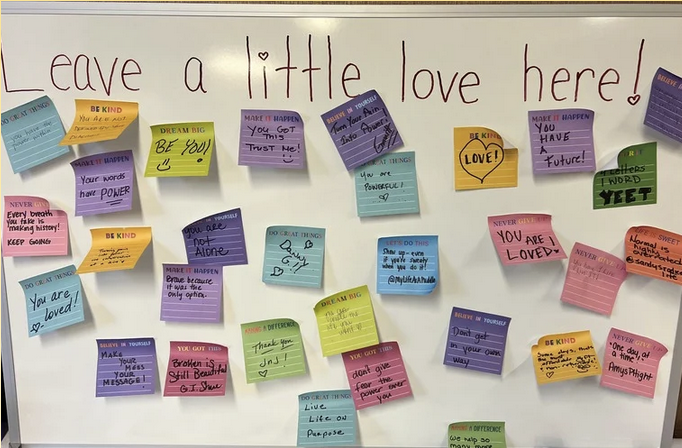
A photograph showing the message “Leave a little love here!” with lots of post-it notes full of affirmations below. Some notes include “you are loved!,” “you are not alone,” “you are powerful,” “be YOU,” “your words have POWER,” and '“you have a future.”

Most of all, I left with a renewed determination to push for environments that truly include people with IBD and other chronic conditions. We deserve to feel normal, included, and valued. We are not abnormal. We are simply made to feel that way by systems that refuse to accommodate us. Anyone can become disabled at any time through illness, accident, age, etc. Anyone can become sick. Anyone can get hurt. Everyone ages (or at least that is the end goal). It is easy to not be concerned about something that does not affect you, but take it from me, it is 100% possible to wake up sick one morning and never be able-bodied again. That is the story of many people with IBD and many people with chronic illnesses. Inclusion matters because disability affects all of us eventually. Anyone can shift into the world that I navigate every day. In turn, inclusion genuinely benefits everyone

All in all, HealtheVoices reminded me that despite my IBD, I am not alone—I never was. It reminded me that there are some spaces where people like me can feel completely safe, completely understood, and completely ourselves. There are places in the world where people with IBD can feel completely and beautifully at home. Being in such a space where chronic illness and disability is the norm shifted my understanding of what it means to feel "normal." It showed me what true accommodation, accessibility, community, and compassion look like. It showed me what is possible when people choose care over convenience. It proved to me that inclusion is not only possible, but it is deeply worthwhile. I will carry that truth with me and continue advocating for a world that chooses to see us, support us, and welcome us as we are. And for that, I will be forever grateful.

Falsified Empathy in the Workplace: Staying Aware as a Young Adult with Chronic Illness

by Rifa Tusnia Mona (Dhaka, Bangladesh)

A photo of a brown and grey wolf, staring into the camera. In the background is out-of-focus rock, similar in color to the wolf.

As the eldest child, I had the privilege of watching my siblings grow—my brother, six years younger, and my youngest sister, still just a baby. I was there for them whenever my parents were busy, and gradually, without realizing it, I shifted roles. I went from being the one protected on the inner side of the road to being the one who instinctively walked on the outside, protecting others.

By the time I entered university, I felt ready to take on the world. I was driven, ambitious, and full of confidence. It felt like a long-prepared plane finally lifting off the runway—a moment where possibility stretched endlessly ahead.

But just when I thought my life was about to take flight, Crohn’s disease collided with my plans. I barely managed to finish my degree. Before falling ill, I was certain I could secure a job after graduation; I knew my skills and believed they would carry me through. But chronic illness changed that confidence. In my country, remote work often means vulnerability to exploitation, and without my own computer, even that option felt difficult. What frightened me most, however, was burdening my already struggling family with my medical expenses.

There were many moments when I felt my story might end there. I am not someone who easily expresses pain publicly. Yet Crohn’s forced me to ask for help, to depend on others, and in doing so, I discovered something I had never experienced before—what I now call ‘falsified empathy’.

Falsified empathy is empathy that exists only in theory—not in people’s actions. I once worked remotely for a company in Bangladesh. During a month of hospitalization, I unexpectedly received my full salary. But later, HR informed me it was an error and that my next month’s entire salary was deducted because I was unable to work while being hospitalized the previous month. From the next month, I started working remotely and was getting paid half of the salary I got paid while working on site. I raised a complaint, but nothing changed, so I resigned. Company policy required me to work an additional month to ease the transition, which I did— although minimally.

At the end of that month, I went to collect my final month’s payment. The funny part was, when I went to receive the salary, they said that the HR did some wrong calculation and I will still receive some salary from that month! What they didn’t mention was that the amount coincidentally matched the unpaid salary I had earned from my final month of work. In other words, they framed it as an act of understanding and kindness—when in reality, it was merely the payment I was already entitled to. And before leaving, they made sure I signed a non-disclosure agreement.

I share this very personal experience because young people living with chronic illnesses are often vulnerable—and some individuals or organizations may disguise exploitation behind a mask of compassion. They are the “wolves in disguise.” Staying aware and cautious is essential, especially when life puts you in a weakened position.

That’s all from me for this month. Thank you for reading my story. Next month will be my final article of the year, and I promise to bring you something hopeful and uplifting to close the year on a positive note.

Featured photo by Christina & Peter from Pexels.

Life with Crohn’s: A Visible Person with an Invisible Disability

by Rifa Tusnia Mona (Dhaka, Bangladesh)

Image of a vast, white sky and ground covered in small brown pebbles. A person with a backpack stands far away, staring off in the distance.

It’s already been a month since I moved to Lisbon. As an Asian girl setting foot in Europe for the first time, almost everything feels new — the culture, the streets, even the rhythm of everyday life. My university is about an hour away from my dormitory, and each morning I take the Carris — the public bus. It’s often crowded, especially during rush hour. On days when I’m carrying groceries, standing becomes a real struggle.

At the front of the Carris, there are four seats reserved for the elderly, pregnant women, parents with children, and people with disabilities. Every time I see those signs, I ask myself quietly: 

Where do I fit in?

Am I “normal”?

Am I someone with a disability?

For a blind person or someone in a wheelchair, the condition is visible — their challenges are seen and, therefore, more understood. But for someone like me, living with Crohn’s disease, the weakness is invisible. Even carrying my laptop sometimes feels like lifting a boulder. On bad days, groceries are out of the question.

A few times, I’ve taken one of those reserved seats just to rest for a moment — and on more than one occasion, an older passenger scolded me in Portuguese. I didn’t have the words, or the energy, to explain.

To make things easier, I sometimes order my groceries online. But when the delivery person arrives and I ask them to carry the bags up the stairs, I often get that same puzzled, slightly judgmental look — as if I’m just being lazy.

The truth is, many people still don’t know what Crohn’s disease is. And when you’re in a new country with a language barrier, explaining your condition to every stranger sometimes isn’t possible.

One day, I was sharing this with a senior from my university. She listened and then said something that stuck with me:

“From the outside, you just look a bit tired and thin. A lot of people are like that. How would anyone know what you’re going through?”

And she was right. There’s no visible “signature” for people with invisible illnesses like IBD. No sign that quietly says, I’m struggling, even if you can’t see it.

That “signature” matters — not just for access to certain rights or support, but also for empathy. When people can recognize what you’re dealing with, even without words, life becomes just a little more humane.

I’ve been thinking: instead of only pushing for general awareness, maybe it’s time for a more practical step — some kind of universal identifier for invisible disabilities. It could be a color band, a card, a small badge — something that lets others know that, while we may look fine, we’re fighting battles they can’t see.

Because when life is already heavy with these hidden challenges, constantly having to explain yourself shouldn’t be another weight to carry.

Thank you for reading. See you next month.

Featured photo by Kyle Miller from Pexels.

Mental Health & IBD Series

by the 2025 CCYAN Fellows

A graphic of the earth, with black text reading “IBD and Mental Health: Global Perspectives.”

This month, some of our fellows worked together to share perspectives on mental health and IBD. Check out their articles and videos on this topic below!

Insights from Beamlak (Ethiopia), Aiswarya (India), and Lexi (U.S.A.)

Living with inflammatory bowel disease (IBD) is never just about physical symptoms. It impacts mental health, education, relationships, and self-worth. For many patients, the emotional toll can be as heavy as the physical pain. We came together to explore the connection between IBD and mental health, and each of us shares a different perspective, facts, lived experiences, and personal reflections. Together, they form one message: mental health in IBD care is not optional, it is essential. We wanted to show that IBD is both a physical and mental health journey. Data highlights the need for better systems of care, and personal stories remind us of the resilience and strength it takes to keep moving forward. Together, we call for greater awareness, compassion, and support for every person living with IBD. 

Read their perspectives:

Insights from Akhil (India) & Alexis (U.S.A.)

Akhil & Alexis (alongside 2022 CCYAN Fellow Maalvika & CCYAN’s Program Manager Rosa) presented about the intersections of Chronic Illness, Mental Health, and Cultural Considerations at the 2025 Bridging Voices, Building Futures: Youth Innovation in Mental Health Conference (hosted by Generation Mental Health). View the presentation below:

“Silent No More: We are the Story and the Solution”

Check out more of our 2025 fellow’s articles and videos on other mental health topics:

What it’s Like Working Through Phobias - Kaitlyn Niznik

Through (on Stigma, Shame, and Talking about IBD) - Michelle Garber

God of Small Things: A Crohn’s View (on Stigma and Connection) - Rifa Tusnia Mona

IBD & Grief by Akhil Shridhar

Internalized Stigma in IBD, Mental Health, and Quality of Life by Aiswarya Asokan

Mental Health & IBD (An Infographic) by Lexi Hanson

Some Do’s and Don’ts of Travelling Internationally with IBD

by Rifa Tusnia Mona (Dhaka, Bangladesh)

Last month, I took my very first cross-border trip—from Dhaka, Bangladesh, to Delhi, India. It wasn’t just my first international journey; it was also my first time traveling by air. That alone is exciting enough, but there was something more that made it meaningful: it was my first adventure after being diagnosed with Inflammatory Bowel Disease (IBD).

Traveling is always a mix of excitement and unpredictability. Add a chronic illness to the equation, and every small detail becomes a bit more complicated—navigating airports, managing fatigue, handling meals, and dealing with unexpected flares. But from this experience, I learned some lessons I believe could help others who are walking the same path. So, here are a few do’s and don’ts for fellow warriors out there traveling with IBD:

✔️ Do: Plan Your Journey Thoroughly
When you live with IBD, planning isn’t optional—it’s survival. While no amount of planning can prevent every hiccup (hello, Murphy’s Law), it certainly softens the ride. For instance, simple things like knowing where to buy a local SIM card, or how to book an airport cab ahead of time can make a huge difference in having a smooth start!

✔️ Do: Ask for Help When Needed
This is something I struggle with, especially as an introvert. At the airport on my return flight, I was utterly exhausted and going through a flare-up. A kind airport staff member offered to assist me, but I declined—probably out of habit or hesitation. I regretted that later. When you’re in an unfamiliar place, everyone is technically a stranger anyway. So if help is offered, take it. Even small support—like directions to the washroom or help carrying your bag—can be a huge relief when your energy is limited.

❌ Don’t: Follow Others’ Travel Routines Blindly
Everyone’s body is different. What works for your friend might not work for you—and that’s okay. Several people recommended I take the Delhi Metro to get around. It sounded smart, economical, and even a little adventurous. But for someone already fatigued, changing between the Yellow and Pink lines during rush hour turned into a nightmare. That day ended in a flare-up. Lesson learned: listen to your body first. Your energy is precious—don’t waste it trying to keep up with someone else’s idea of efficiency.

These are just a few of the moments from my first international trip with IBD. Traveling with a chronic illness can be isolating. Often, it’s hard to explain your condition or expect some stranger to truly understand it. But the truth is: you understand it. And that’s enough.

Acceptance and self-awareness are your greatest tools. Don’t let IBD define your boundaries. Opportunities are still out there, and you deserve to chase them. If you make room for compassion—for yourself first—you’ll find that you’ve already conquered half the challenges.

Don't forget to enjoy my short video of the journey (linked below!). Again, I thank you for reading this far. See you next month!

Flare-up: A Downward Spiral

by Akhil Shridhar (Bengaluru, India)

A black and white image of a spiral staircase (view from above).

It all begins with a flare-up. For most of us, the diagnosis comes only after enduring symptoms for days or months, dismissed as a stomach bug. But when the discomfort escalates into a significant disruption, we hear the term “flare-up” for the first time. The symptoms build like a chain reaction, growing worse until urgent medications—usually steroids or antibiotics—are prescribed for relief.

Difficulty with Food

Almost every food item can trigger nausea or an urgent trip to the restroom, making nutrition a frustrating challenge. While some believe short-term food restrictions might ease inflammation, prolonged deprivation causes more harm. In countries like India, navigating diverse dietary recommendations complicates matters. As newly diagnosed individuals we often seek advice in support groups, hoping for recipes or meal plans that won’t worsen symptoms. But in most households, skipping meals isn’t acceptable. Our parents insist on “good food,” unaware that their concern often fuels the next domino.

The Washroom Runs

Initially, the frequent restroom trips are an inconvenience—but soon, they dictate life. The unpredictability makes outings stressful, and hesitation around food becomes constant. Exhaustion follows, leaving us dehydrated, fatigued, and mentally drained. The cycle feeds itself: eating triggers symptoms, symptoms disrupt daily activities, and fatigue makes even basic tasks overwhelming.

The Mental Toll

Beyond the physical struggle, IBD takes an emotional toll. The anxiety of unpredictability, the frustration of adapting to a condition that doesn’t follow rules, and the isolation of feeling misunderstood weigh heavily. Conversations become filtered—friends may not fully grasp the challenges, and outings are haunted by the fear of urgently needing a restroom. 

Sleep Struggles

IBD doesn’t stop at meals—it disrupts rest too. Pain, restroom trips, and anxiety make sleep elusive, worsening inflammation and fatigue. Poor rest perpetuates the cycle, making daily recovery harder. Many of us try strict bedtime routines, meal adjustments, or sleep aids to reclaim rest. While perfect sleep remains rare, small efforts help ensure the limited hours of sleep offer some recovery.

Finding Balance

What I have realised after a few misadventures is that the best way to get out of this spiral is to consult your medical team and get the required medications right away. The damage that prolonged inflammation has is quite severe and takes months if not years to reverse, sometimes is unfortunately irreversible, therefore it is not worth the risk of ignoring it.

IBD is unpredictable and exhausting, but it doesn’t define life. Over time, we find dietary adjustments, support systems, and coping mechanisms to regain control. Gradually, these adjustments help restore control—accepting the hard days, seeking support, and celebrating small victories. While flare-ups will always come and go, so does recovery. Life continues, not perfectly, but uniquely. And within that cycle, resilience proves stronger than the condition itself.

Image from meister_photos on Unsplash.

God of Small Things, Arundhati & THE LOVE EQUATION - A Crohn’s View

by Rifa Tusnia Mona (Dhaka, Bangladesh)

A single yellow flower with dark green leaves rests against a light background.

Stigmas Have Power! You might wonder why I say this as an IBD advocate. After all, stigmas are often baseless and untrue. But when they come at you from all directions—constantly, persistently—they start to wear you down. That’s when the real distraction, aka destruction, begins.

Imagine this:

One morning, you wake up feeling like something is coiling and twisting inside your stomach. You can’t eat. Or if you do, your body refuses to digest. Nausea takes over. You vomit again and again. The cramps hit without warning, stabbing, vanishing, then returning like waves from a storm. You feel trapped in a body that’s turning against you.

At first, people think it’s temporary—just a bug, maybe food poisoning. But then, something changes. The concern fades, and in its place, they start labeling you.

One morning, your mother decides to take you to church. If you’re Muslim, maybe it’s a hujur or a Sufi healer. Neighbors drop by. They don’t bring comfort; they bring unsolicited advice. "Have you tried this doctor?" "You should pray more."

Later, one morning, you find yourself lying in a hospital bed. A nurse enters and says, “Ask God for forgiveness.”

It hits differently. You’re not just battling a disease anymore—you’re battling judgment.

That’s the thing about stigmas: they’re powerful because they echo from everywhere. Different mouths, same message. And it always seems to come when you’re at your weakest.

But the hardest part?

When it comes from the people you love—your friends, your family—the ones who’ve always stood by you. That’s when the real confusion begins. You think, They care about me. They’ve never meant me harm. So maybe… maybe they’re right?

And just like that, you start to question yourself—not your illness, but your worth.

It took me a long time to realize that human minds are incredibly complex. I used to carry the weight of every cruel word, every dismissive act, thinking I must’ve done something to deserve it. But over time, I began to understand: most of the time, it’s not about me.

People don’t always act from a place of clarity or kindness. Sometimes, they hurt others to soothe an old scar within themselves. Sometimes, they mirror the pain they once suffered. And sometimes, they hurt simply because they don’t know how not to.

That’s when it hit me—pain is transferable.

It doesn’t just live in one person; it moves, it multiplies, it morphs into behaviors, into beliefs, into judgment. And many of those who hurt us are, in fact, carrying unresolved pain of their own. 

“The God of Small Things” by Arundhati Roy feels like a masterpiece to me—layered, lyrical, and hauntingly beautiful. But if I had to pick one part that truly stayed with me, it would be the part about what Roy calls ‘The Love Laws’—or, as I like to think of it, the unspoken equation of love.

“That it really began in the days when the Love Laws were made. The Laws that lay down who should be loved, and how, And how much.”

-Page 33, Chapter 1, Paradise Pickles and Preserves, The God of Small Things

According to this idea, the amount of love we receive can sometimes feel predetermined—set by invisible rules we never agreed to. From Arundhati Roy’s words, I understood that love is often measured through two things: care and concern. These are the true units that define the depth of a relationship.

For love to feel genuine and meaningful, both must be present—together. When only one shows up, or when they're offered inconsistently, the relationship starts to feel imbalanced. It turns into something less whole, something we try to justify as "complicated" or label as, “Please, try to understand.” But deep down, we know—it’s a compromised connection.

“After Ammu died (after the last time she came back to Ayemenem, swollen with cortisone and a rattle in her chest that sounded like a faraway man shouting), Rahel drifted. From school to school. She spent her holidays in Ayemenem, largely ignored by Chacko and Mammachi (grown soft with sorrow, slumped in their bereavement like a pair of drunks in a toddy bar) and largely ignoring Baby Kochamma. In matters related to the raising of Rahel, Chacko and Mammachi tried, but couldn’t. They provided the care (food, clothes, fees), but withdrew the concern.”

-Page 15, Chapter 1, Paradise Pickles and Preserves, The God of Small Things.

There was a time when I was hospitalized for over a month. My father had a full-time job, and my mother had to juggle between caring for me and my younger sister. With both of them stretched thin, I reached out to every friend and relative I knew, hoping someone could step in as a caregiver. But no one came forward.

I was already battling an undiagnosed illness, and on top of that, navigating hospital departments alone, collecting test results while being so physically unwell—it felt like walking through fire. In that moment, a thought struck me hard: “After living over two decades, have I still not understood the love equation?”

Living with a chronic condition like Crohn’s has, in a strange way, been like being handed a special lens. I began to see certain relationships for what they truly were—fragile, one-sided, and built on illusions. That clarity gave me the strength to say “No” and walk away from connections that no longer served me.

It might sound harsh, but when your body is already carrying so much pain, the weight of empty relationships and unmet expectations becomes unbearable. Letting go became a form of relief, a way to breathe again. I’ve come to believe that sometimes, releasing old bonds opens up space for new, more meaningful ones. And life, quietly but surely, moves forward.

In a world where being "different" is often taboo, genuine relationships—the ones rooted in care and understanding—can feel like a warm shield. They make all the difference.

These are just my reflections, and as a reader, you’re welcome to hold your own. But thank you for making it this far—I appreciate your presence here, and I hope to meet you again in my next write-up.

Featured photo by Kaboompics.com from Pexels.

I am more than what you see: Living with IBD body changes

by Beamlak Alebel (Addis Ababa, Ethiopia)

A person in a dark blue shirt holds a rectangular mirror over their face. The bright blue sky with clouds is reflected in the mirror.

Living with inflammatory bowel disease, my body has changed in ways I didn't choose. People see my outward appearance and make assumptions. Often, they don't wait to hear your story, and they judge you based on your size or looks: no words, no chance. It hurts because words can't always express what we feel inside.

They don't see the battles I fight every single day. I’ve heard it all: 

"You are too skinny." 

"You don't look strong." 

"You must not eat enough."

But I know myself - I am strong. My journey is filled with courage, healing and hope. I don't have to be judged by my size, I am more than that. My size doesn't define my strength, my resilience does. 

I have faced many tough times, but people don't see me as a serious person because of my appearance. I have survived painful flare ups, countless hospital visits, difficult medication side effects, surgery, and emotional lows and that could have broken me.

And yet, I am still here: still standing, still fighting.

I may not have a body society views as "tough," but I carry strength in my spirit. 

I carry it in my story. 

Being judged by my body and appearance has been painful, but it has also taught me what really matters: my ability to rise again and again. 

I am not a slab of meat to be consumed or judged. Your power lies in what you overcome, not in the size of your frame or your appearance. We are more than our bodies, we are warriors.

No one knows what tomorrow holds, and what we have today is not guaranteed. Life changes, and bodies change, but our worth remains. Let’s learn to see beyond appearance, and appreciate our strength. We never know the silent battles someone is fighting – behind every look, there is an untold story.

Photo by Unsplash.

Potential IBD Accommodations for Teachers and Students (from a NYS Teacher)

by Kaitlyn Niznik (New York, U.S.A.)

This infographic was created from discussions with other teachers in the United States living with IBD.  Through those conversations, I realized that the workforce can be a scary and precarious place for people living with chronic illness.  As a unionized, tenured teacher in a public school, I acknowledge I am in a privileged position to disclose my IBD.  However, a teacher or student can choose not to divulge their chronic condition for a number of reasons including job instability or the fear of being singled out.  I made half of my graphic focus on discreet ways to manage your IBD within the education system without revealing personal health information.  This half includes having an emergency supply pack, trusted contacts that you can call for assistance, and knowing the location of private bathrooms instead of public stalls. 

The other half of my picture illustrates ways a student with an IBD can pursue written accommodations to protect them at school.  These include obtaining an Individualized Education Program (IEP) or 504 Plan after their doctor writes a note confirming their diagnosis and its impact on the student's daily life.  In the student's records, they would be classified under the "Other Health Impairment" category and this form would be reviewed and adapted annually.  Parents, teachers, and district personnel would work together to create an IEP or 504 plan that supports the student's needs, helps them manage their illness, and works to reduce the student’s stress in an educational environment.  Teachers with an IBD can also present a doctor’s note to their district to receive reasonable workplace accommodations.