
Personal Stories

What It’s Like Working Through Phobias: Creating A Comfort Toolkit

by Kaitlyn Niznik (New York, U.S.A.)

Four drawings of different comfort tactics (described below) on a light purple background.

I can't remember a time when I didn't have a blood/needle/medical phobia.  I would regularly faint at the doctor's office and even talking about blood was enough to make me pass out in high school.  It wasn't a problem until I developed chronic stomach issues and was diagnosed with microscopic colitis.  All of the sudden, I was pushed headfirst into a world of doctors' appointments and countless medical tests.  It's hard enough to find answers from doctors, but fear can make you ignore your problems, making things worse.  I still struggle with this phobia today, but with the help of a therapist, I’m working through my issues.  Please seek the help of a trained professional to face your phobias in the safest way possible.  Here are several strategies I'm using to make progress facing my fears.  

A drawing of a dark purple “Encyclopaedia Anatomica” on a light purple background.

Desensitization Training/ Exposure Therapy

Desensitization and exposure therapy can start with looking at images of videos of your phobia, eventually progressing to more realistic scenarios. For instance, someone with a blood phobia might progress from viewing images to medical shows and eventually going to blood drives.  The overall goal might be to get bloodwork done, but you have to build up exposure over time to get more comfortable with your fears.  

I've been unknowingly trying to do this my whole life.  As a kid, I would reread veterinary books to expose myself to a little literary medical gore.  I would deem it a success if I didn't get woozy.  Today, medical imagery has become an inherent part of my artistic practice.  I find exposure more palatable if I attempt to explore images and procedures from a place of curiosity rather than fear.  If I'm looking at veins, I try to ask myself what colors I see under the skin.  I've progressed to the point where I can look at surgical photos of arteries and attempt to draw them without getting queasy.  It's easier for me to separate myself from a picture than a procedure happening to me, so that's where my exposure therapy has started.  

Working with a therapist, I did a deep dive on my phobias and my hierarchy of fears.  Instead of just seeing all situations surrounding blood or needles as being equally terrifying, I was able to sort them into a list of situations with varying intensity.  While younger me thought a finger prick was the worst situation possible, I now list it much lower on my list, opting to put IVs in a higher position.  It's all a matter of perspective.  By making a fear hierarchy, I was able to tackle lower intensity situations and gain confidence and resilience before braving my top fears. 

A drawing of two different chairs (one upright, and one reclining) on a light purple background. The upright chair has a red circle and line through it, indicating “no,” while the reclining chair has a yellow circle and check mark, indicating “yes.”

Keeping A Sense Of Control 

When I was little, my family had to trick me to get me in the doctor's office.  In adulthood, I tried to mimic this strategy by being spontaneous. Instead of scheduling a flu shot and worrying about it for weeks in advance, I'd wake up and decide to go that morning.  This strategy somewhat lessened my stress, but it also felt too hurried. I never had a sense of control, just urgency to get it done and over with.  It didn't leave me in a good headspace and I still found myself fretting over the possibility of getting a shot for weeks ahead of time. 

Now, I'm better prepared.  With the help of my therapist and journaling, I've made lists of what is within my control during doctors’ appointments.  I keep a “comfort bag" ready and always bring it with me to appointments.  If I need blood work, I pack my own snacks for afterwards and plan to reward myself with a sweet treat from a nearby cafe.  I also pick out my "victim” arm ahead of time based on which arm feels stronger than day.  

When it's my turn for bloodwork, I tell my nurse right away that I'm terrified and I'm a faint-risk.  I also ask for the reclining chair when possible.  It's not so upright that I'll get dizzy and slump over, but through experience, I've also found that fully lying down feels more vulnerable and heightens my fear.  A reclining chair puts me in a better headspace, so it is important that I advocate for my preferences.  Doing small things consistently and giving yourself small choices in your healthcare can help you feel more in control and you'll know exactly what to expect.   

A drawing of a tote bag and it’s contents on a light purple background. The bag is labeled “My Comfort Bag,” and next to it are a pair of headphones, a pack of tissues, a granola bar, essential oils, a worry stone, phone, and a tennis ball.

Pack A Comfort Bag, Activate Your Senses

In an effort to ground myself, I try to pack things in my bag that activate my 5 senses of sight, sound, smell, taste, and touch.  I always have these items in a bag and ready to go.  Consistency is key, so I bring them with me to all of my medical appointments.  When I’m in the waiting room, I grab my headphones and put on some music.  I also pack sensory items that are calming like fidget toys to distract myself with.  If I’m getting blood drawn, I have a tennis ball handy that I can grip, tissues for when I cry, and a snack for when it’s all over.  This kit can be any size and it should be personal to you.  Here’s a list of what I keep in my bag: 

  • Snacks

  • Water

  • Tissues

  • Tennis ball (to grip)

  • Lavender essential oil

  • Hand warmer

  • Electrolytes packet 

  • Fidget toy or comfort object (worry stone)

  • Headphones for calming music or ASMR 

An image of a ‘box breathing’ exercise on a light purple background. Arrows guide you around the sides of the square, which are labeled: "exhale, hold, inhale, hold.”

Don't Just Wing It, Strategize 

Plan out your day ahead of time.  Plan to have downtime afterwards to chill, recover, and reward yourself.  I like to have a friend or family member drive me to and from appointments just in case I feel dizzy afterwards.  

Pressure therapies or tense & release exercises have also been proven to help calm the body.  Box breathing is another exercise to keep in your toolkit.  It can stop you from hyperventilating and keep you calm.  Make sure to try these techniques out BEFORE an appointment or exposure to your phobia.  Practice makes perfect and not every therapy works for every person.  Find what fits you and make a plan to tackle your phobias.

God of Small Things, Arundhati & THE LOVE EQUATION - A Crohn’s View

by Rifa Tusnia Mona (Dhaka, Bangladesh)

A single yellow flower with dark green leaves rests against a light background.

Stigmas Have Power! You might wonder why I say this as an IBD advocate. After all, stigmas are often baseless and untrue. But when they come at you from all directions—constantly, persistently—they start to wear you down. That’s when the real distraction, aka destruction, begins.

Imagine this:

One morning, you wake up feeling like something is coiling and twisting inside your stomach. You can’t eat. Or if you do, your body refuses to digest. Nausea takes over. You vomit again and again. The cramps hit without warning, stabbing, vanishing, then returning like waves from a storm. You feel trapped in a body that’s turning against you.

At first, people think it’s temporary—just a bug, maybe food poisoning. But then, something changes. The concern fades, and in its place, they start labeling you.

One morning, your mother decides to take you to church. If you’re Muslim, maybe it’s a hujur or a Sufi healer. Neighbors drop by. They don’t bring comfort; they bring unsolicited advice. "Have you tried this doctor?" "You should pray more."

Later, one morning, you find yourself lying in a hospital bed. A nurse enters and says, “Ask God for forgiveness.”

It hits differently. You’re not just battling a disease anymore—you’re battling judgment.

That’s the thing about stigmas: they’re powerful because they echo from everywhere. Different mouths, same message. And it always seems to come when you’re at your weakest.

But the hardest part?

When it comes from the people you love—your friends, your family—the ones who’ve always stood by you. That’s when the real confusion begins. You think, They care about me. They’ve never meant me harm. So maybe… maybe they’re right?

And just like that, you start to question yourself—not your illness, but your worth.

It took me a long time to realize that human minds are incredibly complex. I used to carry the weight of every cruel word, every dismissive act, thinking I must’ve done something to deserve it. But over time, I began to understand: most of the time, it’s not about me.

People don’t always act from a place of clarity or kindness. Sometimes, they hurt others to soothe an old scar within themselves. Sometimes, they mirror the pain they once suffered. And sometimes, they hurt simply because they don’t know how not to.

That’s when it hit me—pain is transferable.

It doesn’t just live in one person; it moves, it multiplies, it morphs into behaviors, into beliefs, into judgment. And many of those who hurt us are, in fact, carrying unresolved pain of their own. 

“The God of Small Things” by Arundhati Roy feels like a masterpiece to me—layered, lyrical, and hauntingly beautiful. But if I had to pick one part that truly stayed with me, it would be the part about what Roy calls ‘The Love Laws’—or, as I like to think of it, the unspoken equation of love.

“That it really began in the days when the Love Laws were made. The Laws that lay down who should be loved, and how, And how much.”

-Page 33, Chapter 1, Paradise Pickles and Preserves, The God of Small Things

According to this idea, the amount of love we receive can sometimes feel predetermined—set by invisible rules we never agreed to. From Arundhati Roy’s words, I understood that love is often measured through two things: care and concern. These are the true units that define the depth of a relationship.

For love to feel genuine and meaningful, both must be present—together. When only one shows up, or when they're offered inconsistently, the relationship starts to feel imbalanced. It turns into something less whole, something we try to justify as "complicated" or label as, “Please, try to understand.” But deep down, we know—it’s a compromised connection.

“After Ammu died (after the last time she came back to Ayemenem, swollen with cortisone and a rattle in her chest that sounded like a faraway man shouting), Rahel drifted. From school to school. She spent her holidays in Ayemenem, largely ignored by Chacko and Mammachi (grown soft with sorrow, slumped in their bereavement like a pair of drunks in a toddy bar) and largely ignoring Baby Kochamma. In matters related to the raising of Rahel, Chacko and Mammachi tried, but couldn’t. They provided the care (food, clothes, fees), but withdrew the concern.”

-Page 15, Chapter 1, Paradise Pickles and Preserves, The God of Small Things.

There was a time when I was hospitalized for over a month. My father had a full-time job, and my mother had to juggle between caring for me and my younger sister. With both of them stretched thin, I reached out to every friend and relative I knew, hoping someone could step in as a caregiver. But no one came forward.

I was already battling an undiagnosed illness, and on top of that, navigating hospital departments alone, collecting test results while being so physically unwell—it felt like walking through fire. In that moment, a thought struck me hard: “After living over two decades, have I still not understood the love equation?”

Living with a chronic condition like Crohn’s has, in a strange way, been like being handed a special lens. I began to see certain relationships for what they truly were—fragile, one-sided, and built on illusions. That clarity gave me the strength to say “No” and walk away from connections that no longer served me.

It might sound harsh, but when your body is already carrying so much pain, the weight of empty relationships and unmet expectations becomes unbearable. Letting go became a form of relief, a way to breathe again. I’ve come to believe that sometimes, releasing old bonds opens up space for new, more meaningful ones. And life, quietly but surely, moves forward.

In a world where being "different" is often taboo, genuine relationships—the ones rooted in care and understanding—can feel like a warm shield. They make all the difference.

These are just my reflections, and as a reader, you’re welcome to hold your own. But thank you for making it this far—I appreciate your presence here, and I hope to meet you again in my next write-up.

Featured photo by Kaboompics.com from Pexels.

I am more than what you see: Living with IBD body changes

by Beamlak Alebel (Addis Ababa, Ethiopia)

A person in a dark blue shirt holds a rectangular mirror over their face. The bright blue sky with clouds is reflected in the mirror.

Living with inflammatory bowel disease, my body has changed in ways I didn't choose. People see my outward appearance and make assumptions. Often, they don't wait to hear your story, and they judge you based on your size or looks: no words, no chance. It hurts because words can't always express what we feel inside.

They don't see the battles I fight every single day. I’ve heard it all: 

"You are too skinny." 

"You don't look strong." 

"You must not eat enough."

But I know myself - I am strong. My journey is filled with courage, healing and hope. I don't have to be judged by my size, I am more than that. My size doesn't define my strength, my resilience does. 

I have faced many tough times, but people don't see me as a serious person because of my appearance. I have survived painful flare ups, countless hospital visits, difficult medication side effects, surgery, and emotional lows and that could have broken me.

And yet, I am still here: still standing, still fighting.

I may not have a body society views as "tough," but I carry strength in my spirit. 

I carry it in my story. 

Being judged by my body and appearance has been painful, but it has also taught me what really matters: my ability to rise again and again. 

I am not a slab of meat to be consumed or judged. Your power lies in what you overcome, not in the size of your frame or your appearance. We are more than our bodies, we are warriors.

No one knows what tomorrow holds, and what we have today is not guaranteed. Life changes, and bodies change, but our worth remains. Let’s learn to see beyond appearance, and appreciate our strength. We never know the silent battles someone is fighting – behind every look, there is an untold story.

Photo by Unsplash.

Michelle’s IBD “Burn Book”

by Michelle Garber (California, U.S.A.)

A Mean Girls-style graphic on a bright pink background reads “Burn Book (IBD version).” It has doodles scribbled over the text, including drawings of intestines and the poop emoji.

Inspired by Mean Girls and high school yearbooks, I created an “IBD Burn Book” to shed light on the invisibility of IBD and emphasize the importance of empathy when interacting with someone with IBD.

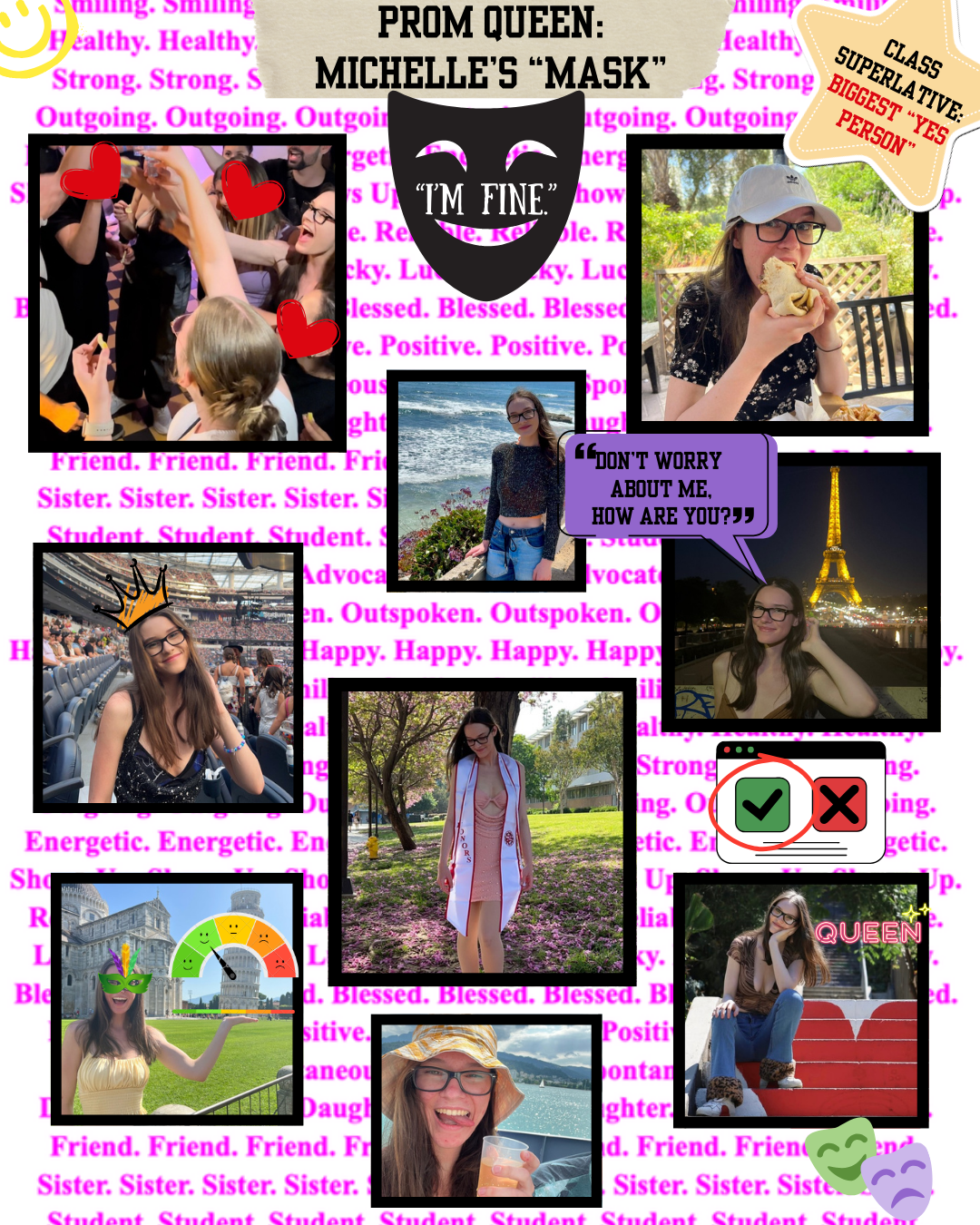
A yearbook-style photo collage of Michelle smiling and looking happy, with phrases like “don’t worry about me, how are you?” and “class superlative: biggest yes person.” In the background are the repeating words “smiling, outgoing, healthy, strong, energetic, reliable, lucky, blessed, positive, spontaneous, daughter, friend, sister, student, advocate, outspoken, happy.”

When you first open the Burn Book, you’ll see that my “Mask” has been crowned Prom Queen. The images on this page are from moments when I had my mask on—when I pretended to be “fine.” The background words reflect how others perceive me more positively when I wear this mask, which is why it was elected Prom Queen.

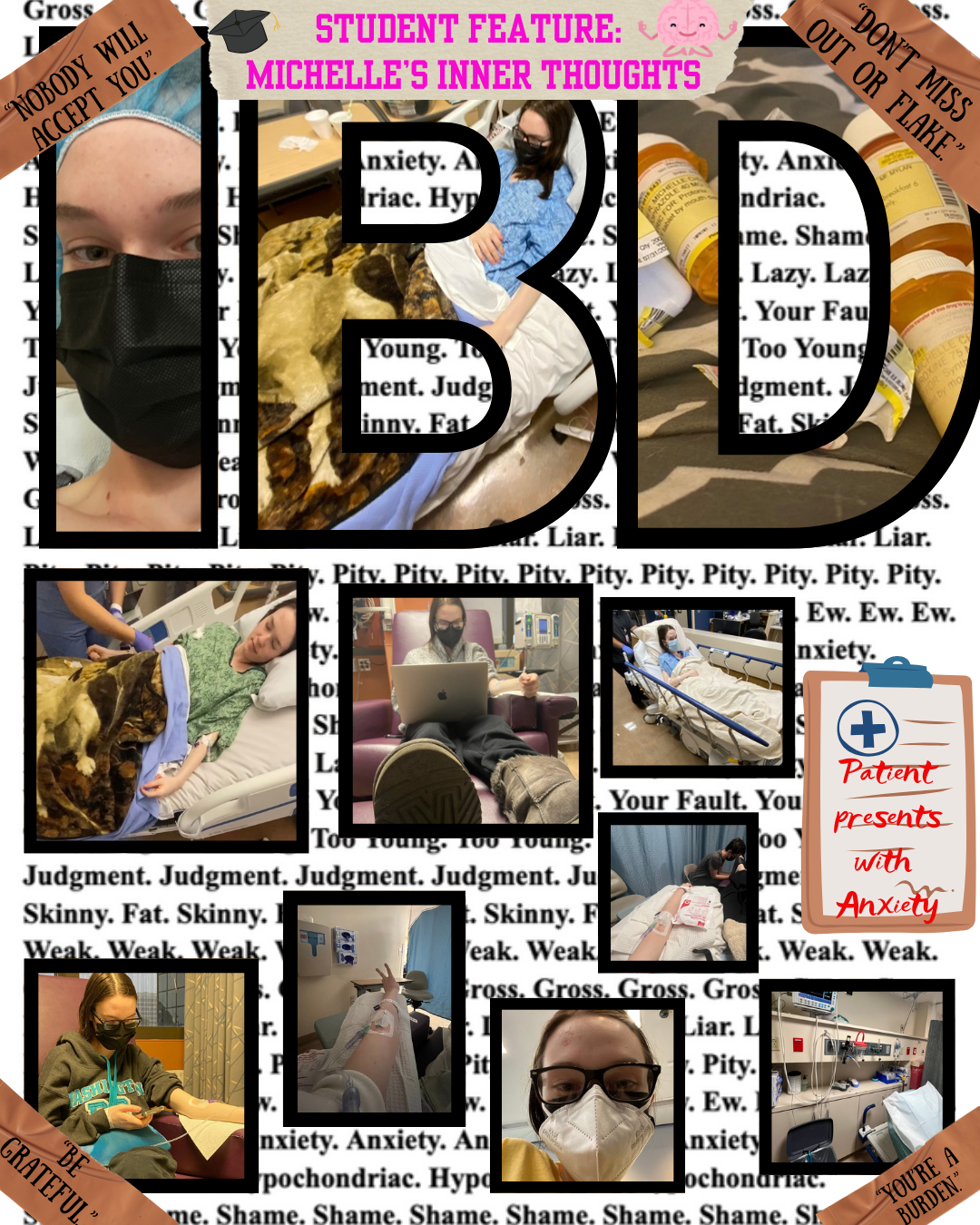
A yearbook-style photo collage of Michelle looking tired in various medical settings (the hospital, getting infusions) with phrases like “don’t miss out or flake,” “nobody will accept you” and “patient presents with anxiety.” In the background are the repeating words “gross, liar, pity, ew, anxiety, hypocondriac, shame, lazy, your fault, too young, judgement, skinny, fat, weak.”

The next page is a Student Feature of my Inner Thoughts. Here, I am without my mask. This contrast serves as a reminder that appearances can be deceiving—what you see on the outside isn’t always real; it might just be a mask.

Michelle’s ‘not hot’ list has a pink background with white squares. The following phrases are X’ed out in red pen: “I don’t want to touch you,” “so you’ve got bad genes?,” “i could never live like that,” “you’re too young to be sick,” “at least it’s not cancer,” “you look like a holocaust survivor,” “i have IBS too!,” “have you tried yoga?,” “gross,” “It’s all the junk food you’re eating,” “look on the bright side, you lose weight easily,'“ and “i guess this means we’ll have to adopt.”

Following that is a Not Hot List, which consists of a collection of phrases people should never say to someone with IBD. (Sadly, every one of these remarks has been said to me).

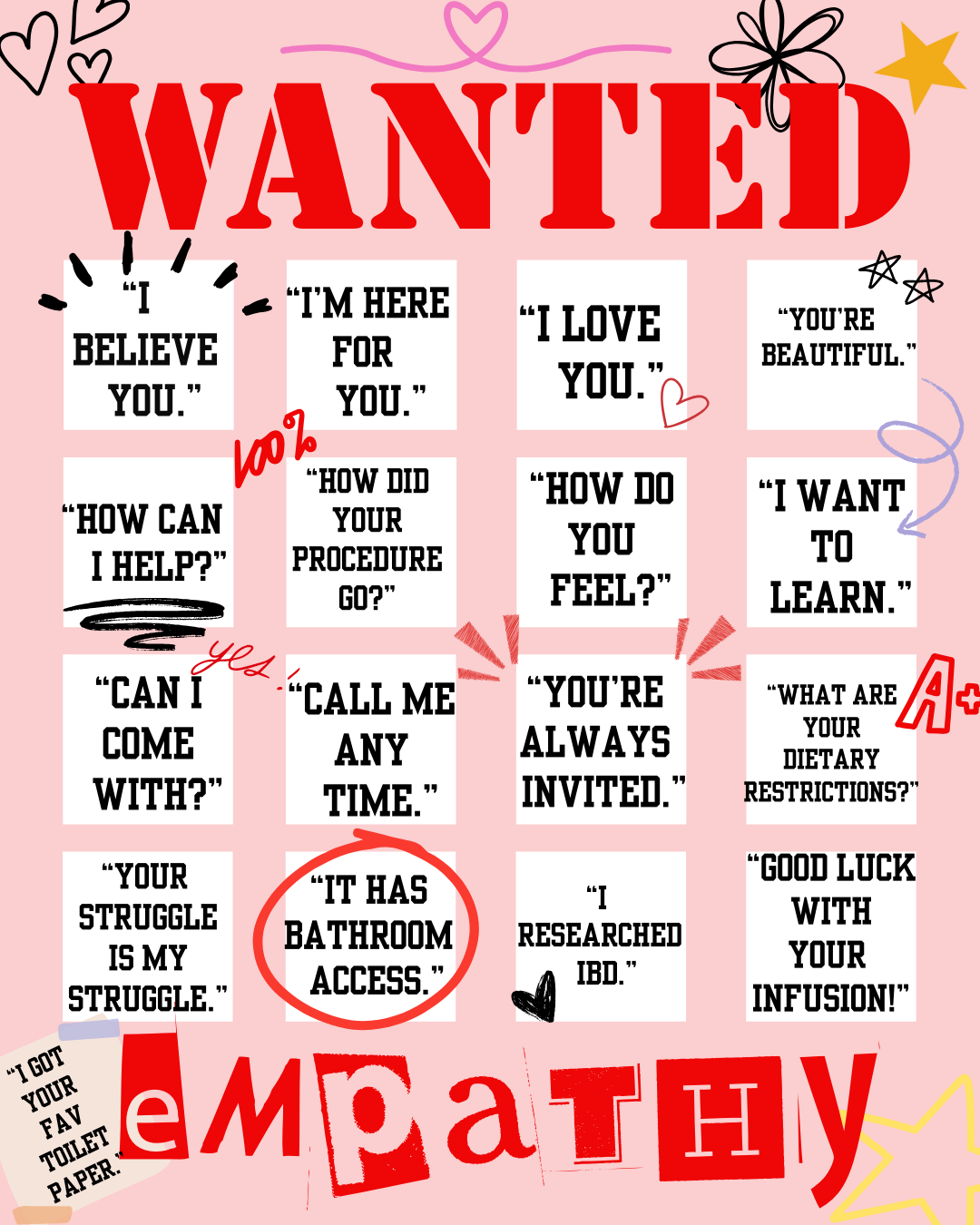
A pink poster labeled “wanted: empathy.” In each square, there is a different phrase: “I believe you,” “I’m here for you,” “I love you,” “you’re beautiful,” “how can I help?,'“ “how did your procedure go?,” “how do you feel?,” “I want to learn,” “can I come with?,” “call me any time,” “you’re always invited,” “what are your dietary restrictions?,” “your struggle is my struggle,” “it has bathroom access,” “I researched IBD,” and “good luck with your infusion!.” The phrases are emphasized with stars, hearts, and stickers that read “100%!” “yes!” and “A+.”

The final page of the Burn Book is a WANTED poster—for empathy. Instead of harmful comments, this page lists empathetic phrases one should say to someone with IBD. Essentially, it serves as the “Hot List” in Mean Girls or high school terminology.

———

Invisible illnesses come with their own set of challenges—such as a widespread lack of awareness—but the focus here is how easily someone with IBD can hide their struggles. Smiling through the pain, pretending to feel well—it becomes second nature. I’m not the first person to wear a “mask” to feel accepted or to make others comfortable, and I certainly won’t be the last.

The reality, though, is that IBD is a constant battle. Even if you see me dancing with friends, traveling, or enjoying a big meal, I am still struggling. The takeaway? You never truly know what someone else is going through, so always choose kindness. More importantly, choose empathy. If you do know what someone is going through (specifically IBD in this case), be especially mindful of your words and actions. While you might assume your words and actions don’t affect us, remember—we’ve had a lot of practice hiding our pain.

IBD and Grief

by Akhil Shridhar (Bengaluru, India)

A cup of coffee, a pen, and a napkin with the 5 stages of grief (denial, anger, bargaining, depression, and acceptance) sit on a blue table.

Each person has a unique story when it comes to their experience of coming to terms and living with IBD. What I realized after speaking to some of the patients who have struggled with the disease for quite a few years is that there is a similar pattern in our response to this life-altering event. The diagnosis, which in itself is a drawn-out process of striking out every other possible disease of the gut to finally settle on one condition, which includes countless blood tests, scans, endoscopies, colonoscopies with biopsies, like any other chronic condition, is just the beginning. When I came across the commonly used description for the stages of grief, I couldn’t help but notice the similarities.

The stages of grief are commonly described using the Kübler-Ross model, which outlines five stages that people often go through when dealing with loss or significant change. These stages are not linear, meaning people may experience them in different orders or revisit certain stages multiple times. The stages are Denial, Anger, Bargaining, Depression and Acceptance. With our diagnosis of a chronic condition, we experience a profound shift in reality that can evoke similar responses: 

Denial

Initially we struggle to accept the diagnosis, believing it to be a mistake or downplaying its seriousness. For most of us who are coming across IBD for the first time, usually without any family history, this sounds familiar. I would perhaps lean towards the latter, as a history of psoriasis, a similarly chronic condition, majorly influenced my decisions, which I would come to regret later.

Anger

As reality sinks in, we often have feelings of unfairness and frustration. This anger is usually targeted at our body, medical professions and, in most cases, our loved ones. I found myself feeling guilty of my circumstances, angry at the doctors for not understanding my concerns and addressing them, which feels ironic, and frustrated with my loved ones for downplaying the symptoms.

Bargaining

We then attempt to negotiate our way out of the situation, trying alternative treatments, lifestyle changes, or even stopping medications altogether. Due to my previous experience with psoriasis and other circumstances, I found myself slowly stopping medications. As expected, when the symptoms started flaring up again, I looked into alternative treatment that had shown good results for my psoriasis, a grave mistake which put me in the severe Crohn's category taking me years to recover from.

Depression

As we finally come to terms with the condition’s long-term implications, a sense of loss and hopelessness follows, leading to sadness, withdrawal, or a loss of motivation. Although with IBD being a disease of the gut, this just adds to the list of causes for depression for many of us.

Acceptance

Over time, we adapt and find ways to manage our condition and integrate it into our lives. We begin to accept the new normal and find strength and purpose in this new journey. Five years into this journey, I find myself here, a veteran I say to myself, with a new resolve to help others navigate theirs.

The emotional and psychological journey of adapting to a life-altering event closely resembles a grief-like path. Chronic conditions not only impact our physical health but also our identities, relationships, and goals, making the process of adjusting and coping essential. It's important to note that these stages are a framework, not a one-size-fits-all process. People grieve in unique ways, and other emotions like guilt, confusion, or relief might also play a role.

This is why advocacy can be an incredibly powerful tool to make a difference in helping individuals by providing awareness and education, building a resource network, or helping in accessing resources. It is also important that we encourage empathy and patience with caregivers, family members and society as a whole to provide the required support during these challenging times. For someone going through the journey, engaging in advocacy themselves can be transformative and empowering. On a larger scale, advocacy is also necessary for shaping policies and systems that lead to improved healthcare policies, workplace accommodations, or social programs.

I encourage everyone to seek help and, whenever possible, help out others, as getting diagnosed with IBD can be a deeply personal experience, but one should not be forced to navigate it alone.

(Image credit: marekuliasz from Getty Images)

Potential IBD Accommodations for Teachers and Students (from a NYS Teacher)

by Kaitlyn Niznik (New York, U.S.A.)

This infographic was created from discussions with other teachers in the United States living with IBD.  Through those conversations, I realized that the workforce can be a scary and precarious place for people living with chronic illness.  As a unionized, tenured teacher in a public school, I acknowledge I am in a privileged position to disclose my IBD.  However, a teacher or student can choose not to divulge their chronic condition for a number of reasons including job instability or the fear of being singled out.  I made half of my graphic focus on discreet ways to manage your IBD within the education system without revealing personal health information.  This half includes having an emergency supply pack, trusted contacts that you can call for assistance, and knowing the location of private bathrooms instead of public stalls. 

The other half of my picture illustrates ways a student with an IBD can pursue written accommodations to protect them at school.  These include obtaining an Individualized Education Program (IEP) or 504 Plan after their doctor writes a note confirming their diagnosis and its impact on the student's daily life.  In the student's records, they would be classified under the "Other Health Impairment" category and this form would be reviewed and adapted annually.  Parents, teachers, and district personnel would work together to create an IEP or 504 plan that supports the student's needs, helps them manage their illness, and works to reduce the student’s stress in an educational environment.  Teachers with an IBD can also present a doctor’s note to their district to receive reasonable workplace accommodations. 

Sky also belongs to the birds without wings

By Aiswarya Asokan (South India)

A group of birds flies over the ocean. A pastel blue, pink, and yellow dawn is in the background.

A couple of decades ago, when schools were shut for summer vacations, all the cousins returned to Grandpa’s house to spend the vacation. It was bedtime, and all the children secured their place in the bed, waiting for Grandpa to narrate a story before falling asleep. It goes: 

“Once upon a time, there lived birds without wings, which deprived them of the joy of flying freely in the sky and experiencing the vast beauty of sky and land. Therefore, it spends all its time in the land, trying hard to find its food and merely surviving.

This made the birds extremely sad, and it was believed God had cursed them. Time passed, and it became even more difficult to thrive, then God called them and ordered them to carry the weights of some more objects. Birds pleaded to the god to take these weights away from them, but he disagreed. At last, there was no other way other than to carry this burden.

But to the bird’s surprise, it started floating in the air; the weights that dragged it down were now enabling it to fly. What a pleasant surprise: the weights that caused a burden to the birds have transformed into wings. Only then did the birds realize the weight it carried this long has equipped it to fly high and conquer heights.” 

After all the fun and games and a cozy bedtime story, I dozed off to sleep but woke up abruptly with a bit of discomfort inside my tummy; I had to throw up immediately. Everyone had to wake up in the middle of the night and clean the mess; maybe my stomach was upset from something I ate the day before.

Such incidents occurred again and again, maybe vomiting or else diarrhoea, sometimes some uncomfortable feeling inside accompanied by headaches (later on I learned that these feelings can be named nausea, bloating, abdominal cramps, and heartburn…). I hated any kind of physical exertion, whether a dance class, sports, or walking; Physical Education periods were my worst nightmare. Getting into menarche doubled down the sufferings. I was always clumsy with things and had a lot of pain carrying stacks of notebooks from one classroom to another, carrying my school bag, and climbing stairs to reach the classroom. I used to pant like I had participated in a marathon after making it to the classroom each day. It even demanded a good deal of energy just to complete a proper head and body wash. I used to collapse into the bed after a proper shower. But how to gain some energy back? Okay, let us concentrate on food, but however you try to stuff yourself with food, it just bounces back, putting yourself in much more trouble. And visits to the doctor turned out to be a normal stunt just to repeat the cycle once again. Innumerable nights spent tossing to and fro in bed, squeezing the pillow, with frequent visits to the washroom in between, wondering when I could breathe in peace with a perplexed mind not knowing what’s going wrong. This is usually followed by a week where you have to live with an empty stomach if you need to forget the pain.

It is frustrating to navigate a life that is like walking over eggshells. Even the so-called happy normal days come with a lifespan of a firefly. It's so unpredictable, and all your efforts to mend it can go in vain. This leaves you with a heavy mind full of rage and despair. On the flip side, this journey gives you the resilience, endurance, and wisdom that no exams or university education can ever give you. Once you harness this energy, then the sky is your limit. It teaches you to be humble, empathetic, and to live in the moment. But still sometimes I feel deep inside Mother Teresa was right when she said, “The hunger for love is much more difficult to remove than the hunger for bread.”

Image from Unsplash.

Winds of Perseverance: The Crohn’s Chronicles

by Rifa Tusnia Mona (Dhaka, Bangladesh)

Four years ago, I first heard the term IBD. Before that, I had spent years trapped in a cycle of unexplained symptoms and misdiagnoses. Then, one doctor finally said it—a possibility that changed everything. That moment marked the beginning of a long, lone, challenging journey—one that has shaped me in ways I never expected.

Living with Crohn’s disease hasn’t been easy, especially in a society where few understand it. My family had never heard of it. Neighbors mistook it for a simple gastric issue. Friends casually referred to it as an ulcer. Over time, I found myself explaining my condition again and again, trying to make sense of it for both myself and others.

It was during this confusing time that I found comfort in unexpected places.

Chad, Pete Davidson, and the Art of Indifference

I’ve always loved watching Saturday Night Live, especially the Weekend Update and parody commercials. But after my diagnosis, I found myself particularly drawn to one character—Chad, played by Pete Davidson. Chad never reacts to anything with more than a casual “Okay” or “Cool”. His simplicity and indifference fascinated me. Most importantly, it sort of aided me whenever I got tired while explaining my condition or responding to stigmas. Watching Chad made me realize that not every question deserves a long, exhausting answer—sometimes, a simple response was enough. Realistically, it saved my valuable energy.

Then, I discovered something else—Pete Davidson himself has Crohn’s disease. Watching him use comedy to talk about his struggles, even the painful ones, gave me a new perspective. He didn’t let his illness define him. Instead, he turned it into a story—one he could laugh about. That idea stayed with me.

MrBeast, A Semicolon, and a Shift in Perspective

My symptoms flared up in 2019, just as I was stepping into my role as an environmentalist, organizing startup competitions, and representing my university at environmental fests. Suddenly, everything I had been building felt uncertain. It was as if life had placed a semicolon in my path—not a full stop, but a pause, forcing me to adjust. Throughout the rest of my university moments, I was on the verge of dropping out several times.

That’s when I came across MrBeast’s story. I learned, he, too, has Crohn’s. In one of his videos, he shared how he learned to manage his illness by changing his mindset—choosing to focus on what he could do instead of what he couldn’t. That struck a chord with me. I realized that, like him, I could try turning my struggle into a strength. 

Whenever pain came, I tried shifting my focus. Instead of asking, Why me?, I reminded myself that others might be facing even greater hardships like terminal illnesses. At least I am not dying—that was something to be grateful for. To save myself from stress-induced abdominal cramps, the idea acted like armor.

A Win That Came with Questions

This year, for the first time in five years, I received genuinely good news: I was awarded a scholarship to study my dream subject for my master’s. Out of thousands of applicants worldwide, only 100 women were chosen. I was overjoyed.

But when I shared the news, many people responded with an unexpected question: "Don’t they ask for a medical clearance?"

It made me wonder—how many others have felt the weight of these doubts? How many have been made to feel like their dreams should be measured against their diagnosis?

This article is for them.

To those fighting this invisible battle, I want you to know that your struggles do not define your capabilities. The world may doubt you, but that can be freeing. If you succeed, great. If you don’t, they never expected you to anyway. Either way, you win.

As someone fighting such stigmas in everyday life, I know how vital IBD advocacy is! So, a heartfelt thank you to CCYAN for giving me this space to share my journey—and to you, my dear reader, for walking this path with me. Keep going—You’re stronger than you think.

Linked videos:

Chad Horror Movie - SNL © Copyrighted by Saturday Night Live

https://youtu.be/fF6gExZu-2M?si=iW30vRB3rx-B41mG

What is Crohn's Disease????? © Copyrighted by MrBeast

https://youtu.be/pzlPJmNyepA?si=DlMUgnyYB4Gwxh8S

Featured photo by Life Of Pix from Pexels.

Battling an invisible illness while everyone else plays “doctor”

by Beamlak Alebel (Addis Ababa, Ethiopia)

a person with medium tone skin and chin-length black hair stands behind a clear bubble. Their hands are pressed against the glass, as if they want to get out.

A person with medium tone skin and chin-length black hair stands behind a clear bubble. Their hands are pressed against the glass, as if they want to get out.

Exams are already stressful, but for those of us dealing with invisible illnesses, they can feel like an impossible battle. The pressure to perform, sleepless nights, and depression don't just affect our mind - they also affect our whole body too: and while we struggle through the pain, others think they have all the "expert" answers:

My Brother wonders, "maybe it is some unknown disease science hasn't discovered yet."

My Parents think, "it must be setan (evil spirit), we should take her to holy water."

Society assumes, "it's probably caused by her poor lifestyle or malnutrition."

Meanwhile, I am just trying to survive this exam while everyone else plays doctor.

The silent struggle of invisible illness

Living with IBD means battling symptoms that others can't see. It is a constant storm - worsening digestive system, gut motility issues, poor sleep, and one of the biggest triggers, stress. 

Exam deadlines and academic pressure can make symptoms flare up. But instead of understanding the real impact of stress on chronic illness, people jump to conclusions. They blame supernatural forces, poor diet, or anything except the real medical condition.

Why awareness really matters 

The truth is, many people don't understand invisible illness until they (or someone close to them) are directly affected. This lack of awareness leads to stigma, misdiagnosis, and people suffering in silence. We need more conversations about IBD not just in medical communities, but also in everyday life.

Invisible illnesses like IBD can be incredibly tough. Friends and family should understand that IBD is a serious, life-threatening condition, and many factors outside our control can trigger painful flare-ups. Other people's misconceptions about IBD just add to our stress as patients...so if stress is a known trigger, we need to address these misunderstandings! 

This is why it is important to raise awareness, have discussions, and help others recognize the impact that IBD has on us. 

Because we know invisible illnesses exist, so why do we keep doubting those who live with them?

Instead of playing doctor, maybe it is time we start listening.

(Image from iStock, credit: nadia_bormotova)

Navigating the "Why Me?" Season of Chronic illness

Yeabsira Taye Gurmu: Addis Ababa, Ethiopia

The "Why Me?" season of my journey with Inflammatory Bowel Disease (IBD) was one of the most challenging times in my life. The onset of symptoms—unrelenting abdominal pain, fatigue, and unpredictable bowel movements—left me feeling lost and overwhelmed. Each doctor's appointment felt like a new hurdle, as I faced uncertainty and often dismissed concerns. The emotional weight of confusion, fear, and frustration was heavy, making it difficult to envision a future where I could manage this condition. It was a time filled with questions but few answers, leaving me grappling with the reality of my health.

For new patients experiencing a similar phase, it’s essential to understand that these feelings are normal and part of the diagnostic journey. Expect to encounter a mix of emotions, from denial to anger, as you seek answers. It’s crucial to advocate for yourself and seek support, whether through online communities or professional help. Keeping track of symptoms and preparing questions for your healthcare provider can empower you during appointments, helping to clarify your condition. Remember, this stage is often a tumultuous path toward understanding, and it’s okay to feel vulnerable as you navigate it.

Transforming the "Why Me?" phase into a positive, lifelong attitude is possible. Embrace the challenges as opportunities for growth and self-discovery. Focus on education about your condition, which can demystify the condition and foster a sense of control. Surround yourself with supportive people who uplift you and understand your journey. By practicing self-care and maintaining a proactive mindset, you can turn this difficult chapter into a foundation for resilience and empowerment. Ultimately, this experience can lead to a fulfilling life with your chronic condition, marked by hope and a renewed sense of purpose.

Featured photo by Disha Sheta from Pexels.