
Personal Stories

The Unknown with IBD: My Journey of THE DIAGNOSIS

By Maalvika Bhuvansunder

Crohn's, is a term I am familiar with now, to the extent it feels that I am synonymous with it. In medical terms, Crohn's is defined as an inflammation in the gastrointestinal tract, which manifests in symptoms such as abdominal pain, unexpected weight loss, and many more (Baumgart & Sandborn, 2012). However, all I could understand was that I am in for a journey filled with lots of pain.


It was in 2016, that my health started to get worse. I lost a lot of weight, was not able to eat properly, and was moody all the time. My family and I initially thought that maybe it was the flu or food poisoning. However, my health never seemed to improve. Deciding to go to the doctor, I had made up my mind to expect the worst. To my pleasant surprise, I was diagnosed with anaemia. I say pleasant because my mind had made up that I had cancer, and in comparison to cancer, anaemia was a piece of cake. Despite getting treated for anaemia, my health remained the same, with no improvement whatsoever. Later, I was diagnosed with amebiasis (Pritt & Clark, 2008). I was relieved thinking finally, I have a proper diagnosis. Things seemed to improve for a while; however, it started to get worse. At the suggestion of my GP, we met a gastroenterologist. Now, before this, I was completely unaware of such a discipline in medicine, so my family and I went in completely blank, not knowing what to expect.

All I could understand was that I am in for a journey filled with lots of pain.

The first thing my gastro told me, based on my previous reports, was there seemed to be some sort of inflammation in my abdominal area. I was told to get a colonoscopy done, only after which the doctor could confirm a diagnosis.

On the way home, I started to research the entire colonoscopy procedure. I was stressed out reading the process and was hoping to find a way out of undergoing the procedure. Thinking back to it, I am not sure what I dreaded more, the prep process of having to drink that awful colon cleanse, or the actual colonoscopy itself. Had I known before what colonoscopy was, I might have been less skeptical about it. The day of the colonoscopy went pretty smoothly, and I was drowsy for most of the day. We were not told anything that day and had to return a few days later for the official diagnosis. We again went in completely blank, not knowing what to expect. That is when I got THE diagnosis, CROHN’S. Now, I had never heard such a term and neither had my parents. The doctor’s explanation regarding my treatment plan just sounded gibberish to me. The one thing that I could not take my mind off was, this condition does not have a cure; it will be with me for the duration of my entire life.

We always hear how an early diagnosis can solve half the problems; however, with any gastro-intestinal condition, the dilemma is that the symptoms are very similar, and getting an early diagnosis may not always be possible. From personal experience though, I feel with IBD it doesn't really matter when we get the diagnosis as it is not a curable illness.

This condition does not have a cure; it will be with me for the duration of my entire life.

The scariest part about IBD for me was the unknown. Not knowing when a symptom will hit you, how severe it will be, not knowing if you can make it to plans and outings, and not knowing if it's an IBD flare or the flu, always having to be afraid, fearing the unpredictable. I had never met anyone else with my condition, and I did not have anyone to ask questions about this. I was unable to comprehend why I got this and was really unsure about how I will get through it. Accepting this condition took me a long time. I realised something through this process, the importance of support. If we have the right kind of support and care team, slowly but steadily we will see improvements. Above all, we will be able to accept our condition, and it makes the predicament of the unknown a little less scary.


References:

Baumgart, D., & Sandborn, W. (2012). Crohn's disease. The Lancet, 380(9853), 1590-1605. https://doi.org/10.1016/s0140-6736(12)60026-9 

Pritt, B., & Clark, C. (2008). Amebiasis. Mayo Clinic Proceedings, 83(10), 1154-1160. https://doi.org/10.4065/83.10.1154

Body Neutrality > Body Positivity

By Carina Diaz (Texas, U.S.A.)

My body has been through many shapes and sizes since the diagnosis of my Crohn’s disease in 2012. The combination of medications and inflammation has altered my weight, the shape of my face (thanks Prednisone), and effected my ability to exercise. After many years of weight fluctuations, I now see three people within myself: the person I picture in my mind, the one I see in the mirror, and the one I see in photos. 

Halfway through 2017, I came back home from a four month internship in Florida in very bad shape. I had lost a lot of weight, had little appetite, was under constant fatigue, and went to the bathroom almost 20 times a day. I didn’t deal with many IBD symptoms in college outside of bloating and cramps, so this was new territory for me. I was bed bound for several years and shrunk down to skin and bone. I avoided my reflection every time I went to the bathroom. I felt like a shell of a person. My body felt like an itchy, uncomfortable sweater that I couldn’t take off. 

“I still have days where I’m mad at my body, but being able to take a step back and shift my thoughts away from the frustration has brought back some peace.”

As my health slowly began to improve and my mind became more clear, I noticed how often my thoughts centered around the way I looked. I felt detached from my body and even more so after getting ileostomy surgery in May of 2021. I’ve had to relearn my body over and over again because of the constant changes IBD has put it through. It’s very easy to feel disconnected from your body when you have IBD. I’ve often felt that my body and I are two different entities at war with each other, and neither side wants to wave the white flag. 

There’s so much content online about self-love and loving your body. “Start the day by looking in the mirror and say three things you like about yourself out loud.” “Love the skin you’re in.” “You’re beautiful just the way you are.” I’ve found that it’s not possible to feel good about yourself everyday. Our bodies change, even for people without health conditions. We’re constantly shown images of what we should aspire to look like and the products to buy to help us attain it. 

A concept that has helped me reframe my thoughts around body image is body neutrality. It encourages you to accept your body for what it is and puts more emphasis on what you’re capable of instead of what you look like. To me, this means to meet my body in the day I’m in. For example, on days when I have low energy, I’m going to take care of myself by working from my bed, ordering takeout, having snacks and water within reach, and not worrying about the state of my apartment. I’m not going to expect myself to cook, clean, and run errands on a day that I’m not feeling well.

I know that this might not be a helpful concept to everyone, but it is a practice that has helped my mental health and self image. I still have days where I’m mad at my body, but being able to take a step back and shift my thoughts away from the frustration has brought back some peace. Instead of viewing IBD as a punishment from my body, I’m trying to remind myself that my body is going through this with me. Neither of us are to blame; it’s just our reality. We’re both doing the best we can.

Storytelling for self-growth

By Fasika Teferra, M.D. (Ethiopia)

Have you ever wondered why someone shares their stories with strangers? Regardless of the outlets people use to tell their stories, we see storytelling get used as a catalyst for change. It is a tool that most change makers are using today; that was my initial motivation to start telling my story, until I learned the true potential of storytelling. I was just beginning my fourth year of medical school. With the stress of the upcoming qualifying exam and family moving away for work, I thought the abdominal pain I had started to experience was just anxiety. Although I am fully aware of Crohn’s Disease and its symptoms, I tried to get quick solutions to resolve the symptoms.

Regardless of the outlets people use to tell their stories, we see storytelling get used as a catalyst for change.

From a young age, I was told to pull myself together and not show vulnerability, which was why I suffered for eight months before getting my diagnosis. I knew what the disease was, the medications I needed to take, and that it was a chronic illness with no cure. But accepting that was one of the hardest things I ever had to do. A lot of factors played in truly accepting my diagnosis and make the decision to be more knowledgable as an IBD patient, but the major one was reading stories of other IBD patients. It opened up my mind to the possibility that I could lead a normal life. That was why I started to share my story, to be an inspiration to others.

From a young age, I was told to pull myself together and not show vulnerability, which was why I suffered for eight months before getting my diagnosis.

Living in Ethiopia, where most doctors state that IBD is rare, I knew I needed to speak up. I needed patients to know that they are not alone and I needed to communicate with my medical community that it is not so rare. I am glad I decided to be open about telling what I went through and how I am coping with IBD and it is not for the reasons you think. Sure, I am grateful to be able to make a change; I am happy my story is inspirational to other Ethiopians and non-Ethiopians alike. However, I am so thankful for what storytelling did for me.

Through storytelling, I learned acceptance.

I was not in remission when I started nor did I had a clue about managing IBD as a patient. I started only 2 years into my diagnosis and did not fully accept my diagnosis at the time. Through storytelling, I learned acceptance. As I shared my story more and more, it made me want to learn more about how to manage my condition. It also helped me step back and see how far I have come because telling my story means going back from the beginning and share the how, the why, the what of each and every detail. If there is one thing I want you to takeaway from this, it is that it doesn’t matter how much you know about something, speaking about your experience is not just so others can learn from you, it is a tool to aid in self-growth and reflection. Storytelling did not change my Crohn’s Disease diagnosis or all the hardship I faced, but the story helped me, the teller, transform and grow.

Law School and IBD

By Savannah Snyder (Canada)

Undergrad is already a daunting and tiring experience - intense classes, homework, exams, socializing, self-care. It is insanely difficult to balance it all. Throw a chronic illness such as IBD into the mix, and it becomes even harder. As many of you know, IBD can take over your life and can make working towards your goals a challenge.

My undergrad experience was full of ups and downs, from being severely ill dealing with stomach aches, joint pains, fatigues, hospitalizations, doctors appointments and more. But, I’m here to remind you and what I wish I heard someone with IBD tell me, is that you can accomplish your dreams, even with IBD.

Ever since high school I wanted to be a lawyer. I dreamed of going to a top law school. I was intimidated by the process and knew it was extremely competitive. When I was diagnosed with IBD in my fourth year of university, I thought that goal might be out of reach for me. I had to withdraw from a semester of school and move back home. I thought “how would someone like me, with holes in their transcript and withdrawn classes, be accepted to law school? How will I be able to handle a rigorous program and career while simultaneously dealing with IBD?”

Looking back, I realized I was dealing with IBD my entire undergrad experience. Instead of gaining the freshman fifteen in my freshman year, I lost fifteen pounds. I knew something was wrong each day but continued to ignore my symptoms, until I was forced to face reality and was hospitalized with a severe Crohn’s Disease diagnosis. I was scared that if something was wrong with me, I wouldn’t be able to work towards my dreams. If I was ignorant regarding what I was feeling, it wouldn’t be true.

When I withdrew from school and returned to my family home, I put my body first. I slowly came to realize that I might as well try to reach my goals of becoming a law student. I began to study for the Law School Admissions Test (“LSAT”), and spent time studying in my bed when my energy levels allowed. I started my first biologic, Humira, was hopeful it would work in time, and I booked my first LSAT 2 months away. I contacted the LSAT admissions team and received accommodated “stop the clock” washroom and pain breaks for my test. As the test date crept up, it became obvious that Humira was not working. I had to increase my prednisone dosage. I was nervous, scared, and began to lose hope. I was upset that Humira wasn’t working for me and was scared about writing a test under these conditions. The increase in prednisone brought nausea, brain fog, mood swings, irritability, fatigue, and more. When my doctor told me I had to switch off of Humira, it was too late to cancel my test. So, I decided to write it anyway. I ended up receiving my first Stelara infusion the day before the test. I told myself, this test will be a practice - and that whatever happens… happens.

I am not telling you to support the hustle culture and ignore your body. I gave myself grace around my results. I told myself if I felt negative symptoms in any way while writing, I would stop and go home. But, I was able to do it.

I wrote the LSAT and did OK and then ended up writing it again the next fall. Stelara ended up being the medication that I’ve been on ever since. I applied to law school as an access student - highlighting the experiences I’ve been through and how dealing with an illness like IBD will make me a better law student and lawyer.

I returned for my last year of school and was able to receive accommodations for exams and classes. I took a smaller class load to balance self-care and healing myself along with my goal of graduating. I’m proud to say I was accepted to my dream law school and have just completed my first semester. Although I have dealt with flares and sickness this past semester, I have reached out to accommodation services and received support. I have advocated for myself and been able to reach the dreams I had before my Crohn’s diagnosis.

I promise you, if there is something you want to do, it is possible. A life with IBD is full of spontaneity - you may never know what’s next. But, all you can do is try. Put your health first, always, but never give up on your dreams.

Photo by Polina Zimmerman from Pexels.

Major Life Transitions: IBD and Starting Graduate School

As a young adult who lives with IBD, feeling safe and secure is almost as necessary as breathing air. Navigating the endlessly winding path of chronic illness has caused me to be more aware of my environment and how it affects me. Through this, I have come to find solace in my environment. After getting accustomed to this sense of safety, I finally found comfort. But, what happens when that sense of comfort and stability is challenged?

Recently, I just moved 500 miles away from home to attend grad school. This was probably one of the most impactful decisions I’ve ever had the privilege of making. While the process of moving for grad school is difficult for everyone, I want to emphasize the added barriers that chronically ill people face. After I received my acceptance letter from the University of Pittsburgh, I was overcome with joy. Finally seeing the fruits of my hard work, determination, and labor was extremely validating. Shortly after this period of elation, I immediately became overwhelmed with intrusive thoughts such as “Well, can I really move away from home with ulcerative colitis?”, “What happens if I flare again?”, “I don’t want to leave my doctor.” I tried to give myself space to feel my emotions, but it was still difficult. Ultimately, the decision to move was clouded by, what I like to call, health hesitation.

Not only did I have to deal with the social pressure of applying to grad school, I also had to cope with the idea of being away from my established support system. I’ve worked so hard to build meaningful relationships with my medical team, so how on earth would I manage to completely restart? Something that I found beneficial was being open and communicative with my doctors throughout the entirety of the grad school process. My GI doctor knew the second I was accepted, she knew when I took my first flight to visit campus, and she knew about every important date leading up to my departure. Being transparent allowed her to assist me with navigating insurance, finding new doctors, and recommendations. This significantly helped with my transition and it helped relieve some of my health related anxiety. For myself, stress and anxiety are triggers for my symptoms, so mitigation is salient. This emphasizes the importance of advocating for yourself and being open and honest with your doctor(s).

An important tip I would give someone moving for grad school is to be proactive about setting up doctors appointments before you move. Prior to moving, I made sure that I had the basics down, like dentist and eye doctor visits. Getting the lower priority appointments out of the way definitely eased some of my anxiety. This also extends to being proactive about finding doctors once you arrive. The process is very overwhelming, but I found that taking these steps helped mitigate some of that stress and anxiety. A second tip I would give is to check to see if the school you're attending has an on-campus pharmacy. I, like many others, have quite a few necessary medications and transferring to a new pharmacy can be a bit of an undertaking, especially when it’s out of state. For example, The University of Pittsburgh has an on campus pharmacy that takes care of insurance and the medication transfer process in a quick and efficient manner. Never hesitate to seek out local resources, especially through your campus disability resources center.

In summation, no one experience is going to be universal. We will all experience our own set of unique trials, anxieties, and stressors. With that being said, moving for grad school is a decision I will never regret. If I ever feel like second guessing myself or I get discouraged about having to restart everything, I always like to remember that this experience is an investment for my future, both professionally and personally. Always be vocal and advocate for yourself, especially when seeing new providers, give yourself space, try to quiet that health hesitancy, and enjoy your experience. If I can do it, anyone with IBD can do it. We are all capable of withstanding hardship!

This article is sponsored by Connecting to Cure.

Connecting to Cure Crohn’s and Colitis is a grassroots, volunteer organization that brings together the IBD community with a focus on caregivers and families. Connecting to Cure Crohn’s & Colitis provides community and support for those coping with these chronic illnesses, while raising awareness and funds for research as well.

LEARN MORE ABOUT CONNECTING TO CURE

Starting a New Treatment: My Experience with Humira and Stelara

This article is by Jennifer Lee from the United States.


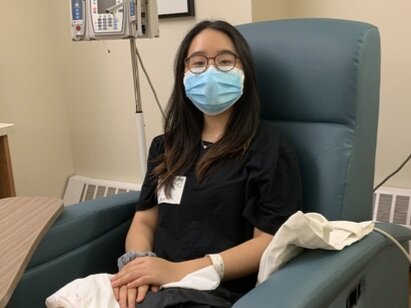
Here’s a picture of me before my treatment! A bit nervous, but hanging in there.

Here’s a picture of me before my treatment! A bit nervous, but hanging in there.

This past week, I received my very first dose of Stelara, my latest biologics treatment, at Mount Sinai in New York City! Unfortunately, even after a year on Humira subcutaneous injections, my Crohn’s symptoms have not subsided as we had originally hoped. After having seton drain placement done back in December 2020, along with another operation in June 2021, my healthcare team at Mount Sinai’s IBD Center decided that it may be best to try a new method of attack with a new set of biologics treatment.

Before starting the treatment, I had multiple healthcare workers stop by my room to explain what exactly Stelara was. I’m grateful that my mom was there to be by my side during this transition, but I also know what a blessing this is. When I was first diagnosed back in June 2020, I was completely alone in the hospital while COVID-19 infection and hospitalization rates were through the roof. The simple comfort of being surrounded by a loved one went a long way. 

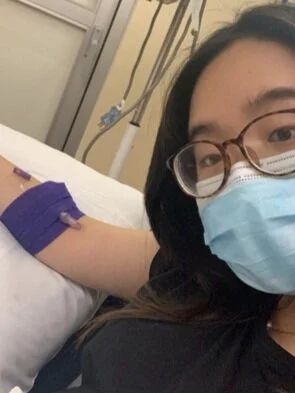
Here’s me while receiving my first dose of Stelara intravenously! The next dose will be done via injection, hopefully on my college campus.

Here’s me while receiving my first dose of Stelara intravenously! The next dose will be done via injection, hopefully on my college campus.

While I originally had a bit of trouble breathing in the first few minutes, my nurses assured me that this was not an allergic reaction to Stelara and that I was reacting well to the medication. It only took about an hour for the entire round of Stelara to be infused, but I did wait an additional 30 minutes to ensure that I would not experience any additional side effects. Truth be told, I was surprised at how efficient and fast-paced the entire infusion center at Mount Sinai was; I felt completely safe and well taken care of in their midst. Shoutout to the tireless effort of the amazing healthcare workers at Mount Sinai!

The day immediately after my first dosage of Stelara, my chronic fatigue kicked in, leaving me completely knocked out the morning after. Even after a year of living with Crohn’s disease, I’m still surprised by the ways that chronic fatigue manifests in my life. Although self-care admittedly goes a long way in understanding my body’s signals, I was most definitely caught off guard by how exhausted I was after the first dosage. 

Moving forward, it’s a bit terrifying knowing that my treatment plan may or may not work. However, I feel so grateful to have access to doctors that specialize in IBD care and surgery; all IBD patients deserve access to the most effective treatments for their specific condition. My first dose of Stelara was a reminder of not only how fortunate I was to have a second chance at a biologics treatment, but also of how much more work needs to be done to ensure that healthcare becomes equitable for all.

"But You Don't Look Sick" - A Photo Journal

By Vasiliki-Rafaela Vakouftsi from Greece.

“But you don’t look sick”. How many times I have heard this? Maybe I don’t look sick to you but I am sick and my daily life is far from what you may think. 

I tried to captures in pictures my daily routine as a chronic patient and I’m going to share them with you. 

First of all, let me tell you some things about me. My name is Vasiliki-Rafaela, I’m a musician and I have Crohn’s Disease, Adrenal Insufficiency, Psoriasis and Psoriatic Arthritis. I have written a book about my journey with Crohn’s and a book about my life with Adrenal Insufficiency. Also, I really like traveling and I really miss it with the pandemic. 

Now let’s start with the hospital visits…

...the hospital stays and therapies…

Screen Shot 2021-08-30 at 4.48.18 PM.png
Screen Shot 2021-08-30 at 4.48.27 PM.png

...the hospital stays and therapies…

...take the pills, medicines and supplements…

Screen Shot 2021-08-30 at 4.48.41 PM.png

...and maybe today is the day of the week for the injection for Crohn’s…

Screen Shot 2021-08-30 at 4.48.54 PM.png

...or maybe I need the emergency shot for Adrenal Insufficiency…

Screen Shot 2021-08-30 at 4.49.00 PM.png

And now it’s time for a walk.. Don’t forget to carry the pills with me...

Screen Shot 2021-08-30 at 4.52.21 PM.png

...and of course my medical ID…

Back at home again.. Really exhausted...Let’s check the e-mails and read a book before going to sleep

That’s a little idea of how my daily life is. But, you’re right. So before saying “You don’t look sick” think of what is behind the image and what you cannot see…

What I Eat in a Day

TW: mention of eating disorders & disordered eating

I really didn’t want to write this article. I am pretty open about how I have a lot of dietary restrictions. When I go out to eat with friends, I usually tell them that I follow a strict diet for my Crohn’s Disease. Then they’ll ask if I can have anything on the menu, and I will say No. The inevitable next question is always: So, what can you eat? I’ll list off a few foods like oats, bananas, blueberries, broccoli, chicken, and buckwheat, and that's usually the end of that conversation. I’ve had it so many times; honestly pretty much any time I meet somebody new.

I tend to think that when I give people that list that they just assume I stop listing things because it would get excessive if I named every food I could eat. I imagine that they might think I am going through a typical day, and maybe other days look different than the short food record I have given. I don’t think that anybody really considers what it feels like to eat the same 5-10 foods over and over and over and over again. But I do. I do because that has been my life since January of 2019 when I entered “remission”.

Remission for me has always been rocky. I noticed really quickly that while I felt better overall (you know, my body wasn’t trying to set records for lowest hemoglobin and highest CRP simultaneously), I still had some symptoms. I decided to take the advice I give a lot of my IBD patients these days and start a food journal to try to find my trigger foods. Slowly I started feeling better as I cut back on the foods that I noticed were giving me hives, acne, bowel cramps, diarrhea, and a whole host of other symptoms. 

So I got to a baseline diet with some foods I knew I felt good on and did that for a bit. It was wonderful, as long as I ate these foods, I felt pretty much “normal” and could do all the activities I wanted. But I wanted to find more things I could eat, so I started to do food reintroduction. I would try a new food for one meal and see how I felt afterwards. If I felt worse, I knew that food wasn’t a good fit and I’d mark it as a trigger food.


Fast forward to 2+ years of trying a new food every weekend and you’d expect my diet to be all normal and varied with only a few restrictions. Haha I wish. I’m pretty sure after all this time it has gotten worse. I guess the problem really is that my body thinks pretty much everything other humans call edible is unfit for consumption, and it lets me know that loud and clear.

That all is the much needed background to my current diet. I guess I should share what it looks like at some point as that is the main reason I wrote this article, so here goes:


Breakfast

  • 3 cups of cooked rolled oats with ½ sliced banana and ½ cup blueberries.

  • 1 Orgain Nutritional Shake

Snack

  • 1 Orgain Nutritional Shake

Lunch

  • 2 cups of cooked buckwheat, ½ sliced banana, and ½ cup blueberries

  • 1 Orgain Nutritional Shake

Dinner

  • 2 cups of cooked buckwheat, 1 ½ cups cooked broccoli, ½ a cooked chicken breast.

So…..yeah. I’ve pretty much been eating that or some slight variation (I used to eat a lot of plantains too) day in and day out for a few years now. Pretty messed up right? I am pretty sure from the outside this looks like at least disordered eating if not a full blown eating disorder. But, like, what am I supposed to do? It's not like I am not trying to expand my diet, I just can’t without Crohn's kicking my butt. Also I promise I’ve told every GI doc I’ve had about this and unfortunately there hasn’t been anything they have been able to do to help.

I decided to write this article because during the few years I’ve had these issues with all these trigger foods I’ve never really found anything online that mirrors what has happened to me. My hope is that if there are more people with IBD out there who struggle with these food issues as much as I do, that you at least feel validated that you aren’t the only one going through this. It sucks, and maybe one day we will have an answer as to why it happens. 

Until then, if you are having issues with foods triggering your disease, bring it up to your doctor or dietitian. Spread the word. Even if, like in my case, the doctors or dietitian isn’t able to fix the problem, at least we are fostering awareness and discussions that will bring about solutions in the future.

Growing Pains: IBD Lessons Learned from the COVID-19 Pandemic

In March 2020, the COVID-19 pandemic turned the world upside-down as we knew it -- that, in and of itself, is already the understatement of the year. Disability activist Alice Wong spoke of how the nation’s need for ventilators in hospitals directly conflicted with her needs as a disabled patient; Tiffany Yu, founder of Diversability, used her platform to raise awareness of transparent masks for easy lipreading access. Already, at-risk patients suffered from a lack of attention and space, only for this to be exacerbated by a public health crisis. 

However, the pandemic also offered a chance for those with disabilities, and specifically IBD, to rethink our routines and lives. For example, in my own experience with Crohn’s disease, I’ve found that staying at home during the school semester had me re-thinking all my prior decisions in my relationship with food. It was, in fact, possible to regulate my diet and work in my medications without compromising my education -- the flexibility of virtual classes in university had opened up a new way of life for myself, one where I could sneak off to the bathroom during lecture without worrying about missing key points or bumping into desks. 

Living with Crohn’s, it often feels as though my time is not my own. This phenomenon of constantly running on other people’s schedules is not exactly unique to Crohn’s or IBD as a whole -- in fact, it refers to a concept known as ‘crip time,’ in which society and its timetables ought to bend to meet the needs of disabled bodies and minds. It’s a community-inspired term that essentially encourages us all to work on our own time, taking up space as necessary to meet our individual body and mind’s requisites. 

Whether it’s knowing where the nearest bathroom is, or having accommodations to turn the Zoom camera off, accessibility is an essential cornerstone of working with IBD. As a college student, I’ve found that communication with professors and administrators has become easier in a virtual setting, allowing for flexible office hours and minimal commute to buildings. In all workplaces, key lessons should be taken and continuously applied from the pandemic, particularly in regards to accessibility for disabled folks. 

With this being said, a major caveat is that we as a society are almost always ‘plugged in’ or online -- being available on Zoom has made it near impossible to draw the (much-needed) line between home and the office, allowing professionals to work around the clock. As the world shifts back to a new state of burgeoning normalcy, may we all remember the importance of accommodating disabled folks in the workplace, in-person and virtually. 

For those with IBD or any chronic illness, it is of the utmost importance that we too learn where to place boundaries in our work lives, prioritizing our physical and mental health above all. 

Diversity in IBD: Being Disabled and Asian American

Almost exactly one year ago, I was diagnosed with Crohn’s disease after a grueling few months of trial-and-error diagnoses by my medical team. Truth be told, the news was a shock to my family, but not for the reasons you may first think of. 

In my mother tongue, there is no widely accepted translation for “Crohn’s disease,” not to mention “Inflammatory Bowel Disease.” In a way, my Asian American identity is one reason why it took so long for me to receive my diagnosis of Crohn’s disease in the first place; my gastroenterologist had not previously thought to test for a condition that was thought to be more common in Caucasians or Ashkenazi Jews. Even amidst official resources from various foundations, it is admittedly difficult to find Asian representation within the IBD community.

As a disabled Korean American woman, I experience IBD through the lens of multiple marginalized identities. At the intersection of ability, ethnicity, and gender lies an incredibly complex set of conversations that society has yet to fully parse out and create space for. 

While chronically ill and disabled folks found themselves facing a morphing status quo that was being overturned by a worldwide pandemic, their fight for accessibility and accommodations was simultaneously accompanied by embroiled racial justice initiatives. The Health Advocacy Summit has written extensively on how racism is a public health crisis, underscoring the need to include all marginalized communities in our activism efforts.

Personally speaking, I came face-to-face with the inevitable intersectionality of advocacy in the fight against anti-Asian hate. In the wake of 2020, the United States began to witness an alarming surge in anti-Asian racism that quickly escalated to violence and hate crimes. As a chronically ill patient, I knew exactly how it felt for an entire community to be marginalized, vulnerable, and at-risk, making it all the more urgent for me and my fellow student leaders to speak up against these acts of hate.

The intersectionality of these two identities is rarely discussed, yet they both mold and inform the other. My diet, my language, and my roots are so intimately tied to my Korean heritage, and in turn, my Asian American identity shapes the way I understand my chronic illness. As Sandy Ho wrote in Alice Wong’s Disability Visibility, “taking up space as a disabled person is always revolutionary,” but especially in the ways in which traditional East Asian attitudes often conflict with the mindset of the evolving American immigrant. 

The same goes for the ways in which Asian culture influences food options for those with IBD. Nandani Bhanot, another 2021 CCYAN Fellow, wrote about how IBD diets and treatments are rarely created with people of color (POC) in mind, alluding to the lack of content on modified diets with traditionally Asian dishes.

Moving forward, I believe that my journey with Crohn’s disease and Asian American advocacy are not unrelated, but in fact, closely tied. Perhaps the best next step our IBD community can take is to create space for disabled POC, uplifting their stories and amplifying their voices.