
NEWS

AIBD 2020: Optimal Management of Clostridium Difficile Infection (CDI) and CDI Recurrence in Patients With IBD
C. difficile is a naturally occurring gut bacteria which is harmless, until the gut bacteria balance gets altered by antibiotics, allowing C. difficile to multiply. This is when it becomes an infection, leading to diarrhea and potentially causing serious bowel issues. Many cases of C. difficile infections occur in a healthcare setting because of their links to antibiotic therapy.
As mentioned in my previous article, a C. difficile infection (CDI) can be incredibly destabilising for IBD patients and can cause flare-ups even in patients who had previously been in deep remission. Hence, to know more about CDI and IBD, I attended the AIBD 2020 CME Symposium on ‘Optimal Management of Clostridium Difficile Infection (CDI) and CDI Recurrence in Patients With IBD’.
The first talk in the symposium was given by Dr Sahil Khanna on the epidemiology, risk factors, and diagnosis of C. difficile infections in IBD patients, and here are the key takeaways from his presentation -
The number of patients with C. diff infections is rising every year, and so is the proportion of patients with both IBD and C. diff.
The risk of recurrent C. diff infections is higher for patients with IBD compared to patients that do not have IBD.
Risk factors for CDI in IBD - antibiotic use, prior CDI, colonic disease, active/uncontrolled IBD, active immunosuppression (biologics), chemotherapy, long-term hospitalisation, surgery
Patients with IBD and CDI are more likely to not respond to IBD therapy, undergo surgery, have more frequent ER visits/hospitalizations, greater recurrence and mortality rates, and incur higher healthcare costs compared to IBD patients with no CDI.
All IBD patients with a flare should be tested for CDI because of overlapping symptoms.
A PCR test is insufficient for testing CDI. A 2-step algorithm comprising of GDH and EIA is desirable.
The second talk in the symposium was given by Dr Ari Grinspan on the treatment of CDI, and the important points of his presentation, from a patient perspective, are listed below -
IBD patients are at a very high risk of CDI recurrence.
FMT is a safe and effective option for treating recurrent CDI. It has a cure rate of 80-90% among IBD patients with recurrent CDI and the probability of a post-FMT IBD flare is very low. It also improves the microbiome diversity.
FMT should be done earlier, perhaps after a 1st recurrence of CDI, for better long-term results.
Escalation of IBD therapy after a C. diff infection is safe.
COVID hasn’t increased CDI rates, but patients with diarrhoea should be checked for CDI.
OpenBiome (stool bank) is on a temporary clinical hold because of COVID, hence, FMT for recurrent CDI is on hold at many centres.
The symposium concluded with case discussions and a Q/A session, of which an important point to note was
Probiotics have no role in the treatment of CDI among patients with IBD. Recent research has shown that probiotics may not only be ineffective at preventing recurrence but may even cause harm.
The symposium, although directed at clinicians, was enlightening to me as a patient. Chronic illness takes over almost every aspect of our lives, and as a patient, the more knowledge and information we have about what we are dealing with, potential scenarios, control measures, the more we feel at ease and are able to move forward with life without having a constant fear of the unknown. This information is even more valuable to patients living in regions with substandard healthcare facilities and/or are financially strained. I’ve thoroughly enjoyed AIBD 2020 so far, and even though many sessions have been technical, it has really increased my understanding of my condition, and also made me aware of my own lapses in self-care. I hope this article helps you in similar and other ways.
Thank you! Stay safe :)

AIBD 2020: Talking Nutrition with Your IBD Patients
On the first day of AIBD 2020, one of the breakout sessions I attended was “Talking Nutrition with Your IBD Patients.” Led by Dr. Maria Abreau from the University of Miami Miller School of Medicine, she was joined by Ashwin Ananthakrishnanan, MD, MPH (Massachusetts General Hospital and Harvard Medical School); Kelly Issokson, MS,RD, CNSC (Cedars-Sinai); Andrew Grossman, MD (Children’s Hospital of Philadelphia); and Mark Mattar, MD, FACG (MedStar Georgetown University Hospital).
I want to start out by saying that this session and what was discussed made me extremely hopeful for the future of patient care when it comes to incorporating and implementing complementary therapies. The word complimentary was used to highlight the fact that dietary therapies are not necessarily alternative therapies, but can play a role in and be an integral part of treating mild to moderate IBD.
As Dr. Abreau mentioned, too often patients are told by doctors that food doesn’t matter, and that they’ll come to her and say, “My last doctor said it doesn’t matter what I eat.”
Having personally experienced this exact situation firsthand, when a doctor once told me that no food will affect me except for popcorn and Chinese food, to hear an expert in the field finally say that, “You lose the patient’s trust when you tell that diet doesn’t have anything to do with it,” is in itself a step in the right direction. Her hope is that those who joined this session, which was specifically centered around approaching and having discussions about nutrition with patients, will have at least learned not to say that it doesn’t matter what you eat. I share that same hope. And no, this does not mean that food causes IBD, and it certainly doesn’t mean that food can cure IBD - this just means that food, something that is a part of our everyday lives, does play a role when it comes to your body. It means that both the progression and management of the disease, as well as the process of bringing one closer to remission, need to be seen with a multi-faceted lense.
The presentation consisted of addressing a variety of patient scenarios, from the management of stricturing of Crohn’s disease to a teenager with growth stunting. By going through each case and discussing their individual situations and needs, this inherently showcases how incredibly individualized both IBD and nutrition are.
When discussing the presence of strictures in patients, as seen in one of the patient cases discussed, the panel brought up an important point. While this is a scenario where low fiber needs to and should be emphasized, low fiber is brought up much more often than it should be. It ends up being the default suggestion to everyone, which is not beneficial, and can actually be harmful. Instead, patient individuality needs to be at the forefront.
There were a few distinct common threads that were woven through each of the cases that I want to especially highlight below.
1: The importance of Mental Health/Mindset Surrounding Food
As a patient, it gives me hope that doctors and dieticians are working together and having discussions about helping patients with the very real food avoidance/ food fear that can come with IBD by focusing on not only mindset reframing, but also their own verbiage. It is critical to help patients establish a better relationship with food as part of their healing, and this is something that requires support, which I’ll dive into soon when addressing the importance of working with a dietitian who is well-versed in IBD.
Too often, it creates great duress in patients when they are presented solely with a seemingly-never ending list of foods that are off limits to them; the thought of food elimination alone can be triggering on top of an already overwhelming situation. Instead of solely focusing on, “What do I need to avoid?” it’s imperative to help shift it to “What CAN I eat?” (like proven anti-inflammatory foods). In doing so, it’s also important that more doctors begin to make it clear to patients that in a setting of active inflammation, food intolerances may be different than they are in remission.
The fact that these conversations are being had and these changes are being made on a professional level is going to be of immense benefit to both the physical and mental health of IBD patients.
2: The Importance of Nutritional Status
Assessing and addressing nutritional status in IBD patients is a must, both in general and in those on dietary therapies when any kind of elimination is involved. This includes vitamin b12, d, iron, etc.
As I learned in another session, “Infectious Complications in IBD and How to Manage the Patient with Ongoing Infection,” malnutrition increases the risk of infections in IBD patients. Intervening early and being vigilant in respect to nutritional status is imperative to mitigating additional repercussions.
3: The Importance of Working with a GI-trained Dietitian
To sum it all up, one of the most prominent threads woven throughout this session was the need for quality, accessible dietitian support. All of the above points come back to this one; because there is wide variability in which foods can trigger symptoms in an individual, because food fear is a very real thing, and because malnutrition can lead to even more complications, all experts on the panel recommend seeing a GI/IBD focused dietician.
It’s imperative to know that nutritionists are NOT registered dieticians. Yet, as patients, it can often be difficult and challenging to identify and find true GI or IBD focused dietitians. To help with this, as Kelly Issokon suggested, these following sites have searchable databases to locate one:
I hope that with resources and insights like the ones above, and with conversions like these, access to dietary therapies, information about dietary therapies, and the ability to succeed with dietary therapies (again, as complementary therapies, not necessarily alternative therapies), will become more attainable and feasible for all IBD patients.

AIBD 2020: Highlights of IBD Publications in 2020
As part of the Advances in Inflammatory Bowel Diseases (AIBD) conference, I joined Session V: 2020 Editor’s Focus, introduced by Miguel Regueiro and moderated by David Rubin. In the session, David, alongside Gary Lichtenstein, Jean-Frederic Colombel, and Raymond Cross showcased some notable pieces of research that had been published in various gastroenterology journals throughout 2020. These were followed by the best clinical abstract research presentation by Shintaro Akiyama, and a summary of the pregnancy and IBD study called ‘PIANO’ by Uma Mahadevan.
Notable papers from four different gastroenterology journals were discussed. The journals included Gastroenterology https://www.gastrojournal.org, the American Journal of Gastroenterology https://journals.lww.com/ajg/pages/default.aspx, Clinical Gastroenterology and Hepatology https://www.cghjournal.org, and Inflammatory Bowel Diseases® https://academic.oup.com/ibdjournal.
Managing IBD during the COVID-19 pandemic
David Rubin and colleagues published an article about managing IBD during the COVID-19 pandemic (https://www.gastrojournal.org/article/S0016-5085(20)30482-0/fulltext). The key take home messages from this article were that:
people with IBD do not appear to be at a high risk for infection with SARS-CoV-2, the coronavirus which causes COVID-19;
People with IBD who aren’t infected with SARS-CoV-2 should not stop their IBD treatment;
People with IBD who are infected with SARS-CoV-2 but have not developed symptoms of COVID-19 should temporarily stop methotrexate, thiopurines (e.g. azathioprine, 6-mercaptopurine, thioguanine), and tofacitinib, while delaying biologics for two weeks while monitoring for symptoms of COVID-19;
People with IBD who develop COVID-19 should temporarily stop methotrexate, thiopurines, and tofacitinib, and biologics, until their symptoms have gone, or if available, when a follow-up test comes back negative;
The severity of COVID-19 and IBD should result in a careful risk-benefit decision regarding COVID-19 treatment and IBD treatment.
One study by Erica Brenner and colleagues (https://www.gastrojournal.org/article/S0016-5085(20)30655-7/pdf) found that steroids, but not anti-TNF biologics (e.g., adalimumab, certolizumab, golimumab, infliximab), are associated with worst COVID-19 outcomes in people with inflammatory bowel diseases (IBD), providing some reassurance for those on anti-TNFs.
Identifying people with Crohn’s disease who are more likely to fail on certain biologics
Aleksejs Sazonovs and colleagues in the UK published a paper (https://www.gastrojournal.org/article/S0016-5085(19)41414-5/abstract) which looked at a new way of potentially predicting those people with Crohn’s disease who may develop anti-drug antibodies to infliximab and adalimumab. When people develop anti-drug antibodies to biologics, they can become ineffective, resulting in a change in treatment. This study found that a particular variation of a gene, called HLA-DQA1*05, was linked with an increased chance of developing anti-drug antibodies to infliximab and adalimumab in people with Crohn’s disease. Although further research is needed, if this finding is proven, it could mean that people with this type of gene could be identified before starting treatment, so that they could be placed on different treatments or combinations of treatments to help prevent the development of anti-drug antibodies.
Low FODMAP diet does not influence microbiome
Cox and colleagues performed a study in people with inactive IBD looking at the FODMAP (fermentable oligosaccharides, disaccharides, monosaccharides and polyols) diet. They looked for an effect on symptoms, the fecal microbiome, and markers of inflammation. Although a low FODMAP diet appeared to improve irritable bowel symptoms, the researchers did not find any difference in the composition of the microbiome and markers of inflammation. They concluded that they don’t really know whether a low FODMAP diet has anti-inflammatory effects for those with IBD.
Safety of newer medicines called JAK inhibitors
Olivera and colleagues looked at the safety of a newer type of medicine used to treat IBD (and other immune-related conditions) called JAK inhibitors (short for Janus Kinase inhibitors). The only JAK inhibitor medicine approved in Ulcerative Colitis is called Tofacitinib, although there are others available and licensed in rheumatology. The researchers looked for the risk of serious infections and infection with the varicella-zoster virus (herpes zoster infection). Compared to other treatments, serious infection risk with JAK inhibitors were no different than other treatments used. However, there was an increased risk of herpes zoster with JAK inhibitors. Therefore, people starting these treatments should receive a vaccination against herpes zoster.
Differences in IBD gut microbiota
Pittayanon and colleagues looked for differences in gut microbiota in people with and without IBD. Although some differences between Crohn’s disease and ulcerative colitis were seen, the researchers concluded that while there were some differences between people with and without IBD, these findings were not consistent.
Promising results from a new biologic called Mirikizumab
Sandborn and colleagues presented findings from a Phase 2 clinical study on a new biologic called mirikizumab in people with ulcerative colitis. Mirikizumab is known as an anti-IL-23 biologic, since it attaches to IL-23, an inflammatory molecule in the body involved in IBD. The study looked at clinical remission, clinical response and improves on endoscope at 12 weeks. The results were positive and showed that the 200 mg dose seemed to be more effective than 600 mg. As a result, mirikizumab would move into a larger phase 3 clinical study in a larger group of people.
Subcutaneous injection of vedolizumab in ulcerative colitis
Sandborn and colleagues also looked at the effects and safety of vedolizumab as a subcutaneous (under the skin) injection, compared to intravenous vedolizumab, which is how it is currently given. In people with ulcerative colitis, the subcutaneous injection had the same effects and safety as the intravenous version. The researchers now wait for the subcutaneous injection to be approved by the medicine regulators. They then expect doctors to begin moving some people with ulcerative colitis over to the subcutaneous injection, which may provide some more convenience for people to fit treatment around their daily lives.
New oral medicine called Etrasimod appears to be effective in ulcerative colitis
Sandborn and colleagues found that a new medicine called Etrasimod at a dose of 2 mg was more effective than placebo, and the study would be progressing from a Phase 2 to Phase 3 study in ulcerative colitis. Etrasimod is a next-generation, once-daily, oral treatment which changes signals within cells involved in inflammation.
Another new oral medicine called Mongersen does not appear to be effective in Crohn’s disease
Sands and colleagues published the findings of a phase 3 study of Mongersen, an oral medicine that targets inflammatory signals in gut cells, in people with Crohn’s disease. Although the phase 2 study showed promising results, the phase 3 study was disappointing, showing that clinical remission was no more likely with mongersen than with placebo. The researchers said that reflections on the negative results led to another piece of research to help them learn why the results of this study were negative. These reflections showed how it is important to ensure that the study design is well thought out. They noted that the phase 2 study was performed in a small number of hospitals in Italy, and pointed out that collecting study data from a single centre can risk the future results of studies.
Other research highlights published in IBD journals throughout 2020
Antibiotic-resistant intestinal microbiome can persist in people with pouchitis.
A number of different biomarkers (biological clues) were found to be present years before an IBD diagnosis. This understanding may lead to the development of future trials to prevent IBD for people who are at higher risk, or at least to help ensure people are diagnosed earlier on.
Home infliximab infusions cost more than office and hospital infusions. Home infusion-based patients were also seen to be more likely to not adhere to their treatment, compared to office and hospital-based infusions.
Further studies are required to understand whether further treatment is needed after people have been in hospital with IBD to prevent acute venous thromboembolism (blood clot) within 60 days of being in hospital.
Imaging of the anus using Magnetic resonance (MR) enterography can reveal unsuspected perianal fistulas in people with Crohn’s disease.
IBD-attributable hospital costs declined modestly over time for people with Crohn’s disease, but did not change for people with ulcerative colitis.
Anxiety and mood disorders increased the risk of stopping anti-TNF biologics, especially during the first year following treatment initiation in over 1000 patients.
Curcumin was shown to not be effective in preventing post-operative recurrence of Crohn’s disease.
A Mediterranean diet can improve body composition, liver steatosis and disease activity in IBD.
High levels of certain while blood cells called eosinophils is more common in paediatric-onset IBD and is associated with a more severe disease course.
Primary sclerosing cholangitis-ulcerative colitis (PSC-UC) is a milder form of ulcerative colitis and should be regarded as a unique form of UC. People with PSC-tend to be younger at diagnosis and have milder disease severity, despite being more likely to have inflammation of the entire colon. Response to treatment similar to people with ulcerative colitis.
Daily aspirin use is not associated with worsening IBD.
Infliximab is not associated with excess weight gain in women with IBD.
Cumulative histologic disease activity is associated with neoplasia in chronic colitis.
Anti-TNF biologic use is associated with lower rates of colon cancer, as shown by analysis of the Explores EMR database between 1999 and 2020. Anti-TNF biologics on their own or given with other treatment reduced the rate of colon cancer.
The prevalence of anxiety, depression, and post-traumatic stress disorder (PTSD) over a 15-year time period in veterans with IBD was shown to be increasing.
High dose flu vaccinations are associated with better response to vaccine in people receiving anti-TNF biologics.
A Canadian based study in 2016 estimated the cost of IBD, at $ 498 bn for Crohn’s disease, and $ 377 bn for ulcerative colitis. Pharmacy costs were shown to have the largest incremental cost.
Direct healthcare costs attributable to IBD have more than doubled over 10 years between 2005 and 2015, driven mostly by increasing expenditures on biologic medicine.
The Crohn’s and Colitis Foundation’s Cost of IBD Care Initiative also reported the cost of IBD care to be high. From a study with over 50,000 people with IBD, the average direct costs per year were $ 22,987 per person. Costs per year increased significantly from 2013, driven by the cost of biologics, opioids, steroids, and emergency department use, among other factors.
High deductible health plans do not decrease costs and are associated with delays in essential care.
Best clinical abstract research presentation - winner of the best clinical abstract
Shintaro Akiyama looked at contributing factors for fistula development in people with IBD treated with proctocolectomy (surgical removal of the colon and rectum), with ileal pouch-anal anastomosis (J-pouch surgery). He found that pouchitis (inflammation of the lining of a pouch created during surgery) can develop in up to 70% of people with IBD after J-pouch surgery. He also highlighted that not all instances of pouchitis are the same, which has led to the development of the Chicago Classification of Pouchitis. He concluded that deep inflammation of the resected colon is a specific predictor for fistula formation in J Pouch, and so people with this may require closer monitoring by their healthcare teams.
Pregnancy and IBD - The PIANO study
Uma Mahadevan talked about the 12-year PIANO study, which included over 1700 pregnant women with IBD in the US. The study is still ongoing and still recruiting those on biologics or small molecules. Of 1490 women with a pregnancy outcome, the average maternal age at delivery was approximately 32 years, with a total pregnancies averaging 2.1. The womens’ disease duration was around 8.3 years, with 62% having Crohn’s disease, 36% having ulcerative colitis, 2% having undifferentiated IBD. Most of them were on infliximab, followed by adalimumab, certolizumab, golimumab, natalizumab, vedolizumab, and ustekinumab. 51 women had multiple biologic exposure (mostly with other anti-TNF biologics).
She concluded that exposure to biologic, thiopurine or combinations of treatment during pregnancy was not associated with increased negative maternal or fetal outcomes at birth or within the 1st year of life. Disease activity of the mothers is an independent risk factor for spontaneous abortion, and preterm birth increased the risk of infant infections.
Healthcare professionals should continue biologic and/or thiopurine therapy throughout pregnancy and lactation, given no evidence of increase in harm from drug exposure and the clear association of active disease with side effects.

AIBD 2020: The Role of FMT in IBD
I attended the Clinical Breakout Session titled ‘Role of FMT in IBD’ chaired by Dr Jessica Allegretti. On the panel were Dr David Binion, Dr Alan Moss, and Dr Monika Fisher.
Fecal Microbiota Transplant, or FMT, is one of the emerging treatment options for IBD. It is considered as an effective treatment option for C.Difficile infections. As around the world, several clinical trials are underway in India as well. It can be an attractive option for patients in a country like India, where biological therapy is expensive and not covered by insurance. As a result, patient interest in FMT has increased considerably in recent times.
Although the session was not aimed at a patient audience, I absorbed a significant amount of information that can be useful for patients. Some of the key points to note as a patient were:
A C.Difficile infection (CDI) is very destabilising for someone with Inflammatory Bowel Disease (IBD). Even patients who have been in deep remission for years can suddenly experience flare-ups post a C.Difficile infection. Hence, it is of utmost important to treat the infection as early as possible in patients with IBD.
Patients with IBD have a 50% chance of recurrence of C. Difficile infection post-treatment with a 10-day Vancomycin course.
COVID has impacted the availability of FMT as a treatment.
IBD therapy may need to be ramped up post a CDI, but high-dose steroids should be avoided.
Diet can be considered in some regards as a prebiotic and influences the microbiome, which can have significant effects on the clinical course of a patient.
Patients with mild disease (ulcerative colitis specifically) benefit the most from FMT.
There is very little data to support the usage of FMT for the treatment of patients with Acute Severe ulcerative colitis.
For some patients with mild-to-moderate Crohn’s/colitis, FMT may be beneficial.
FMT is not yet FDA approved for the treatment of IBD in the absence of CDI. It has to be done in a clinical trial setting.
FMT can be done for patients with internal pouches as well. The success rate is almost the same as for IBD patients without a pouch.
Colonoscopic delivery of FMT seems to be more effective and provides the best results.
Retention of donor material can be an issue for patients. The therapy still works even if some material comes out.
Sometimes, patients can be sedated to take a small nap post the procedure to avoid loss of material.
AIBD 2020: Clarifying Complications of Therapy
One of the sessions I delved deeply into on the first day of AIBD was “Clarifying Complications of Therapy”, which began with a presentation by Dr. Laurent Peyrin-Biroulet, MD from Nancy University Hospital, on malignancy (cancer) in IBD patients. Following Dr. Peyrin-Biroulet, was a presentation on infectious complications in IBD, by Dr. Edward V. Loftus Jr., MD from the Mayo Clinic.
Before delving into the details of risks and complications associated with immunosuppressive therapy, let us first outline which factors play into how immunosuppressed an individual is. First and foremost, not every patient with IBD is inherently immunosuppressed, rather only those who are on immunosuppressive medications fall into this category. Even amongst patients on the same drug, the following factors alter the amount of immunosuppression an individual may experience:
Increased age
Malnutrition
Comorbidities
Medications
Hospitalization
In other words, if two patients are both on the same immunosuppressive drug, but patient A is 20 years old with no comorbidities, and patient B is 60 years old and has COPD, patient B may be at a higher risk.
During the presentation on cancers in IBD patients, Dr. Peyrin-Biroulet noted that the focus was on anti-TNF drugs specifically, and that no robust data was available for other immunosuppressants. I want to make note of that, because this data does not speak for all IBD treatments, or all IBD patients.
Three of the cancers that were discussed in this presentation were skin cancers, lymphoma, and cervical cancer, all of which are associated with heightened risk in IBD patients who are immunosuppressed. That being said, Dr. Peyrin-Biroulet noted certain measures physicians can take to mitigate these risks as much as possible. I’ve created a simplified outline below for each of the cancers discussed:
Skin Cancer
Risk: there is an increased risk of non-melanoma skin cancer in IBD patients.
Prevention: use of sun protection and skin surveillance.
Lymphoma
Risk: there is a risk of lymphomas in IBD patients who are immunosuppressed.
Prevention: avoid more than 2 years of combination therapy in young males, and for older males who have tested positive for Epstein-Barr in their past, restrict the use of thiopurine drugs such as 6-Mercaptopurine (6MP), and azathioprine, as they may pose a greater risk of lymphoma in the patient.
Cervical Cancer
Risk: there is an increased risk of cervical dysplasia and cervical cancer in IBD patients.
Prevention: HPV vaccine is recommended to protect against HPV, which may lead to cancer.
In addition to Dr. Peyrin-Biroulet’s presentation on cancers associated with IBD and immunosuppression, Dr. Loftus spoke to the increased risk of other types of infections among immunosuppressed IBD patients. This included an increased risk of fungal infections, an increased risk for herpes zoster, and the importance of testing (and if necessary, treating) tuberculosis prior to starting anti-TNF therapy.
In the presentation, Dr. Loftus included a table that I found interesting and informative on determining whether or not to pause immunosuppressant treatment for IBD during an infection, in addition to treating the infection. I’ve simplified the table below, and added examples to the different drug classifications. Please note to consult with your doctor before making any changes to your actual drug treatment plan.
For Thiopurine (Including azathioprine and 6-mercaptopurine [6MP]):
Viral: you may need to stop immunosuppressants
Bacterial: stop, then individualize plan
Fungal: stop, then restart when cleared
C.Diff: continue
For Anti-TNF (Including but not limited to infliximab and adalimumab):
Viral: probably OK to continue (exception of Hepatitis B)
Bacterial: stop, then individualize plan
Fungal: stop, then restart when cleared
C.Diff: continue
Anti-Integrins (Including but not limited to vedolizumab):
Viral: continue
Bacterial: continue
Fungal: continue
C.Diff: continue

An Ecosystem of Advocacy
My fellowship at CCYAN is coming to an end. Coincidentally, I have felt short of ideas these few weeks. I’m writing this one late, partly because it has taken me a long time to fully recover from COVID, and partially because I was torn inside my head about what I wanted to say. Lately, my brain has felt like a cauldron with a stew of thoughts in it. I had been hiding safely in my home from COVID, but now that it got me, it’s time for me to go back to my pre-covid life.
At the time of writing, I’m about to fly back to my campus. I had deferred my exams for the previous semester hoping that the pandemic would settle down by Sept/Oct. That did not happen. I have lost a whole academic year. I now need to work twice as hard to get my degree. The pandemic has also doubled my healthcare expenses, and hence I need to work more than usual, which decreases the time I can devote to my academic work. I have also not been to the doctor in more than a year. After a long time, I have once again felt the fear of things going wrong and beyond my control.
One of the things that I’ve come to realise and feel in recent days is how isolating IBD can be. IBD symptoms can vary from person to person, but when you look at those symptoms in conjunction with life experiences, every one of us is on a very different path and fighting a very different battle. It is true for every chronic condition. One community, one group, can never be the answer. We need multiple communities composed of people with diverse experiences to thrive and work with each other. An ecosystem. Without that, there’ll always be someone feeling alone in their experience.
I have always been someone for whom repressing is more comfortable than expressing. Does that not make me inadequate for the job of a patient advocate? Repressing pain and trauma has enabled me to survive. The goal of life shouldn’t be to survive, though. I have compromised on every other aspect of my life so that every day I can do enough to stay on track with my goals and ambitions. Some compromises must be made, but some are forced upon by circumstance and external agents.
In the ancient world, people believed that the sick were cursed by gods. Treatment consisted of praying and giving a sacrifice to the gods. The ill thought that they were cursed. They were killed when the gods didn’t pay any heed to prayers. You might think times have changed, but they haven’t. Too many of us have been told that our illness is punishment for our past sins. Many of us believe it also, so much so that a patient recently said to me that their experiences didn’t matter because they were not good experiences. India is a country where the concept of “invisible disability” is yet to be introduced. In such an atmosphere, people with chronic conditions and invisible disabilities are forced to compromise. After all, it’s practical and easier for everyone. Any ill person that “complains”, does not radiate positivity and inspiration is useless. The attitude in general, towards sick people in my country, reminds me of the phrase - “Ignorance is bliss.”
So if you’re chronically ill - not only do you have to make compromises in various aspects of your life, not because they should be made, but because it’s comfortable for everyone else, you also do not have access to communities where you can share your frustrations, your experiences with people facing similar, if not the same set of circumstances.
Some say that we should not highlight our disability. Some argue that many people are successful with Crohn’s Disease or Ulcerative Colitis, but they do not talk about it. Talking about it is just asking for pity. The people who are going to succeed will succeed despite it. Such thinking patterns stigmatise our illness and strengthen the notion that patients are the problem, not the illness. Patients are not doing enough; others are.
As with everything else, things will not change unless we accept that there is a problem and that there is a real need. The irony in India is that those with voices do not have the need, and those with needs do not have a voice. There is an urgent need to build communities that provide support and advocate for better solutions.
I often feel that I say the same things every month, but I also feel that these things haven’t been said enough times. So to my fellow patients and the people who understand our needs - keep speaking up and keep talking, until our voices are too loud to ignore.
Thank you. Stay safe.

Finding the Moments That You’re Thankful For
I became obsessed with the card game Hearts during my sophomore year of college. Simply put, if you have the least points when someone else reaches 100 points, you win the game. You do this by avoiding the hearts suit and the queen of spades. Each heart is one point and the mighty queen of spades is 13. However, if you end up with all of the hearts and the queen, you can shoot the moon, giving you zero points for that round and giving the other three players 26 each. And sometimes you shoot the moon after starting out with a hand that was destined to be a horrible round.
November always rolls around and I get excited about Thanksgiving with family in addition to the other things I love about fall - the leaves, hiking, cool runs, coffee on the porch, football, you name it! But, more importantly, November is a time for me to reflect more closely on my year...what’s been good, what’s been bad, and what goals do I have for myself now? It’s almost laughable to say that in 2020, but I do have much to be thankful for. I think about how, almost five years ago, I was just starting to get the hang of living life with ulcerative colitis (UC), but I was probably bitterly reflecting back on the hand I was dealt that year.
I wish I could go back and comfort 23 year-old me and let her know things would get better. That the hand of mismatches wouldn’t seem so awful in a few years. That, in time, she’d be thankful for the support that encouraged her to do something with all of her frustration, anger and sadness when she was ready. Thankful for her own grit in deciding to share her own story to educate others and provide a safe space for anyone who didn’t feel seen or heard. And that was only the beginning - listening to patient after patient while on clinical rotations as a physician assistant (PA) student, truly hearing their stories reminded me of the providers that heard me when I had mild, easily dismissable symptoms, but ones that were way out of the ordinary for me. I’m now thankful that I’ve been an IBD patient myself and that I can use this experience to truly empathize with others going through a similar diagnosis one day.
I’ve also been so thankful to learn about my CCYAN co-fellows’ experiences; if you’ve read or watched any of our content this year, you know how amazing and inspiring they are. Their stories help me grow as an advocate, but also help me reflect on some of my darker memories of my IBD journey. For some, you may not remember because you were so young, and for others it may be all you’ve ever known. Yet, for another group, the line between pre- and post-diagnosis could be so sharp that it now demarcates two distinct periods of your life. I know some have shared that it is almost too painful to look back at certain memories during life with IBD, and that’s ok. However, I think the same people would agree with me that there’s still a light brightening that darkness. There’s still a new sprout growing from those ashes. The physical and mental pain we have all lived through serves as a stepping stone for strength. Just as we can look back and see the growth that came from the positive experiences we’ve had, we wouldn’t be where we are now without our painful experiences either.
Lastly, I realize you may not be at a place where you are ready to reflect yet, but I hope you will get to a point one day where looking back on your IBD journey can be helpful and perhaps cathartic for you. I’ve learned so much in less than 5 years - about myself, about others, and from others - that I’ll carry with me for the rest of my life. I will be a more empathetic PA in my career because of it and will always strive to be an advocate for IBD patients. Even though I initially looked at the hand I was dealt and my heart sunk, I think I found my own way to shoot the moon.

A Capital Mistake
Disclaimer: These are my views and observations, based on my experience with online Inflammatory Bowel Disease support groups in India.
“It is a capital mistake to theorize before one has data. Insensibly one begins to twist facts to suit theories, instead of theories to suit facts.”
~ Sir Arthur Conan Doyle, Sherlock Holmes
When I began my fellowship at CCYAN, I was a stranger to patient advocacy. I had a very vague idea of what the word meant. A couple of months later, I began a local initiative to explore the possibility of building a patient advocacy group for the Indian IBD (Inflammatory Bowel Disease) population. I started by imitating and trying to replicate the actions of existing advocacy groups in the US and the UK. However, it didn’t work. I soon realized that there is a larger fundamental problem that has to be addressed before I speak up for anything. It is the problem of patient education and health information.
Patients in India are far less aware and informed about their condition than patients in the developed nations. A higher rate of illiteracy, language barriers, lack of counselors, and short consultation times are major reasons. While it may seem that this problem can be rectified easily by disseminating educational materials among patients in various ways, the reality is that the void created by a lack of information is not a void at all. My observation is that the void has been occupied by incorrect and unsubstantiated information that prejudice a patient’s mind when it comes to learning and accepting correct, evidence-based information about their condition. This “defect” in the knowledge that a patient has about their condition can lead to deterioration of their condition and, in some cases, prove to be fatal.
The lack of patient education itself is a mechanism through which misinformation spreads. Existing patients with defective knowledge pass it on to the newly diagnosed. In the absence of rectifying sources/agents, such information can propagate and spread among groups of patients - very much like a virus. One of the places where things go “viral” is social media. The networks that connect us all are one of the pathways through which information that has no factual basis propagates.
In India, we have a small, but a fair number of Facebook and WhatsApp groups of patients suffering from Inflammatory Bowel Disease. Members of these groups exchange information daily on various topics - meds, diets, exercise, doctors, etc. I observed that there is a small subset of people, not always, but usually the creators of these groups that influence these discussions. This subset of people also acts as a source of “information” and “knowledge” for the other members.
In my experience, the majority of the discussions revolve around food and alternative treatments. Sporadically, there might be a discussion on the unaffordability of biologics, the struggle of young adults with the condition to get a job, study, or get into a relationship. However, these discussions are limited to a few comments, and that’s it. Several topics are not discussed out of shame. Erectile dysfunction because of IBD/surgery, anal dilation, rectovaginal fistulas, marital problems, reproductive issues - these are just some of the few issues that people seldom discuss in these forums. A support group is supposed to be a safe space, but these groups don’t feel like one to me. Nobody feels safe about opening up on problems that affect them very much because of fear of judgment and shame. The “advocates” too, rarely take any initiative to remove the stigma and taboo. We, the patients of India, with our ignorance, play a major role in keeping the taboo and stigma associated with IBD intact. The creators and moderators of such groups rarely take care to protect the newly diagnosed from misinformation. Many even float their own theories and post uncorroborated information.
A year ago, the mother of a 31-year old patient called me. She was crying. She asked me to visit her son and counsel him. I received her call a couple of weeks after I had moved to Bangalore for my graduate studies. I was unsure, but I went to her home and visited her son. He was lying down on the bed, with a heavily bloated stomach and a hot pack on his abdomen. I started talking to him. He told me that he had been diagnosed with Crohn’s disease 7 years ago. Initially, he was prescribed Pentasa, which he took for two weeks only. He did not feel that he was responding to the drugs, and hence, he stopped taking the medication without consulting his doctor. He never visited his doctor again.
On the advice of “advocates” and “experts” on the internet, he began buying and consuming naturopathy products, special brands of water with a certain pH, and many other products that he claimed were alternative medicine. He was importing many of these items. When he ran out of money, he borrowed money from people on the pretence of treatment and bought the products. He hadn’t seen a GI in 6 years! He showed me the results of a 3-year-old imaging test. It mentioned internal fistulas. He could not even stand up. His old mother was caring for him. Sometimes, when he would be in a lot of pain, his relatives would take him to the emergency room where he would be advised immediate surgery. He had been refusing the option of surgery every time. I spent an hour trying to talk him into surgery and explaining that an ostomy is not the end of the world. He wouldn’t budge. I returned - disappointed and angry. A few days later, I received a message from him. It said that he did get a temporary ostomy, but he’ll be going back to naturopathy to save his colon. I wished him all the best and urged him to act responsibly. I never heard from him again.
This person was ready to die instead of accepting treatment from a doctor in a structured and safe manner. He spent his time lurking on the internet in such “support groups,” where he learned various expensive and ineffective remedies for his condition and went on to irrationally and blindly pursue them. He could have avoided the surgery, had these very “advocates” told him to get back to his doctor.
Let me clarify here that I’m not speaking against the use of alternative therapies, some of which in recent times have been supported by some studies as a good supplementary treatment option. I object to disseminating unsubstantiated information in a manner that evades judgment, analysis, and scrutiny. Science, rational thinking, reason, is how humanity has come so far. It’s the gift we have—our capacity for reason and imagination.
Modern medicine does not fully understand inflammatory bowel disease and many other conditions. This, in turn, has become an opportunity for some people to form and present their theories which are either completely unscientific or based on some science, but completely opaque to scrutiny. These baseless theories and cures are dangerous. Desperate patients often end up losing a significant amount of money, time, and health. Such theories and their preachers often evade accountability.
We can only fight something well if we know what we’re fighting against well. I feel that most IBD patients in India are fighting blindly. The larger population of IBD patients in India faces a wide variety of problems compared to the handful of patients who have the luxury to engage in comfortable discussions in closed spaces on social media. Those problems are rarely discussed and confronted.
Inflammatory Bowel Disease is a complex disease. Good communication is the first step towards helping patients navigate the physical and emotional roller coaster that comes with having an illness like IBD. We must develop a culture of sharing medically verified and factual information amongst ourselves. It’ll help create a community where everyone is aware and informed. The newly diagnosed, who are often confused, shall receive appropriate guidance and support. Only then can we begin to speak up as a collective voice for matters that can help improve the quality of life of Indian patients with Inflammatory Bowel Disease.
That’s all from my side this month. Stay safe :)

The Difficulty of Finding a Treatment
For the ordinary individual, health is accepted as a given. It’s a part of life that mostly runs in the background like a minimized window on a computer. It’s always running, keeping us alive, and impacting our physical and mental states. Yet again, for most people, it’s rare to directly confront it on a minute to minute, or even second to second basis. Instead, it emerges at the forefront of life either by active and deliberate personal choice, or when something goes wrong. When a previously silent computer program running in the background becomes unresponsive, what was once insignificant becomes a major issue. To a greater extent, when that disruptive program causes our computer to crash and lose all of our work, it’s catastrophic. In a similar way, the typical individual goes to the doctor only on the occasions when their health is compromised by infection, injury, or other issues. Plus, when our health is stable and we are well, the changes we make, like starting a fitness regime, new diet, or implementing mindfulness strategies to our lifestyle, are done by choice.
However, when you live with a chronic illness, health management becomes significantly more complex. For one, chronically-ill patients often do not have the benefit of having a lifestyle defined by stable health. Chronic illness is by its very nature unpredictable. Diseases like Crohn's disease and ulcerative colitis revolve around periods of peaks and valleys - remission and flares. Once again, living with a chronic condition transforms the nature of managing health. The process of searching for, utilizing, and adjusting to a treatment for inflammatory bowel disease, or other chronic conditions, is one of trial and error. Unlike treating the common cold or a broken bone, the path to recovery is much less clear cut. Personally, I have tried various medications across a variety of different medication classes only to discover that they were not effective for treating my particular case of ulcerative colitis. It takes constant monitoring of your symptoms, and a commitment to embracing change to successfully navigate the healthcare system as a chronically ill patient.
It’s a difficult reality that many patients struggle through countless medications, clinics, and treatments before finding relief. Simply put, when you live with a chronic illness, your health is never certain. It’s unlike managing short-lived, common conditions, because there’s no clear timeline. Patients are forced to adjust to a new normal. This new reality is a reality where an individual must persist despite burnout, despite anxiety, and despite certainty. It involves significant sacrifices in one’s lifestyle, and even identity. Confronting health is no longer a special event or a choice, instead it’s a part of the daily routine. I believe this is part of why accepting illness is full of so many emotions, and why fatigue can easily take over. Everyday, patients are fighting a difficult, and often invisible, battle while living normal lives full of other responsibilities. The process, and the challenges, involved with finding and managing treatment do not make this balancing act any easier. Thus, it’s important to recognize the difficult, frustrating, and exhausting experience of patients worldwide. After all, despite illness, set-backs, and struggles, we persist to live lives as friends, artists, and advocates.

How My Mental Health Was Affected by IBD
Mental health has been on my mind a lot lately. From hearing it in relation to the COVID-19 pandemic, to having conversations about the need for more resources for IBD patients, to dealing with my own experiences with depression and anxiety - mental health resources are perhaps one of the most underrated and underfunded sectors of healthcare. I realize this as I’ve gotten older, immersed myself in the medical field, and as I have utilized it for my own mental health after being diagnosed with ulcerative colitis (UC) in 2016.
I bet many of you have also dealt with IBD affecting your mental health whether you realize it or not. For most of us, we were the only person we knew who had IBD at the time we were diagnosed. Some of us may not have even heard of it until we were told after our colonoscopy or endoscopy. The world around you suddenly feels a lot busier and bigger, and you feel very small and alone. Alone, wrapped up in your thoughts, your pain, your exhaustion, your fear. None of us asked for this. What did we do to deserve this?! In the days after my colonoscopy, this thought permeated my mind and I wanted to curl up in a ball and wish it all away.
But, you can’t do that when you are a busy pre-med student working full time and taking classes! We are expected to stay strong and keep up our front that says “Everything’s fine,” when, in fact, we’re not. I had great people to talk to and that would listen to me, but I still went through a mourning process. I mourned my life before when I thought I “just had a sensitive stomach.” I mourned that fact that my diet would probably change and change again and that I maybe would have to be on immunosuppressive medication. I dreaded the future conversations that would come up when someone would ask why I had to go to the bathroom so much or why I couldn’t eat or drink something. Really, everything’s fine…
But, it’s not. CHRONIC is a word that I hoped never to hear in regard to my medical history. We now have a new label that we must carry for the rest of our lives, and it’s anything but predictable. We have to explain this diagnosis so many times we feel like it might actually define us. The reality of my UC diagnosis began to truly sink in and anxiety began to seep into my daily life. My energy and concentration was poured into reading about UC, finding a better “diet”, looking for tips on how to achieve and stay in remission, and finding some kind of outlet for my anger and frustration.
Honestly, I should have given myself a little more time to process and try to seek the help of a mental health professional. Now, I think, I should’ve thought about my IBD and mental health together rather than separately. I let myself have a little time to mourn my UC diagnosis, but I thought I needed to be strong and keep my diagnosis to myself, much like others had before me. If we don’t look sick, perhaps no one will know. Even when we try our best to be strong and adapt to this normal, our mental health often still ends up suffering.
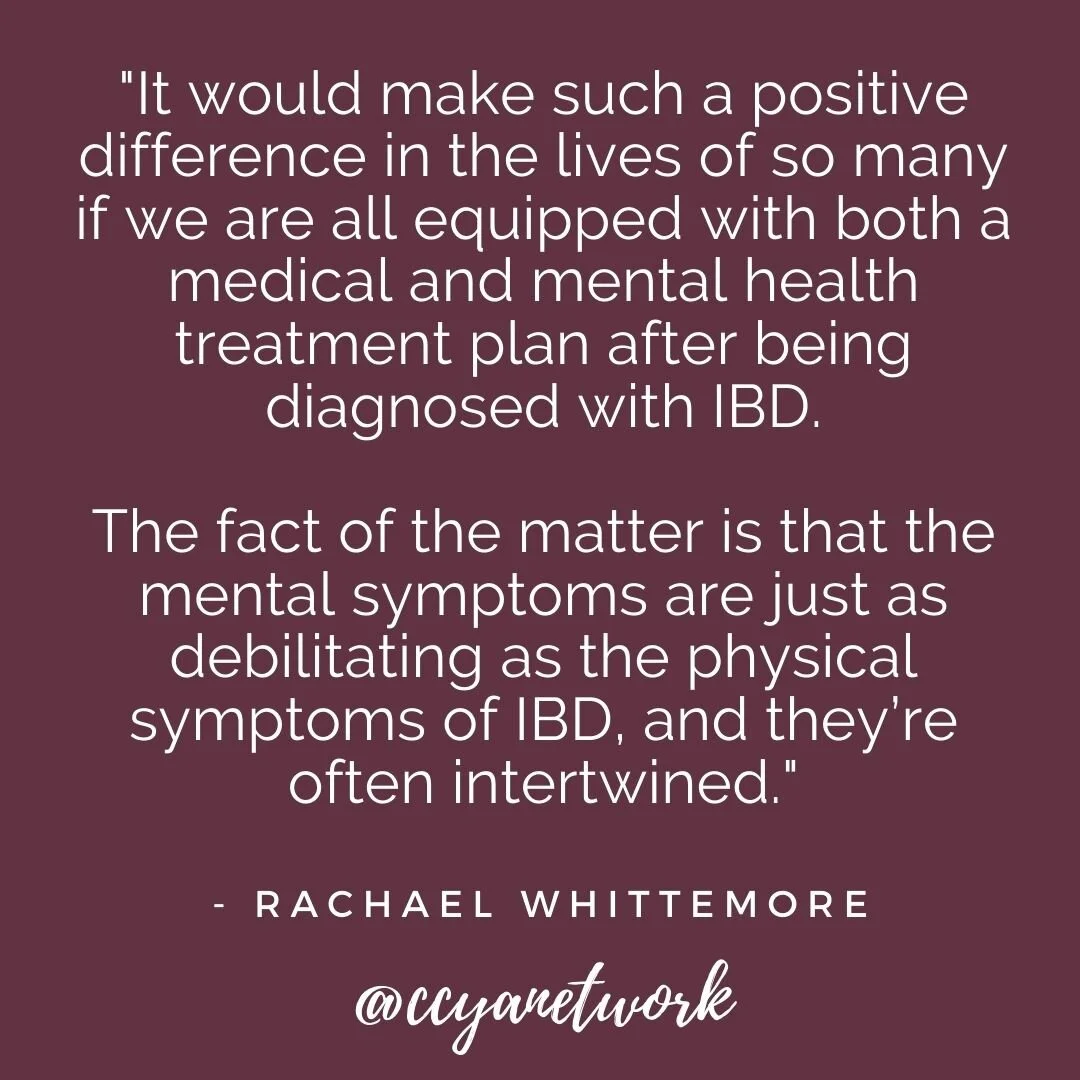
I think it would make such a positive difference in the lives of so many if we are all equipped with a medical and mental health treatment plan after being diagnosed with IBD, because the fact of the matter is that the mental health symptoms are just as debilitating as the physical symptoms of IBD, and they’re often intertwined. We need this kind of support as we manage our diagnosis - which sometimes can land us in the hospital or needing major surgery. I can’t speak to these kinds of experiences, but they can be traumatic in their own ways. How many failed medications or pain does one endure until they receive a potentially life-changing surgery? Thinking of the mental health hurdles that my co-fellows have dealt with and shared so vulnerably leaves me in awe of their strength. When they share what they have lived through, it also makes me sad that there was not adequate mental health services available to some of them when it could have offered an outlet for some of their pain.
Even now, almost 5 years out from my diagnosis, I take medication for my depression/anxiety and have re-established a relationship with a counselor that has experience in treating clients with chronic illnesses. I still go through the peaks and valleys of life and IBD, but, now, I’m better equipped to handle the lows when they hit or when a flare affects my mood and interest in doing things. I want the mental health support that has been so instrumental to some of my healing to be more accessible and affordable for those with IBD in the near future.
I hope speaking candidly about mental health and sharing some of these reflections helps you feel less alone and more validated in what you’ve been going through. The process of untangling all of these emotions is normal when grappling with a chronic illness diagnosis and what that means for you and those you love. Everyone processes major life changes and trauma differently, but don’t be afraid to ask about mental health services when you see your GI or primary care provider. Finding the right mental health support could be the treatment you never knew you needed.