

NEWS
Studying with Crohn's
By Simon Stones

I feel as though I’ve been studying for most of my life – well, there is some truth in that! After 22 years in education, it is safe to say that I am well and truly ready for the formality of it all to end… though I know I’ll never stop learning in life!
There’s no right or wrong way to go through education, especially once you reach the end of your compulsory education. Add into the mix one or more chronic conditions like inflammatory bowel disease, and things can feel a little more complicated– especially when deciding on what you want to do, and the way in which you want to do it. Moreover, what works for one person won’t necessarily work for another – which is it’s so important to do what’s right for you.
I went straight from compulsory education to University, where I completed a four-year Bachelor’s degree in Biomedical Sciences, before going straight to a three-year PhD in healthcare. Some may say it’s sensible to get all of your education done at once. Some may say I was lucky to be able to progress through the ranks one after another. Some may also say I must be slightly bonkers. In all honestly, it’s a good mix of the three, especially the last one!
My thirst for learning really began during childhood, while living with juvenile idiopathic arthritis. As a result of my restricted mobility at the time, I struggled to participate in sport. It is here when I channeled my energy into my academic learning – my body wasn’t much use, but I had a brain and I wanted to use it. Living with a chronic condition throughout my childhood had, in one sense, conditioned me to be inquisitive and desperate to learn. Although I missed quite a lot of time at school through being at the hospital and being unwell, I never gave in. I would always be working – it could be reading, completing workbook exercises, or writing. Every appointment, every infusion, every day sat in bed unable to move. In one sense, it gave me a purpose at a time in life when a lot of things didn’t seem to be going my well.
When I was diagnosed with Crohn’s disease at the age of 14, I was just about to embark on the final two years of secondary school here in the UK, where I would complete my first set of important exams, known as GCSEs. At the time, I wanted to become a science teacher, and so I knew it was essential for me to do well in my exams. Everyone kept telling me that I would pass, but being the perfectionist I am, I didn’t want to just ‘pass’ – I wanted to ‘the best’. Others often assumed that because of my health problems, getting a ‘pass’ would be ‘amazing’. This was often well intended but came across as a little patronising. I asked myself why should I achieve less than what I am capable of, just because of my health? It was this mindset which pushed me through. Don’t get me wrong – the stress of the exams in their own right, plus the stress I placed myself under, wasn’t helpful towards my health, and a regular pattern around exams would be a flare-up of symptoms. The same went for my A-Levels, the qualifications required for most University courses.
Over time, I tried my best to develop strategies to help to me manage my stress, while making sure everything was in place to help me achieve my potential without being at a disadvantage from my health conditions. It is often easier said than done, but planning has been fundamental to me limiting the stress I’ve found myself under while studying. In practice, this meant keeping on top of work, writing up notes as soon as possible, and looking ahead at what needed to be done by when. I also made sure that my school and college were fully aware of my health conditions, and that I had access to all the support I needed. This included extra time and the option of rest breaks in exams if needed, as well as being in a room away from the main exam hall that was near to an accessible toilet. Nowadays, with increasing use of technology, I would hope it is easier for students to keep in closer contact with their teachers/tutors, as well as be able to access different pieces of work electronically. This was starting to happen when I was at college between 2010 and 2012, but a lot has changed since then!
“It always seems impossible until it’s done.”
I started University in September 2012, originally studying Biology with a view to becoming a science teacher. I had toyed with the idea of studying Medicine, but I came to the decision that it wasn’t for me at the time. Sometimes I wish I had pursued the Medicine route, but I’ve certainly no regrets. After one year of Biology, I decided to focus my degree on Biomedical Sciences. It was during this period that I began my patient advocacy journey and found my love for research. Inevitably, the first few years of my degree involved quite a lot of work in the labs, which I thoroughly enjoyed and found fascinating. However, on a number of occasions, I did have some issues. While experiencing flares with both my Crohn’s disease and arthritis, in addition to experiencing quite severe cramps and pain while also in remission, I found it challenging to be on my feet constantly while performing tests in the lab. I always had a lab chair nearby, but it wasn’t always practical to be sat down. There were many times when I would be wishing for time to pass quickly so I could get my work done and sit down to get some relief. These experiences helped me to decide that being in the lab 24/7 in the future wouldn’t be for me, despite my love for science and research. Thankfully during my third year, I spent a year on secondment with a pharmaceutical agency, where I was able to use my knowledge and love of science in a way to inform medical communications and the drug development process. Like most things in life, you learn along the journey… coming across the things you least expected doing that you learn to love the most.
While I loved my time at university, I certainly wouldn’t want to repeat the undergraduate degree process! While it was worthwhile and an incredible experience, it was demanding. Thankfully, I graduated in 2016 with a first-class degree.
I then found myself at another crossroad. Do I take a graduate job and leave studying behind, or do I go on to do a PhD? Most people tend to undertake a Master’s degree before a PhD… but I guess I’m not most people. I came across a three-year funded PhD place in healthcare, focussed on supporting children with long-term conditions. I felt as though it was screaming out to me, ‘please apply!’ I decided that I would only apply for this PhD, and if I didn’t get it, then I’d look for a graduate job. I genuinely didn’t believe I would do, but with some luck, I received that wonderful call on Thursday 9th June 2016 – the afternoon after delivering a talk at the European Rheumatology Congress in London. I couldn’t believe my luck!
Fast forward nearly four years, and I am near the very end of my PhD – writing up my PhD thesis on a topic that is so close to my heart – supporting young people with juvenile idiopathic arthritis and their families to manage their health and wellbeing. It’s like a dream. The PhD study experience has been a very different one to everything before. Unlike school, college and an undergraduate Bachelor’s to a degree, a PhD doesn’t feel like ‘studying’. It certainly feels more like a working job, but one where you’re wandering around in the dark. It’s also quite an isolating and lonely journey, though I have been blessed with wonderful supervisors, supportive colleagues, and great friends and family.
As I’m writing up my 80,000 to 100,000-word PhD thesis (yes, I know, it’s going to be a book!), I’ve been doing an awful lot of reflecting, thinking about what worked well, what didn’t work well, and what I would do differently if I was to repeat the PhD again, or do another PhD… which I can guarantee is not going to happen! During this thought process, I feel blessed to have been given the opportunities that I have received over the years, but I also acknowledge that the majority of those achievements have been down to guts and perseverance – and I should be proud of that.
Sadly, it has also highlighted many of the cracks where people with chronic conditions fall through along the academic journey – and how attitudes and practices need to change so that others aren’t discriminated against by an ableist culture which doesn’t recognise and support people of all backgrounds to achieve their goals. We can do this by speaking up, highlighting our needs, and making sure others support us in doing what is needed. Never feel as though you are making a nuisance of yourself, or that you are demanding unachievable things – and if you are made to feel like this, don’t give up, seek support, and fight for what you are entitled to.

What have you experienced as an IBD patient because of the pandemic?

Photo by Bruno Cervera from Pexels
Today the Crohn’s and Colitis Young Adult Fellows joined together to share what they’ve experienced as an IBD patient during this global pandemic. So we asked our fellows how they have been affected by the pandemic as IBD patients and this is what they want to tell you!
“Thankfully, I’ve not had too many problems during the pandemic. My IBD is relatively well controlled at the moment, but I still fall in the group of people in England who are strongly recommended to stay at home, because I am immunosuppressed. Therefore, I haven’t taken any chances. I was able to get my medications delivered to the house, and I now have weekly food deliveries too - though trying to get a slot is harder than you think! My regular follow-up appointments at the hospital have been cancelled until further notice, but I am doing okay at the moment so there’s no need for their input. I have the IBD helpline and email address should I need them - but hopefully not! The only other problem I’ve had is arranging for my three-monthly vitamin B12 injection, which I’ve had for around 10 years due to malabsorption. My surgery has deemed this ‘non-essential’, and are only injecting those with consistently low levels. Clearly, I don’t fall in that category, because I’ve been on regular treatment for so long. They have suggested oral supplements which I would need to buy myself, but the problem of malabsorption - so the supplements are unlikely to be of any benefit.”
Simon Stones
“Though I am not on any immunosuppressive medication, I have felt heightened awareness of the fact that I have an autoimmune disease and an overactive immune system in general. When I realized how serious the pandemic was, my anxiety spiked not only because of the reality that was to come but regarding how many people dismissed the repercussions of proper, careful social distancing or #stayinghome. I was lucky that I was able to communicate with my GI provider and get refills of medications I use during flares and on a regular basis without having a last-minute visit. I only leave my house for essential needs such as groceries (once per week max), prescriptions or to get out of the house to exercise so I can regroup physically and mentally.”
Rachael Whittemore
“As someone who is immunosuppressed, I have been experiencing heightened anxiety because of the pandemic. I have been fortunate to work from home and have the privilege of having family nearby that can transport my groceries to me, but that being said, I still feel the fear and frustration upon seeing the news every day and knowing that there are many people who are not taking this as seriously as I feel they should. I began isolating before the quarantine was in full swing, because of my compromised immune system, and have only been in public to go to the pharmacy drive-in (while wearing a mask of course!). I am trying to channel my anxiety into healthy outlets, such as my art, to avoid prompting a stress-induced flare. All I feel that I can do at this time is stay at home.”
Lucy Laube
“As someone with IBD who’s living in a developing country, the major challenges stem from the lack of robust health infrastructure. Thankfully, I’m not in a flare and neither am I on any medication. However, I do have an ileostomy which requires constant maintenance. I have been facing difficulties in acquiring bags and other components of my ostomy. Luckily, I was able to procure a small amount of these components before the lockdown, but at an inflated rate. I’m also having difficulties procuring basic things like cotton and micropore tape. This keeps me in a constant state of anxiety. I am constantly checking apps to see if I can get the essentials at reasonable rates. Additionally, there is no easy access to any form of basic healthcare in case of an emergency, and that makes me nervous.”
Nikhil Jayswal
“To already live in a body and in a life that inherently holds so much unknown and vulnerability when it comes to my health, and to have that sense of uncertainty that constantly exists within myself now amplified throughout the world, to have that unknown intensified to this extent, has brought even more challenges and emotions to the surface. It feels like the unpredictability that comes with living life with a chronic illness has multiplied tenfold. I am immunosuppressed, and the only time I have gone anywhere except for my house or my backyard was to get blood work taken to check on my levels. While every precaution was taken in doing so, and it is a privilege to have such access, it was still an anxiety-ridden experience. I am incredibly grateful that I am not currently flaring and that I have the ability to be in contact with my GI provider through telehealth services, but I think it’s important for people to realize that IBD doesn’t just “stop” or “slow down” during a pandemic.”
Rachel Straining
“As someone who is immmunocompromised due to the medications I am on, I am always cautious of when I go out and am in large groups of people. With the pandemic, this caution has increased tenfold. I am fortunate enough to be staying with my parents right now. They go grocery shopping so that I do not have to go to the stores. I limit the number of places I have to go. When I do go out, I wear masks and gloves. I come home and immediately put my clothes in the washer and take a shower. I sanitize everything that I buy. When I’ve had to go for my infusions, I have to go through multiple check points to ensure I do not have the virus. All of my doctor appointments have been virtual. Although my health is not perfect right now, I am thankful to not be flaring like I was at this point last year, as I was in the ER every couple weeks. While the rest of the world seems to want to jump into reopening, I get anxious thinking about the ramifications of opening too soon. I cannot control how anyone else responds to this and who follows quarantine and who does not. But I can continue to do my part and stay at home.”
Samantha Rzany
“When you live with a chronic illness, you’re often forced to make compromises for your health. You have to take on a second job as the captain of your health. Since the pandemic began, navigating the healthcare system has become more difficult and uncertain. Chaos is a part of any illness that remits and flares, but when chaos is the defining state of the global world, it can cause undue stress. Personally, I’ve had to postpone doctor’s appointments, and alter my treatment plan to cope with our new reality. It’s been difficult to choose not to participate in activities I enjoy doing, like socializing with friends, but I know that I have to make sacrifices to protect my health and the lives of others. While I cannot eliminate all risk, I am trying to minimize my stress and focus on what I can control. I am taking precautions, such as wearing a mask, and going out for only essential needs. The entire experience of the past few months has brought health to the forefront of the public’s attention. I am hopeful that it will improve the public discourse on chronic illness, and lead to more resources in the health sphere. After all, public health is a collaborative effort, and not an individualistic one.”
Grady Stewart
As someone who is immunocomproised, I carry around the stress of potential sickness anxiety with me. Before the pandemic, I have always been transparent with people in my life about my need for them to stay clear of me if they are not feeling well . This advocacy that I was working on getting good at is now amplified x3. My remicade appointments have carried on, first I couldn’t bring anyone now I am allowed to and it’s back to normal. I feel isolated and lonely but thankful for my roommates who keep me company and my cousin who drives me to the grocery store. For me, it has been a major trigger to have the topic of conversation constantly be of health and healthcare. My hope is that this will bring a new normal. That together we can collectively make workplaces schools etc more accessible for all and that there is now a general awareness and understanding for the immunocompromised community.
Amy Weider
My Experience as a Young Adult with IBD in Iran

Note: Ershad’s primary language is Kurdish and thus some of his original article has been adjusted for clarity with his consent.
Hi, I'm a 19-year-old boy from Iran.
I have been diagnosed with IBD for about 9 months. It dates back to two years ago. It was in the middle of summer that the symptoms started and I was inattentive. I told myself it was nothing special but after a month, the symptoms got worse and we went to the doctor. I'd better say doctorS!! Many doctors came and went, but none of them worked. The first doctor we went to told us that it was nothing special. He wrote some herbal pills and told me to go home and it will get better in the next few days.
After a week, I saw more severe symptoms with blood. When I explained the matter to my mother, she was very upset and told us to go to another doctor quickly. We rushed to another doctor, and after a few tests he said, “Your liver enzymes have increased too much. You should be hospitalized.” We were very confused and my mother used to say, "We're here for a stomach ache, while you are talking about liver enzymes!!” The same day we went to another doctor, he also did some tests and CT scans and said let's come back after receiving the answers. The next day, after checking the results, he said that my intestines were inflamed and my liver enzymes increased. He wrote a prescription and said to take these medicines and come back for an examination a month later. After two weeks those drugs didn't work either, but my liver enzymes were at their normal level. The reason for their increase remained a secret!!!! We decided to go to another doctor. After the examination, he told us to have a colonoscopy as soon as possible. The doctor told me to go out so he could talk to my parents alone. After a few minutes, my parents came out and my mother was crying. I was very upset and asked, "What did the doctor tell you?" My parents said nothing in response.
I started researching the Internet about my symptoms. And I wondered if I had bowel cancer? Then we went for a colonoscopy and found that a colonoscopy with anesthesia was available in another city about 300 kilometers away. We set out for that city called Tabriz. And after the colonoscopy, the doctor told us that I had IBS. He wrote me a prescription with some medicine and told me to come back for an examination two months later. During these two months, the abdominal pain was relatively good. Later, for some time, the drugs I was taking did not work and one of our relatives suggested another doctor in Tabriz.
Finally, when we went to this doctor, he diagnosed me with an inflammatory bowel disease (IBD) through colonoscopy and some tests. And now I'm taking Mesalazine. He suggested that I reduce the amount of food I ate at each meal and increase the number of meals throughout the day, and to exercise more. He also advised me to get a good night's sleep. Following this doctor, I was able to relieve the symptoms of the disease within forty days, and my illness remained silent for four months. Once the coronavirus became global and we were quarantined at home, my sleep schedule was disrupted. And for about three months now, all the symptoms of the disease have returned. It has reached a point where my intestines are not responding to the pills. I hope that the world will return to normal as soon as possible and that I will be able to see a doctor again.
I know this disease has a negative impact on life. But I learned from these negatives that no medicine can be like “hope.”
Keep the human standing!
I learned that anyway.
And you have to love all the time
Even in times of fatigue, illness and despair
I learned to fight forever for the life
He closes his eyes to what he have
Sometimes you have to live with peace of mind
Get rid of every battle and defeat
people love to count their problems
But they don't count their pleasures
Always take into account what you have, not what you lose …


00-12 in 12 Months
This article is sponsored by Gali Health.
By Samantha Rzany
Ulcerative colitis is described as, “a chronic, inflammatory bowel disease that causes inflammation in the digestive tract”. And while most of the symptoms associated with IBD take place in the gut, some of the hardest and often most shameful ones take place elsewhere in the body. While most people know about my struggles with IBD, very few know about the subsequent issues that accompany my disease.
I’m someone who was always fairly thin and had a pretty fast metabolism. I never really struggled with my views on my body and was always pretty comfortable with my weight. I had seen numerous friends struggle with eating disorders, and while I could sympathize with them, I never really understood how someone could just stop eating. But when I started getting sick, I quickly grew to learn all of the emotions and struggles associated with eating disorders.
I was diagnosed with ulcerative colitis on December 10, 2018, but my symptoms began long before then. Beginning around September of 2017, I began having severe stomach pains and found myself sick after nearly everything I ate. I started to try to adjust what I was eating in an attempt to see what it was that was causing such extreme pains. I saw numerous doctors who told me I was just stressed or that I had IBS and just needed to learn better management of my stress and emotions. I went to my first GI, who ran multiple tests that all came back negative. We started restricting types of foods like gluten and dairy to see if they were causing my symptoms.
Because of the pain I was in and the limited foods I could eat, I was dropping weight pretty rapidly. I started hearing how “good” and “thin” and “healthy” I looked. People asked if I had started working out or what diet I was on. I was at my sickest, but to everyone else, I apparently looked my best. While test after test continued to come back negative and I continued to feel sicker and sicker, my weight also continued to drop. I found a sense of control in being able to choose whether or not to eat each day. People’s comments about how “good” I looked started to get to my head. I began to restrict my eating far beyond what was medically necessary to control my symptoms.
I soon found myself to be the weight that I was when I was 13 and in 7th grade. I was shopping in the children’s section of stores and buying XS and 00 sizes in women’s. People told me I must be incredibly fit and in shape because they could see my abs, but in reality I was just so thin, that there wasn’t anything else there.

I continued getting tested for different illnesses and diseases, and the results kept coming back negative. I was angry, I was in pain, and I needed to control something in my life when everything else seemed so uncontrollable. By April of 2018, I was sickly thin. I finally admitted to myself that I needed help. I sought out a therapist that specialized in eating disorders. I worked extensively with her throughout the course of the summer. When school started back up in the fall of 2018, I was back to my normal weight and mentally doing much better. I had found a good medication that helped with my anxiety and depression and felt much more like myself.
While my mental health was in a much better place, my physical health was still struggling. Around November, it began to plummet and, what I know now to be my IBD symptoms, got much worse. In December, I called my GI explaining my worsening symptoms and we scheduled a colonoscopy for the next week.
The next few months after my diagnosis, I continued to get sicker. I was very limited in what I could eat, but I continued working with my therapist and we made sure I wasn’t restricting myself beyond what I needed to do for my IBD. Fast forward to March of 2019 when I was in and out of the ER multiple times a month. I was put on Prednisone for what I was told was going to be “just a couple weeks”. The prescribing doctor warned me of possible weight gain, but said that since I would only be on it for a few weeks, the 5 pounds would fall right back off.
He was wrong.

I was on Prednisone from March until August of 2019. And in the first two months on the medication, I gained 47 pounds. As someone recovering from an eating disorder, this was indescribably difficult for me. I found myself needing to shop in stores I had never been in before. I was wearing sizes I had been able to practically swim in just a short year ago. I went from roughly a size 2 or 4 to a size 12 in just a couple months. I had stretch marks. I had cellulite. And I was much heavier than I had ever been in my entire life.
Over the course of the summer, I struggled hard. I found myself wanting to restrict what I ate in an attempt to lose some of the weight I was gaining from the medication. But I remained strong. I reminded myself of how much I had overcome in the past year. I reminded myself that the weight gain due to the medication was far beyond anything I could control and that restricting what I was eating wouldn’t help. I reminded myself that I was still the same strong and resilient person whether I was a size 00 or a size 12.
When I was finally able to get off of the Prednisone and my IBD was in remission, I decided to get a tattoo to be a constant reminder of my strength. In a time when I could have so easily gone back to old habits and had every reason to feel self-conscious, I remained strong and held to the mindset I had worked so hard to get. I got a tattoo of the National Eating Disorder Awareness logo on the back of my arm as a reminder to me of how much I went through and overcame in just one short year.
Nine months later, I have still not lost all the weight that I gained on Prednisone. It is still hard for me to look back at pictures of my normal and healthy self and wish I could look like that again. I have a bin stored away of the larger clothing I had to buy while on Prednisone in case I have to go on it again. It’s easy to look back at my life before my diagnosis and before I started getting sick and wish to go back to that time of my life. But when I look at everything I have gone through since then and everything I have worked so hard to overcome, I can’t help but be proud of the progress I have made.
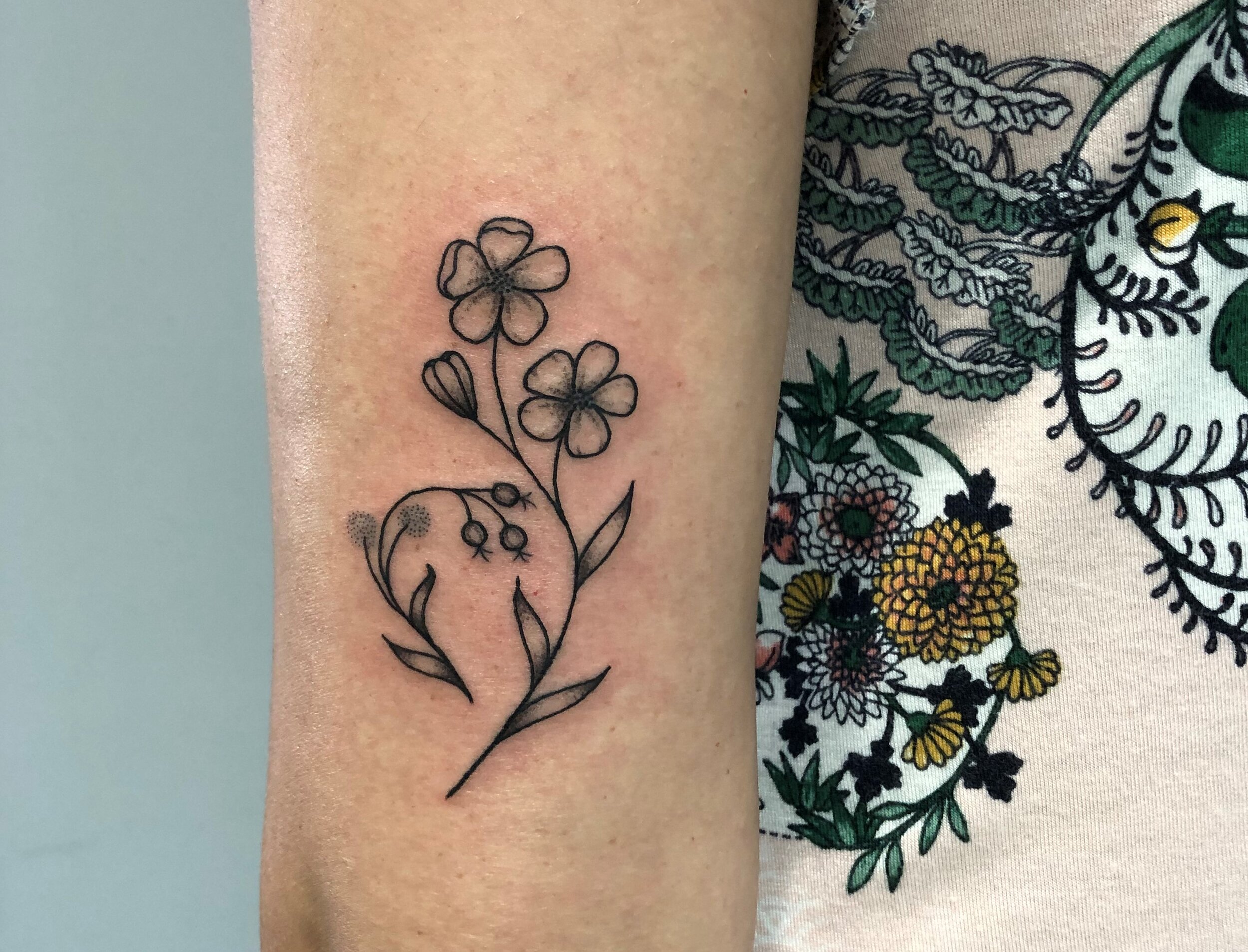

This article is sponsored by Gali Health.
Gali Health is an AI-based personal health assistant app helping people with inflammatory bowel diseases (IBD) proactively manage their condition. Gali gathers knowledge from daily interactions and health monitors to tailor support and information to your specific IBD experience.
The Importance of Sharing Your Story

It’s almost impossible to explain what it’s like to have your life change in one moment. Words crumble into letters, then into illegible hieroglyphics when you try to squeeze a feeling so big into the space between periods. Everyone experiences change in their own unique way, but it's always a shock to lose your sense of normal. With a lifelong illness, so many of the early days of the journey are dominated by confusion, anxiety, and uncertainty. Before a diagnosis, you're forced to fight an invisible war with an invisible enemy. On a daily basis, you deal with unexplained medical issues like abdominal pain, bleeding, and fatigue. Yet, all the while, you have no real option other than to go on living your routine life. For weeks, months, or even longer, you live a double life as a patient bouncing from doctor to doctor, and as your past “normal” self who deals with all of the chores of your past. Ultimately, a diagnosis provides only an answer, not all of the answers.
There’s never a convenient time to be impacted by an illness, but it seems like human bodies break down at the most inconvenient times possible. It’s like how alarm clocks always seem to go off only two minutes after you fall asleep. I was a freshman at university when I first experienced the symptoms of ulcerative colitis. College is supposed to be the beginning of a lot of things. It’s the beginning of adulthood, of professional life, and of real independence. For me, though, it felt like the end. I thought my life was over, and that the future held nothing but medical challenges for me. The truth is that being sick is incredibly lonely, and it’s difficult not to feel like a burden. When you’re surrounded by illness, doctors, and medical appointments, it’s easy to turn inwards to protect yourself. But, by doing that, you also cut yourself off from the outside world.
Loneliness is a feedback loop. In essence, the lonelier you feel, the less you feel you can reach out to others, and the less you reach out to others, the smaller your social circle becomes. Interestingly, in the Internet era, people seem to be lonelier than ever. Despite the fact that we live in a world where connection is constant, people seem to connect less. To clarify, I don’t think technology is evil, or that it’s destroying social structure. It's just overwhelming, and it can be intimidating to be vulnerable and sincere online. But, it’s also incredibly important to be those things.
By speaking truthfully and sharing our stories, we show others, and ourselves, that we are not alone in our battles with chronic illness. We learn more about how to manage our conditions, and we contribute to research. Most importantly, we connect and grow the chronic illness community. Through meeting and talking to others, online and offline, I’ve made new friends, and eased my own feelings of loneliness. I encourage others to share their journeys in whatever form they feel comfortable, and to reach out for support. Together, we are stronger than we are alone. Together, we can make invisible illnesses and struggles visible to the mainstream. So, drop me a line, sometime.
Life Hacks: What Happens When You Age Out of Your Parents’ Insurance?
By Rachael Whittemore

Photo by Michaela from Pexels
You’re done with undergrad, finally got a job you wanted…maybe you went back to graduate school, but, anyway, you’re really getting a hang of this “adulting” business when BAM! You turn 26 and you’re officially kicked off your parents’ insurance plan. In the US, the Patient Protection and Affordable Care Act (ACA) aka Obamacare was enacted in 2010 and, as part of several mandates, upped the age we could stay on our parents’ coverage to 26. I’m pretty sure this was helpful to pretty much ALL young people. For example, my dad started working for the state of North Carolina during this time, and I was able to stay on his Blue Cross Blue Shield (BCBS) plan, which had decent coverage. I was covered by this plan as I went through visits and testing for my ulcerative colitis (UC) diagnosis and was very thankful that the expenses I had to pay were largely covered. I will say that my parents were paying the yearly premiums and any bills that came directly to them; our deal was that I was responsible for any bills that came directly to me and for all of my visit and prescription costs. Now that I’m completely financially independent, choosing health insurance and paying for it is solely up to me.
Let’s go back to 2018 - my 26th birthday was quickly approaching in September and I was thankful I was also starting PA school that summer – I knew there would be a school insurance plan I could enroll in once I was kicked off of BCBS, but didn’t really look into my other options until I started experiencing all of the costs and tedious parts of navigating US insurance plans. I’m here to share some about that experience but also to give you some tips about what types of plans you can enroll in and how to be savvy and advocate for yourself when you invariably get mail from your insurance company one day and you’re like, “WHERE DID THIS COME FROM?!” As someone with a chronic illness and who has specialists I see for other medical surveillance, I have experienced new challenges from navigating the health insurance plan world on my own. First, skim this article for some health insurance 101 so you can better understand some of the terms I’ll discuss below if you weren’t already aware: link
Tip #1: Look at all your options.
If you’re working, see what insurance plans your employer offers if they are required to offer coverage. Look at the healthcare marketplace at healthcare.gov to compare plans.
If you’re a student, look at your student health plan but realize this is typically just medical – if you need dental and/or vision coverage, you usually pay additional costs and it can be pricey and not worth it on our budgets.
Also, if you’re a financially independent, single student over the age of 26, look into Medicaid in the state you live in. You should easily qualify because your only source of money is from loans and that doesn’t count as income. Feel free to call your local state center for Medicaid as they can inform you about your options for various plans if you qualify. Medicaid
If, by chance, you served in the military prior to being diagnosed, you might qualify for health insurance covered by the Veteran’s Affairs healthcare system. See if you might be eligible here. If your parents are currently in the military, you should qualify for Tricare until you’re 23 if you’re a full-time college student. If not, you’re kicked off at 21. Fun Fact: The VA system is the closest thing we have to a true socialized medicine in the US.
Tip #2: Understand basics about health insurance plans.
I know this is annoying, but it is really helpful to understand basics because it will allow you to see what plan best fits your needs. Know the difference between plan types like HMOs and PPOs, if your plan(s) require referrals to specialists, what your monthly premiums are and what your out-of-pocket deductible is if you have one (you will probably have one).
Pro tip: Most of us with chronic conditions do not want a high deductible plan because you will be paying thousands of dollars before your insurance will cover visits, testing, meds, surgeries, etc. Usually, people in our situations will have a plan that has higher monthly premiums but lower out-of-pocket costs for everything else since we utilize the healthcare system more than the average young person.
Know your co-payments for various visits and prescriptions. This varies depending on your plan and what they have determined for visits such as primary care, specialists (hi there, GI providers!), ER, etc. This is typically required regardless of your deductible and coinsurance. Prescriptions are typically tiered and have predetermined costs. Your insurance card or brochure should detail this.
Know what your coinsurance is. Co-insurance is how much your insurance covers + what you cover once your out-of-pocket deductible has been met. My dad’s plan was a PPO with an 80/20 co-insurance. This means that once our deductible was met, I went for a visit, everything was billed and the claim was filed. Our insurance *typically* paid 80% of that bill and then I had to cover the remaining 20% unless it’s considered preventative care.
Example: My current student plan is through United Healthcare Student Resources. The entire cost of the plan (all the monthly premiums together) goes into my cost of attendance for my PA program and is about $3400/year. I have a $500 deductible I have to meet before my insurance will start to pay for anything that’s not considered “preventative care.” After I’ve met my deductible, my coinsurance is an 80/20 – I pay 20% of the bill once the claim has been filed and comes back. And guess what else? If something isn’t covered under my plan’s benefits, I pay out of pocket for it.
Tip #3: Know your benefits!
This is honestly closely related to tip #2 – once you understand a little about the various costs that go into what plan you are thinking about, KNOW YOUR BENEFITS!
Every plan has an outline of what is covered/not-covered and is commonly known as an EOB (explanation of benefits). This outline should also tell you what falls under “preventative care”, which includes things like yearly physicals, Pap smears, STI testing, depression screening, flu shots, etc. That should be covered by your plan at no cost to you.
Tip #4: Your plan won’t disclose everything in your policy.
Refer back to #3 – know your benefits, but know that your plan likely will not disclose every little thing they will cover in the outline of your policy.
This is where things can get annoying and frustrating, at least in my experience. Because not everything can be outlined (and we understand that to an extent), sometimes you open a claim letter in the mail and see an amount you owe that literally makes you cringe and wish our healthcare system was completely different. This is when you should….
Tip #5: Don’t be afraid to question any claim/bill you get!
I cannot stress this enough, especially when I have multiple medical visits throughout the year, several of which are to specialists. I have caught errors made by my insurance company or even the practice I was seen at and saved myself money, which as a poor graduate student – let’s face it – really matters. Look at what you were billed for (the visit, tests, etc.) and if it was covered (even as part of your co-insurance) or if it was outright denied. If you’re totally confused as to why something wasn’t covered…
Tip #6: Don’t be afraid to call your insurance company and go through your claim/benefits.
It literally pains me to type this, because I’ve spent more minutes than I want to admit on the phone with insurance companies (both as a patient and from my previous jobs in the medical field). However, you sometimes can’t get to the bottom of a particular coverage denial unless you talk to someone about your claim. Look at this as advocating for yourself as a patient and making sure you’re not getting overcharged or denied something that should be covered.
I could go on and on with other tips, but what I just wrote above might seem overwhelming. That’s ok. Sadly, we all have to learn how to navigate this system in the US unless something drastically changes in the future. And now back to my own story - currently, I still have my school’s insurance plan until July 31, 2020. I recently enrolled in Virginia Medicaid that includes dental/vision (yessss!). That will be my new/bridge insurance until I get a job after I graduate in December. Remember to do your research and feel free to call the ACA’s marketplace, Medicaid, the companies offered through your employer, etc. People are there to help you and can give you info that allows you to make the best decision for your health going forward.
The "Luxury" of Advocacy
By Nikhil Jayswal

DISCLAIMER: This article does not portray a complete picture of the state and scope of patient advocacy in India. It is my personal opinion based on my personal experiences.
When I tried to find a definition for “patient advocate” on the web, I found not one but several different definitions; each definition listing out various duties of an advocate. After reading various definitions, I’ve come to understand that a patient advocate has three major duties:
Educating a patient about his/her condition and the available treatment options
Helping a patient navigate the healthcare system and make the “right” choices
Speaking for/against policies that protect/endanger the best interest of a patient
If we think about it, doctors are best eligible to be good advocates. They understand the disease the best and they know the system the best. However, as participants of an under-funded and over-burdened healthcare system like the one that exists in India, doctors struggle to be the best advocate that they can be. India therefore desperately needs a community of advocates who can educate and help patients make well-informed decisions. Articles and papers can be found on the web advocating for the creation of patient advocate groups in India.
Patients themselves can be good advocates too. Experienced patients with a good understanding of their condition and the healthcare system can guide other patients to make the “best” choices. In my experience though, sadly, not many patients understand their condition very well. Many patients also shy away from educating and helping other patients because of the stigma associated with sickness. This is also a major reason for the lack of support groups in India.
In such a scenario, how are patients supposed to make well-informed decisions? How are we supposed to act in our best interest? There is a select group of patients though, that have that “luxury” and an entire ecosystem exists, which this group of patients can leverage to get the care that they understand is in their best interest.
Patients with strong socio-economic backgrounds have a larger plethora of treatment options at their disposal. A large number of hospitals and doctors exist that cater to this special group and provide them with all the information these patients need to make a choice. No diagnostic is inaccessible to them and their voice is heard keenly. They advocate for themselves and the system advocates for them too.
I hold no grudges against this population of patients, but the thing that prompted me to write this article is that the socio-economic background of a patient dictates his/her access to information, treatment options, and patient rights. There is virtually nobody who will advocate for you if you do not belong to a select population. This huge divide disturbs me. There are a number of reasons for this divide and it’s a complex situation. Poverty, illiteracy, lack of sufficient government expenditure on healthcare, income inequality, social divide, etc. all contribute to creating a system that is so constrained that it takes away your voice and choice unless you have a privileged background. While such scenarios may exist everywhere, the larger population of patients in India often find themselves in the dark and struggling to protect their best interest.
The consultation times in hospitals that deal with the larger population of patients are often in minutes, sometimes even less than 5 minutes. With a disease that’s as complex as inflammatory bowel disease (IBD), that is in no universe sufficient for a doctor to explain what’s happening to their body to a patient. With few informed patients, it then also becomes difficult to find a reliable peer group. IBD can also be a costly disease to manage, and many patients find themselves without insurance, or with insurers who refuse to cover patients with a pre-existing diagnosis. I was one of such patients and eventually, I went bankrupt while I was still severely ill. Government schemes target those who live below the poverty line and I was not one of them because I did not have a certificate, even though I had no money. Getting that certificate is a lengthy process and I did not have the time for that as my disease was progressing very aggressively. I felt helpless and I contemplated suicide many times because of my financial inability to get treatment. And in fact, many people do commit suicide when they find themselves in that situation. Those who are eligible for financial support from the government, often face harassment by middle-men. I can go on and on about the skewed system that basically takes away your dignity and leaves you feeling guilty about having a disease that you did nothing to contract. You don’t understand what’s happening to you. Most of the treatment options are beyond your reach and you can’t ask for help without breaking your back.
As a young adult, which is the age group where IBD is most prevalent, a lack of advocates intensifies the challenges that arise from getting diagnosed with IBD in India. As a young adult, you do not want to feel so helpless. It takes a huge mental and emotional toll on you. You feel like a burden on your family. You feel powerless against this disease. Depression and isolation intensify these feelings and life can seem pointless at times. Education and employment are hindered and you face discrimination. There is no law to protect you from that discrimination. Your self-image deteriorates. Self-harm and suicidal thoughts can occur frequently in the absence of support. Even with support, sometimes the pain is too much for some to handle, and there have been instances of suicide by young patients in the Indian IBD community because of lack of proper support.
This is why advocacy to me, seems like a luxury in India. And this is why I had to write this article. I have many friends who are struggling to get a basic treatment, and I know people who deteriorated their condition due to a lack of information and counselling. I now know many kids and teens with IBD, and I worry about their future. Without advocates to educate patients, to speak for their rights, to help them make better choices, the young adult population in India cannot be productive and fulfill their potential. India now has the second-largest IBD population after the U.S. Therefore, there is an urgent need in India for advocates who can act as a voice for patients. And I sincerely believe that the people who are lucky enough to advocate for themselves need to come together with those advocating for the lesser privileged population of patients, to create an inclusive environment where every patient gets an equal chance to fight the disease.
In a larger spirit, I want to end with some words of Claire Wineland, with whom I absolutely fell in love, after listening to her talk about her condition and her views on life. When I tried to contact her, I found out that she had died. I encourage you all to watch her on YouTube. She remains the best advocate I’ve ever come across.
“... I'm actually here to talk about how do we change the way that we treat sick people. How do we stop pitying them and we start empowering them? The way that our society works, we teach sick people that when they are sick, somehow, someway, they cannot be as happy as normal healthy people. We teach them that their happiness, their contentment in life, their joy in life is tied to how healthy they are. ...”
“... Innovation doesn’t happen because there’s some person who’s in some great circumstance and everything is going well and they get on a roll and they make something for the world. Innovation happens, art happens because of suffering. …”
“... How do we make it so that when someone is born with a chronic illness, someone who is going to be sick, who might always be sick, who might die sick, can still live a life that they are proud of? How do we teach kids who are sick, teach people who are sick in general, to not feel ashamed of their illness or their experience of life, but to learn from it and to make something from it? ...”
As an advocate, I believe that is what our fundamental duty must be. To change the way society looks at sick people. To change the way we sick people look at ourselves. Everything we do as an advocate must be aimed towards creating a space for sick people to fulfill their potential. I hope I see the day when it becomes possible for every patient to self-advocate for themselves because that will be the day when every patient is empowered and every patient is no longer a “patient”, which originally meant “one who suffers”.
Thank you for listening to me.
P.S. Some of the readers might think that I’m painting a gloomy picture of the situation in India, but this is what I have gone through and many patients go through, and I felt it was necessary to portray the situation right as it is. My goal here is to bring attention to the inequitable situation present in India, and the fact that the lesser privileged section of the patient population in India has a much greater need for advocates than the privileged section of the patient population.
P.P.S. I had initially titled this article - “Patient Advocacy in India”, and my first instinct was to just leave the article blank. Then, one day I was talking to a friend of mine. She’s a nurse and has IBD along with Asthma. I told her that I wanted to write an article about the state of advocacy in India and I asked for her thoughts on it. Her advice was - “leave it blank!”
Stress and IBD
By Grady Stewart

There are times when I am a ball of yarn. I am tangled into forms that cannot be graphed even with the complex mathematical equation. I am twisted into abstract shapes that would make the jaws of even an Olympic gymnast or a world-renowned abstract painter drop agape. It feels like I’m being pulled in a thousand different directions by hundreds of invisible hands. I’m poked, pushed, and prodded by all of these competing forces. In the end though, I never end up going anywhere. It’s odd, because you’d think that eventually I’d be drawn in one direction with all of this energy behind me to move me forward, or sideways for that matter.
Instead, I’m like a magnet. I’m frozen in the static between positive and negative charges, unable to budge in either direction. While it’s exhausting to feel like there are too many demanding directions to chase after, it’s also frustrating to end up going nowhere. I think everyone has experienced a feeling similar to what I have described. Stress, and the feelings of anger, disappointment, and anxiety are universal. However, we all deal with stress in different ways. In fact, on an individual level, we often react differently to different stressful events. Procrastination is a common response to stress. In fact, it’s so common that “procrastination” has practically become its own emotional experience independent of stress.
It’s impossible to avoid stress, but when you live with IBD, it can be a major challenge to even minimize it. Living an everlasting and ongoing health issue naturally consumes a fraction of your energy on a daily basis. It’s like having dozens of Internet browser windows open with each of them on a different website. One of them is open to you email account, and another is open to Google Docs where you’re writing an important article about stress and IBD. In the background, a window is minimized, but always running, and always blaring Russian heavy metal. You try to jump between windows, trying to finish every task you set out to complete, but with the added background noise it becomes much more challenging.
Like that permanently minimized window, chronic illness is something that lurks in the background of life, but that can never be forgotten, closed, or removed. Moreover, in the age of social media, there is an infinite amount of voices constantly yelling at us to grab our attention. On top of that, while it’s easier than ever to connect with others, the competitive nature of social media and overflowing stream of content can feel oppressive.
I’m not saying that social media is bad, or that stress is entirely toxic. Stress can serve as a powerful alarm for danger, or as an indicator that tells us we need to change course. However, when you have IBD, it can be a trigger for a flare and lead to negative health consequences. As patients, it’s important to stop from time to time, and take note of how we’re feeling on a physical and mental level. The goal isn’t to stop stress entirely, and it’s not necessary to delete all of our social media accounts. Instead, the goal should be to adopt a healthier mindset towards our diseases and the factors that influence them - like stress.
It’s easier said than done. After all, we’re all imperfect, and just trying our best. At least, that’s what I’m trying to realize and to learn. Every day, it gets a little easier to understand that not everything is controllable, or even important. It gets easier to slow down, and to learn that not everything has to get done right away. It gets easier to realize that it’s okay to just breathe, and let things come and go as they will. After all, eventually we will all get to wherever we’re going, so why not enjoy the journey?
A Whole New Ballgame

I’ve never really talked about this, but I guess there’s no time like the present. So, here it goes.
I grew up playing sports. It was in my blood. I felt like it was an integral part of who I was and who I was meant to be. The seasons of the year were defined by the sports I played. Sometimes, I felt like I was too, and I liked it that way. That’s how I wanted it to be. That’s how I wanted to be known. I wanted to be the girl who scored the winning goal and saved the day.
Growing up, in the fall, weekends were spent running around a soccer field and getting pieces of turf stuck in my sweaty shin guards and eating orange slices after a game. In the spring, my parents would drive me from pitching lessons to AAU games and I put one too many dents into the siding of our house from pitches gone wild. Then middle school came around and so did new trends and all of a sudden I wanted to learn how to play lacrosse like everyone else.
I thrived in a competitive atmosphere. I used the rush of the bases being loaded or the scoreboard being tied or the game clock ticking down to feel alive. The pressure to be the best came solely from myself, never from anyone else. If I’m going to do something, I’m going to do it right. I was a perfectionist. Well, I still am. It’s both a blessing and a curse; it’s both my biggest strength and my biggest weakness.
I always thought I was going to go to school for sports. Everyone in my family did. My dad was a basketball star who turned down NBA pre-training camps to raise a family. My mom played tennis in college and had the meanest backhand on the court.
I always thought I was going to. I really did. And then I got sick. And a lot changed.
My sophomore year of high school was when I quit the lacrosse team. I was in too much pain and too weak to carry in grocery bags from the car let alone run up and down the field. It was when I had to be put on home-bound instruction to finish out the year when I knew, in my bones and in my soul, that something was wrong and my body was no longer functioning the way it had been.
The day I handed in my jersey was the day I felt like I lost a piece of myself in more ways than one. It felt like the vision I had of my past, present, and future shattered like broken glass. When you’re diagnosed with a chronic illness, in some ways, you do lose a piece of who you were and who you thought you were going to be.
At the time, what I didn’t realize, though, was that the piece of myself that I had to give up would be replaced by a million others and who I thought I was going to be was not who I was meant to be. What I didn’t understand was that I will never be defined by a singular sport or a singular accomplishment or even a singular character trait.
Do I miss sports? Yeah. I miss the way your teammates would wrap their arms around you in a huddle and the way everyone had to shake hands after a game, no matter if you won or lost. But I’ve also found that same support in this community. I’ve found that same sense of pride in simply being myself and being there for others. I feel just as alive helping others as I do when I would strike out a batter. I feel like maybe losing who I thought I was helped me find who I really am.
Just to get this straight - playing sports and having IBD are not mutually exclusive. People like Carrie Johnson, Kathleen Baker, Rolf Bernischke, and so many others have shown me that. My own journey and experiences have also shown me that it just wasn’t my path, and that’s okay. It’s more than possible, but it’s also okay if it isn’t for you.
Nowadays, now that I have more energy, less pain, and the ability to move my body again, if you give me a softball I can still throw a mean curve ball. If you give me a soccer ball I can still pop a rainbow. Those skills have somehow stayed with me through everything, like muscle memory, but they no longer carry the same weight that they used to.
They remind me of some of the best times in my life, like spending hours in the backyard practicing with my family. They remind me of some of the worst times in my life, like when I had to say goodbye to parts of my heart that I never thought I’d lose.
When I think about it, those skills tell part of the story of my transformation - of how the girl I once was evolved into the woman I’ve become. One who isn’t defined by the sport she plays or the home run she hits. I’ve become me, just me, and maybe it took losing sports to finally realize that’s more than enough.
Body Trauma and the Importance of Regaining Trust with Your Body
By Amy Weider

After any body trauma occurs in life one needs to make amends and heal from it. When we are going through a painful life event or any attempt to heal, the process can become increasingly difficult when you are not believed. Learning to regain the trust in your body after you have been invalidated and told to do otherwise can be increasingly difficult. Here I am going to explain a bit about my body trauma, the ways it occupies my life and how I have rebuilt the trust with my body. Trigger warning: mention of sexual assault.
As April is Sexual Assault Awareness month, I thought this would be the perfect time for me to further explore and write about my connected relationship between being a survivor of both sexual assault and Crohn’s Disease. For me as both a sexual assault survivor and someone with an invisible illness, Crohns Disease, I never thought the two could relate, but after I started understanding my assaults more and the ways I handled it, it all felt too familiar. A big linkage is the fact that the people you confide in to express your pain, cannot see either trauma. In both of these life events, folks had to take my word for my pain and believe me. I am so thankful that I was given believing from family and friends and their constant love and support to pick me up and help me through these times. But the world still manages to seep in and flood the mind with doubt and complexities to both of these things in my life.
When people don’t believe you are in pain or what you are going through because it is internal, it causes forever damage to your relationship with trusting your own body. When I was first going through my Crohn’s diagnosis it was hard to trust how my body was feeling when I was being told that it is all in my head or when doctors did not know what to do with me and my symptoms. Many times when folks need a medical diagnosis, they are brushed off as wanting attention or they “don't have it as bad as others,'' having symptoms that appear to be less urgent.This is very samiliar retohric we hear in the media and our everyday lives when it comes to talking about sexual assault survivors. Both survivors of assault and invisible illnesses experience a forgein threat to their body and both engage with the world’s pre conceived notions and ingrained disbelief that relates to the attempt to get help or seek acceptance.
Another experience that seems to be universal among folks with body trauma is the grieving process that can occur. It is so normal to grieve how your body used to be or function in everyday life pre trauma. In my own experience, I will often refer to myself as “pre-Crohn's Amy” and “post-Crohn’s Amy.” I am absolutely a different person than I was before my Crohn’s diagnosis and a different person than I was before my assaults. It can sometimes be hard to accept that things you never chose to do or had any say in affects your life so much and has changed you. I am in love with the person I am today but that does not make it less difficult at times to think about how life would go if these things had not happened.
There is not nearly enough credit given to those who believe what their body tells them they have been through and have to stand up for themselves because of it. I have had to retrain myself to believe when I am in pain and stand up for myself when that happens. I have learned that in society, we have a notion that there is a limited amount of love to be given out. This noise often impacts us and forces us to think “it’s not that bad” or “others have it worse.” Sure, maybe that is true, someone will always have it worse but this is a tactic used so often to diminish someone’s pain and prevent healing. Trusting my body and my pain requires me to take all things that happened to me seriously and not downplay them to make others more comfortable.
My past experiences have given me a sixth sense of listening to my body without questioning it. If I feel tired, stressed or possibly sick I listen and I do what I need to do for further prevention. I do this without any shame now and I think survivors of any body trauma deserve to feel nothing less than prioritizing themselves, their health and their safety. In these times we are constantly being reminded that our bodies are fragile and all we have.