

NEWS
When Your Body Has Other Plans
by Beamlak Alebel (Addis Ababa, Ethiopia)
This personal essay is a special article from one of CCYAN’s 2025 Fellows, Beamlak Alebel:
"Tomorrow, I will do this and that. I will finish my tasks, meet my friends, work on my goals, and finally get everything done." How often do we make plans with excitement, believing that tomorrow will go exactly as we imagined? But when you live with a chronic illness like IBD, tomorrow can be unpredictable, and even the simplest plans can suddenly change.
Living with IBD has taught me that unpredictability is not only about flare-ups. Sometimes, I wake up feeling ready to take on the day, only to experience unexpected fatigue, medication side effects, or an infection due to a suppressed immune system. Suddenly, the plans I made the night before no longer seem possible. Something I was looking forward to may have to be postponed or cancelled, not because I lack motivation, but because my health needs attention.
There are days when I plan to accomplish so many things, only to find myself resting instead. At first, accepting these changes can be frustrating. It is difficult to make plans when you do not know how your body will feel the next day. Chronic illness can make even the most ordinary routines feel uncertain, and being determined to follow a schedule can sometimes become unrealistic.
Over time, I have learned that being determined does not mean forcing myself to follow every plan. It also means knowing when to pause, listen to my body, and allow myself to adjust. I still make plans, set goals, and look forward to tomorrow, but I no longer see a cancelled plan as a failure. I am learning to accept that changing my plans does not mean giving up on my dreams.
Living with IBD has taught me to be flexible, patient, and kinder to myself. I may not be able to control every unexpected change in my health, but I can learn to adapt without losing sight of my future.
Sometimes, the strength to keep moving forward is not about sticking to the plan, but about being willing to change it when life takes an unexpected turn.
Re-discovering Myself
by Aiswarya Asokan (South India)
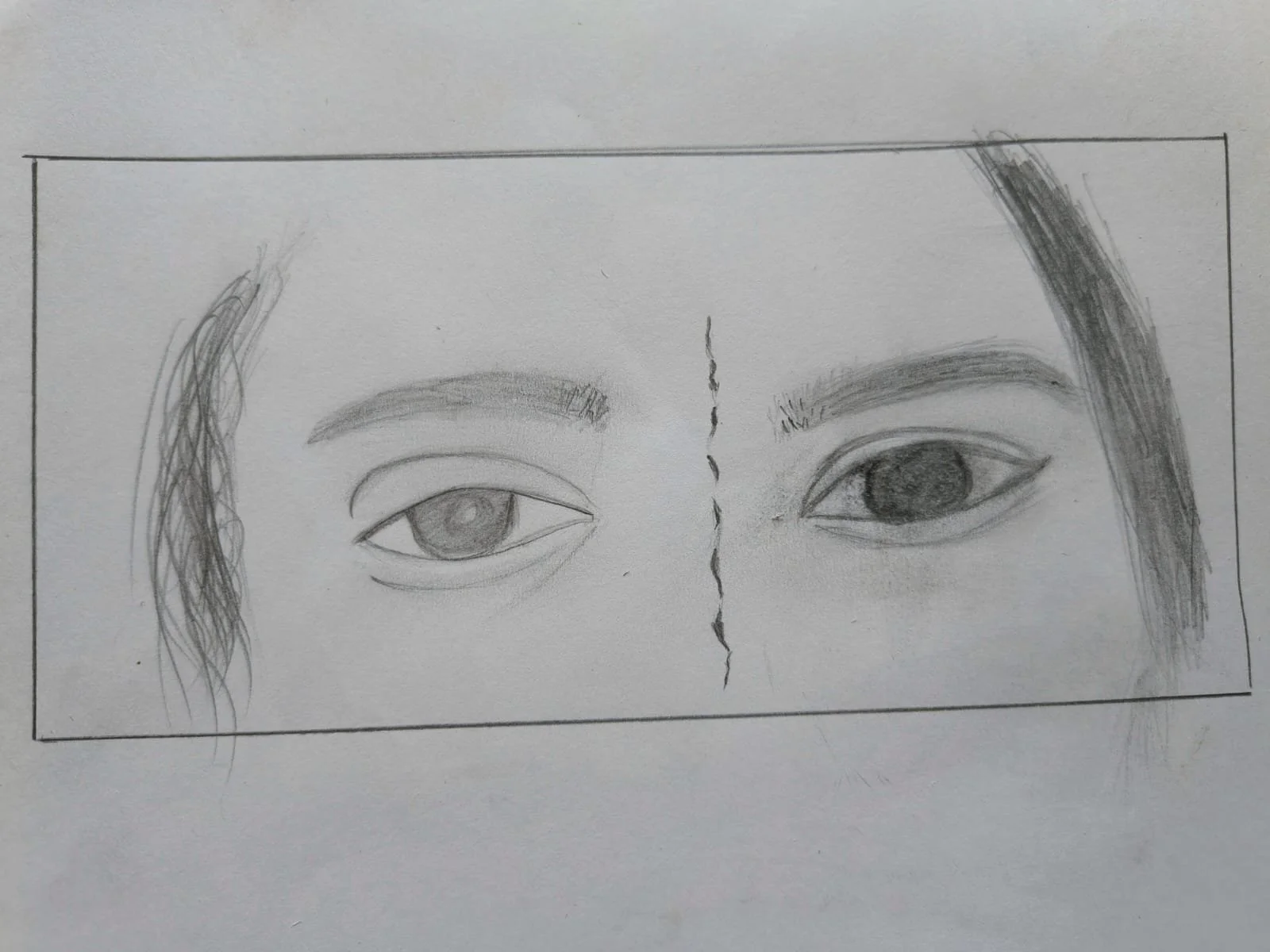
A pencil drawing by Aiswarya, showing two split sides of a face. The left side looks tired and worn down, while the right side looks awake and ready to act.
About the artwork:
The eye on the left hand represents depression, pain, withdrawal and hopelessness, while the one on the right-hand side represents fire, aggression, hunger, frustration, control and the drive for action. The broken line in the middle represents a surgical scar, which remains a symbol of the cost paid by the body for balancing the clash of emotions. The body as a whole is trying hard to hold it all together, to find the balance for emotional stability, for safety, for peace, for happiness. It is looking out for compassion, it is looking for love. And the only way to get to know what it is looking for is to look inward.
Some Things You Learn to Accept Without Questions
by Beamlak Alebel (Addis Ababa, Ethiopia)

A pink background with a blue question mark.
Sometimes there are things in life you learn to accept without asking why. For me, asking questions only made the stress worse, and stress only made my illness harder to survive.
I was diagnosed with inflammatory bowel disease (IBD) when I was very young. Looking back now, I can see how different I was from other children. I was always tired, weak, and running out of energy. While others played and dreamed freely, my body felt heavy, as if it was always asking me to slow down.
School was especially hard. Learning took more effort than I could explain, and there were moments when my body completely failed me. I remember fainting during exams—lying there while the world blurred around me, carrying not only pain but deep embarrassment. Being different from your classmates hurts in ways words can’t easily describe. It makes you feel invisible and exposed at the same time.
There were many days I cried alone. Not being able to do what you want as a child slowly takes away your hope. I watched my classmates move forward while I felt stuck, left behind by a body I didn’t understand. I began to believe that maybe I would never become “someone.”
IBD didn’t just affect me—it affected my family too. I saw their worry, their sacrifices, and their quiet strength. Watching the people you love struggle because of your illness leaves a mark on your heart that never fully fades.
For a long time, I didn’t have the words to explain what I was going through. When people said, “I have no words,” I never understood it. Now I do. My own words were scared. They hid behind silence, afraid to come out.
IBD delayed my education, interrupted my plans, and shook my confidence. But it did not destroy me.
What I have learned is that resilience grows quietly. Hope doesn’t always arrive loudly—it sometimes appears in the simple act of waking up and trying again. Even when the path feels unbearable, even when progress is slow, survival itself becomes an act of courage.
Yes, I am later than others.
But I am not behind.
I am surviving something incredibly hard, and I am still standing.
Today, I am a woman with a past shaped by pain, a heart filled with empathy, and a future that has not been canceled. My journey may look different, but it still matters. And if my story can help someone feel less alone, then every difficult step has meaning.
Featured image from Towfiqu barbhuiya on Unsplash.
Reflections on AIBD 2025
by Kaitlyn Niznik (New York, U.S.A.)
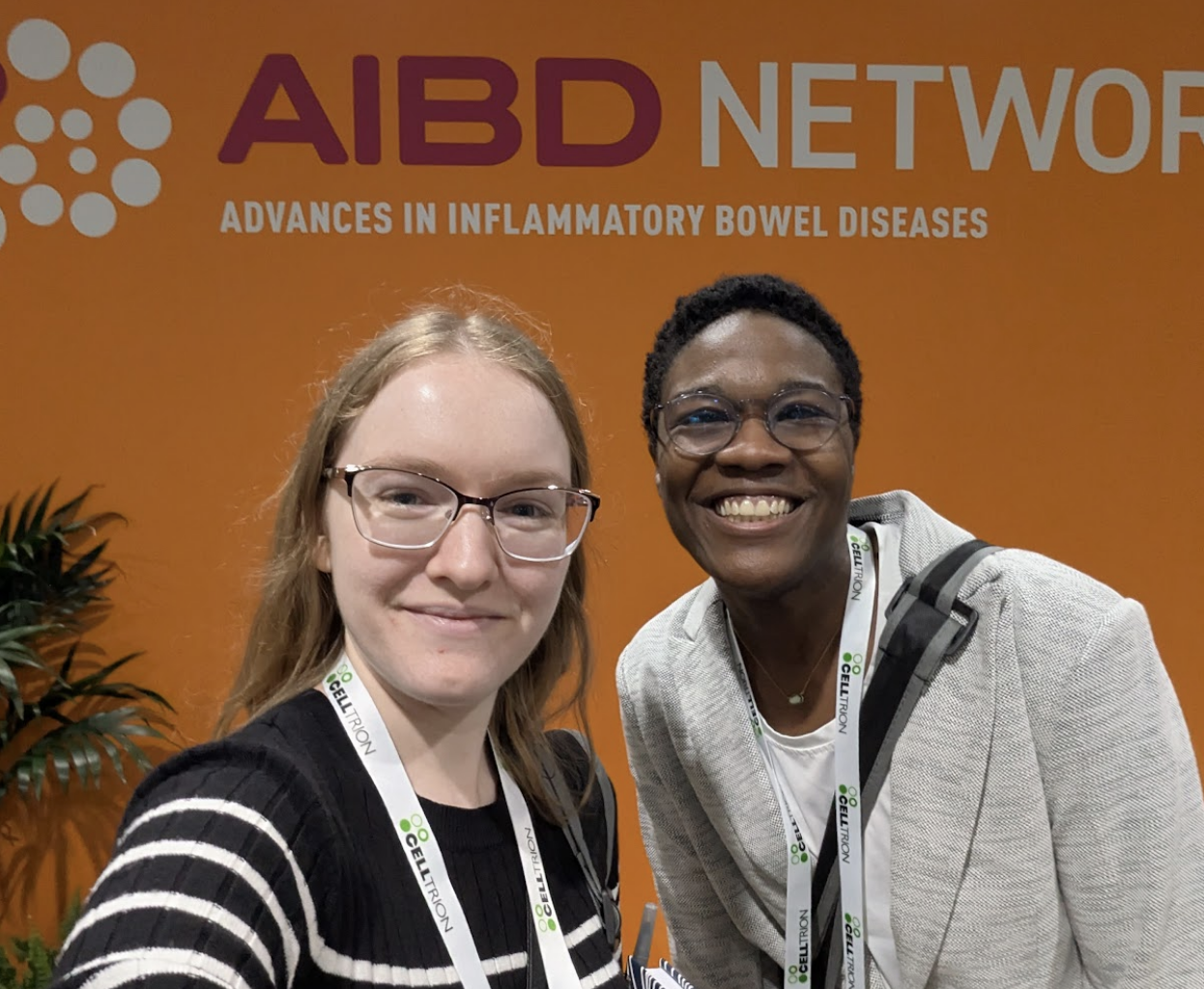
A photo of Kaitlyn & Lexi, smiling in front of an orange backdrop reading “AIBD Network: Advances in Inflammatory Bowel Diseases.”
In early December, I had the privilege of attending the Advances in Inflammatory Bowel Disease (AIBD) conference in Orlando, Florida. While trying to describe my experience, the words that keep coming to mind are “life-affirming.” I couldn't be more grateful to be in a space surrounded by doctors who were passionate about IBD treatment and driven to learn the newest research in the field.
My entire experience with CCYAN has made me rethink my experiences as a patient and what I need from my doctors. The thing I seemed to be missing most was the WHY behind their decisions and treatment recommendations. I know appointments are brief, but knowing the reasoning behind the drugs prescribed or questions asked would have made me trust a few of my previous gastroenterologists a little more. As someone diagnosed with Microscopic Colitis (MC) who was on steroids for years, it was incredibly validating to hear the experts at AIBD acknowledge that steroids are dangerous and should only be a short term solution as a bridge to another treatment. They also recommended steroid use sparingly and tapering whenever possible. It was also interesting to learn about which drugs are first or second line drugs in the treatment of IBD. Sometimes, it can feel like doctors just throw drugs at us waiting for the right one to stick. I liked being able to see that there was a set plan and procedure for treatment options in place.
A refreshing update the conference covered was their take on anxiety and depression. They said that all gastroenterologists should be asking their patients if they're experiencing anxiety or depression. I learned that having one or both of these can affect medication compliance and drug effectiveness. The conference speakers pushed the importance of prehabilitation - preparing the patient pre-op to optimize outcomes. Prehabilitation does more than just help surgical outcomes, according to studies done by Dr. Gil Melmed, it can save hospitals thousands of dollars in the long run. Another important note mentioned early on at AIBD was that vaping and e-cigarette use are a significant risk factor for post-operative recurrence and poorer overall outcomes. Doctors also acknowledged that although IBD patients sometimes say they are doing “well," it may not necessarily mean “well" by normal standards. It can mean a lot of things such as infrequent bouts of symptoms, symptoms that don't interfere much with their daily life, or symptoms that vary or subside after a while. By digging deeper and having open discussions with their patients, doctors can gather more helpful information and set their patients up with the necessary resources.
I also loved seeing the doctors’ personalities come out at the conference. From showing powerpoints reading “weird sh@* happens with stomas” to hearing surgeons argue over their preferred method of stitching up a pouch, it was refreshing to see their passion and silliness. Some speakers’ PowerPoints were more serious with surgical photos and case studies while others used fun slogans and humorous cartoon graphics to get their points across.
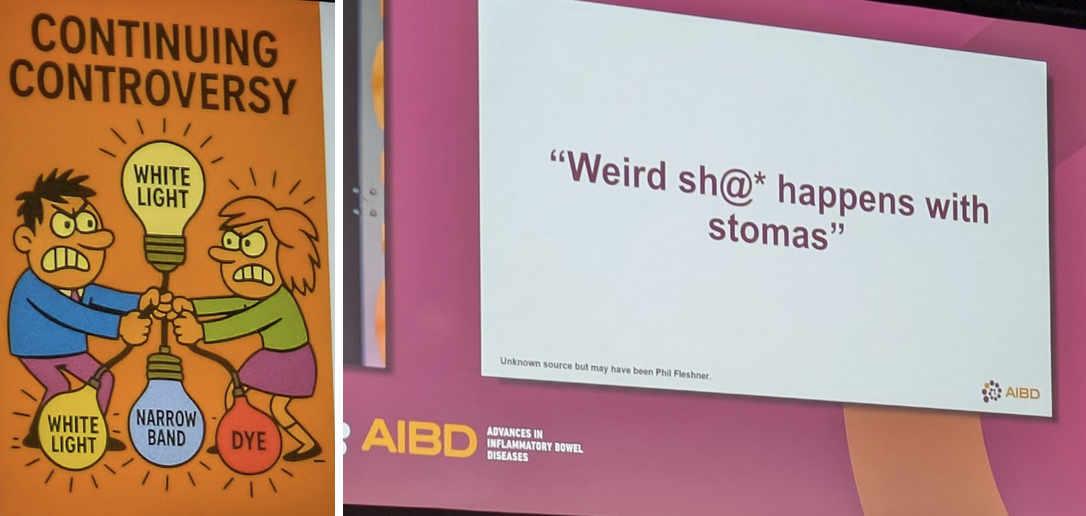
On the left is a silly graphic (debating different techniques for chromoendoscopy), on the right is a photo of a slide that reads “weird sh@* happens with stomas.”
On a personal level, this was my first experience traveling independently across the country. I flew to Florida, navigated the airports, took Ubers, and even took a solo trip to Disney for a day. Despite a few hiccups along the way, (I’M LOOKING AT YOU BROKEN TOILET PIPE), this trip gave me an immense sense of accomplishment and confidence that I can figure things out for myself. I'm hoping to take my newfound independence to new heights in 2026 and go on many more solo adventures. I'm so glad I got the chance to meet Lexi, another CCYAN 2025 fellow, who has such a positive and lighthearted presence. I love how she takes everything in stride and I hope to have her boundless energy one day. I also met CCYAN alumni Mara and Grady (and of course Mara’s service dog Rooster) as well as CCYAN founder Sneha. They were the best group I could have asked for and they were so supportive when I flared during the last day of the trip.
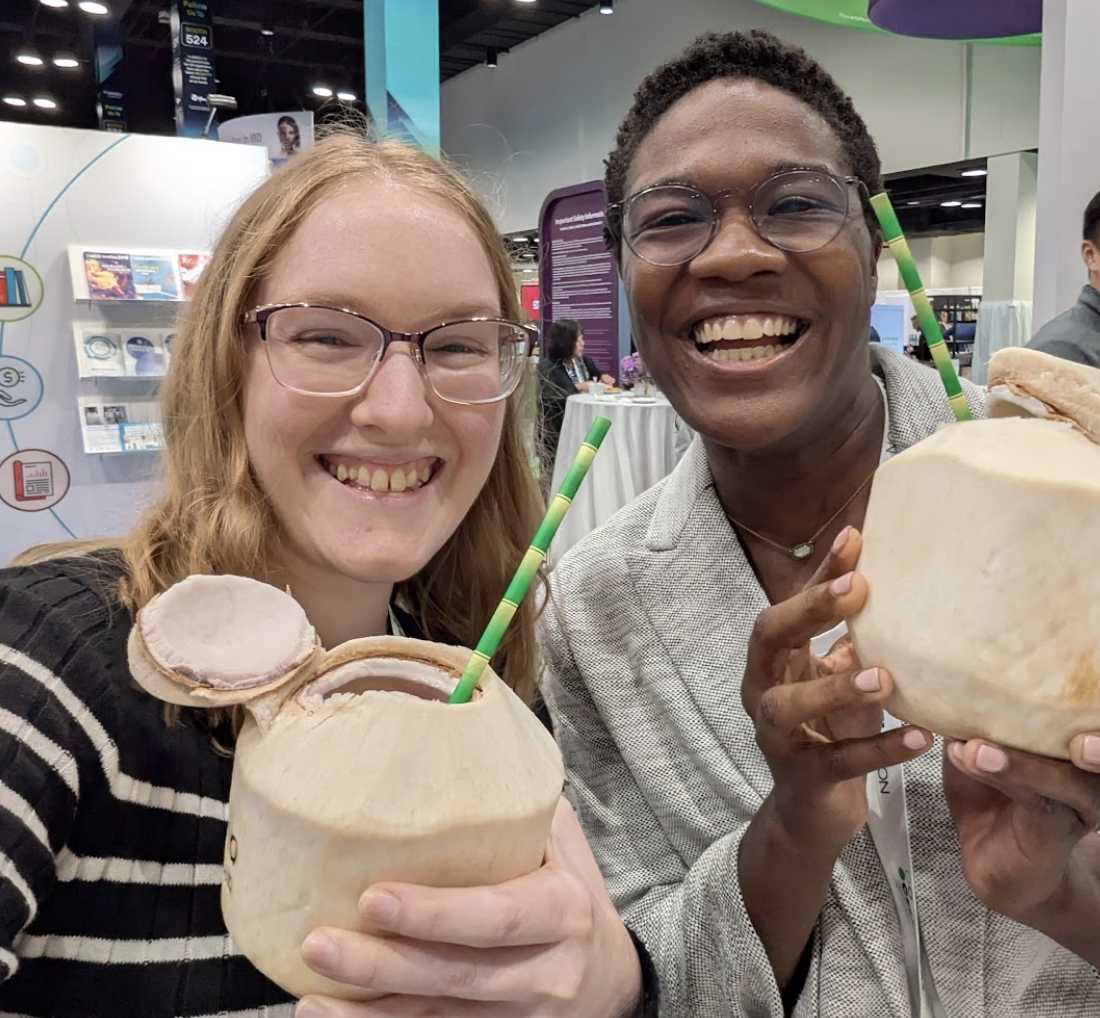
Kaitlyn and Lexi smiling widely at the AIBD exhibition hall. Both are drinking from large coconuts, which have been hollowed out and filled with lemonade.
I can also definitively say that there will be more medical conferences in my future. I’m not exaggerating when I say AIBD was more fun for me than Disneyworld. Getting the chance to attend any and all lectures I wanted was a dream come true! I went to every surgical track lecture, just for the fun of it. I took pages upon pages of notes and came up with a very hefty list of vocabulary words to research for next time. Being at the medical lectures just felt so right. As a teacher, one of my top goals is to develop every child into a lifelong learner - someone who stays inquisitive and follows their passion long after they receive their diploma. I hope I have successfully modeled that for my students and continue to do so. It was amazing to be in a room of a thousand lifelong learners who all want to hone their practice and be better-informed when treating their IBD patients.
Thank you again to CCYAN for this amazing opportunity and for connecting us all into one big IBD family. I'm forever grateful. As they say in Hamilton, “I wanna be in the room where it happens...I've GOT to be in the room where it happens”. Until next time…
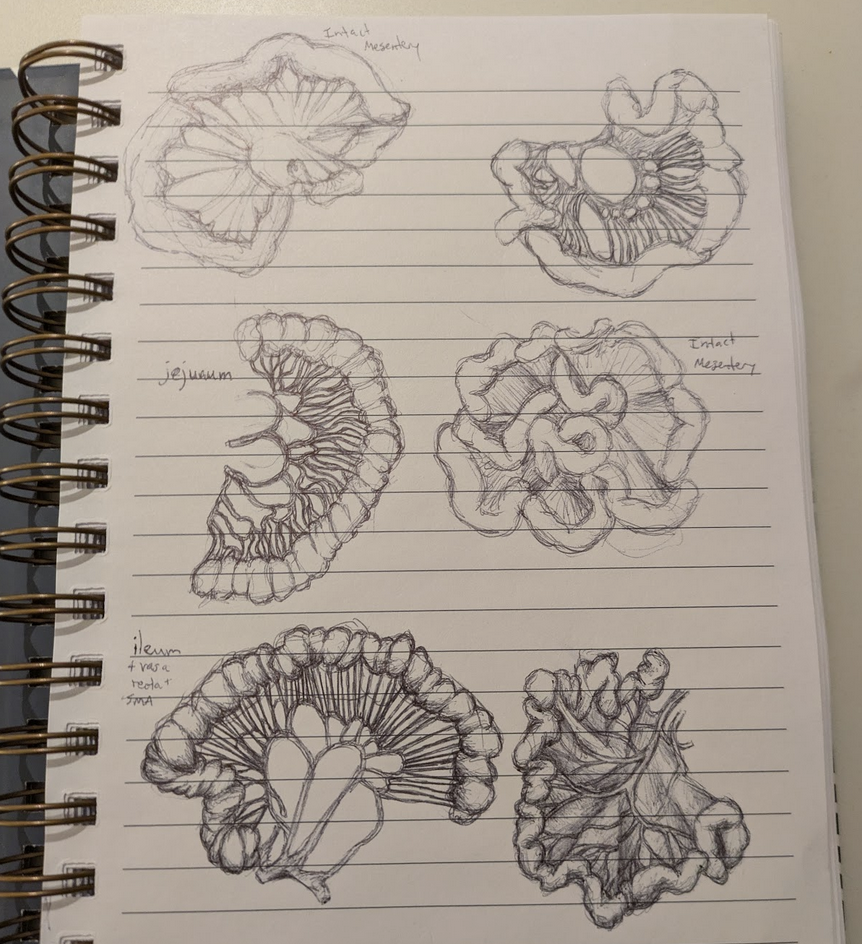
A notebook with some of Kaitlyn’s colon sketches, from her time at AIBD.
Farewell 2025 — A Journey of Self-Discovery, Resilience, and Growth
by Rifa Tusnia Mona (Dhaka, Bangladesh)

A photo of Rifa (a young Bangladeshi woman, wearing a black sweatshirt and blue pants), standing in front of the gate to her university in Lisbon, Portugal. In the background is a large white building with many windows, and a large blue sculpture reading “@technico.”
I can’t believe 2026 is already here! There are so many things that feel surreal to me actually. After having crohn’s, I was bedridden for a long time. While looking at the white plastered roof upside, I knew I was stuck in my life. I didn’t have a terminal illness which meant I wasn’t dying! But, with frequent flare-ups, cramps, weight-loss, and hospitalization reminded me that normal life wasn’t possible either. At some point, I felt blank inside. I remember when someone would ask what I am planning to do with my future, I would say, close your eyes and you will see! They would say it’s pitch black when I close my eyes! Then I would hilariously say, Correct! That’s my future! And that would’ve been true until I decided to finally get up and go all-out. I often say to my mom, ‘Ammu, even if there was an ounce less pain, I wouldn’t have gotten where I am now!’ I felt graceful to god as the pains were coming from all directions and at some point they became the reason for my living.
In the past few months, I boarded a plane six times, traveled to India twice from Bangladesh, and moved to a different continent! To Europe, in Lisbon, far away from the comfort zone of my room, my bed!
I have very small veins, and my body does not absorb oral medications effectively, which made the intravenous treatment particularly challenging. There were days when cannulation was urgently required, yet despite repeated attempts throughout the day, the nurses were unable to locate a suitable vein. By the end of those days, my hands were so exhausted and numb that I could barely feel them anymore.
By this time, the hospital feels like a second home! I got married to Crohn’s and the hospital became my in-laws! Funny, right!
Despite everything, I remain grateful. I am currently at the closing stage of my first semester of my Master’s program in Lisbon, and as part of the mobility track of the Erasmus Mundus Joint Master’s program, I will be moving to the Netherlands in February. The travel plan is almost ready and I am confident that I can do it.
Living with Crohn’s disease has reshaped my sense of fear. When survival itself becomes the central challenge, traditional definitions of success begin to fade. That is what happened to me. Compared to where I once stood, I am no longer simply enduring life; I am moving forward with purpose. That, above all, is what matters to me.
I’ll keep this brief, as I’m currently admitted to H.S.A. Capuchos Hospital, Lisbon, due to a recent flare-up. I’m not sure if my words will inspire, but if even one person feels a little encouraged after reading my story, it will mean the world to me. I am deeply grateful to CCYAN for giving me a platform to share my story, my voice, and my true feelings. I hope the new year brings a fresh start for everyone, filled with love and happiness. Thank you for reading!
Featured photo: A photo of me in front of the university gate taken by my beautiful friend, Hiba Hamada.
The Vasovagal Response and IBD
by Kaitlyn Niznik (New York, U.S.A.)

Fluffy white and pink clouds, in front of a sky that shifts from dark to light blue.
As someone with several medical phobias, I have always been a fainter. Being in a heightened state of fear and stress is a recipe for disaster that usually leads to me being on the ground. It takes skill to faint and take out a row of chairs and your mother at the doctor’s office, but I like to think that I’m improving with time and therapy (see my phobias article for details). However, when I began having digestive issues in college, I started experiencing pre-syncope symptoms frequently during flareups that have lasted to this day. Doctors always told me it was a vasovagal response, so I have been asking nurses and reading up on research in the hopes of finding some answers. Though I have not figured out how to completely stop my symptoms, here is what I have found on the subject and some strategies that may help.
IBD can come with a multitude of strange and hard-to-explain symptoms with some occurring outside of the gastrointestinal system. These extraintestinal manifestations can include feeling faint during a period of intense stomach pain or dizzy during a bowel movement. The vagus nerve and parasympathetic nervous system connect the gut, heart and brain, causing a plethora of vasovagal symptoms when thrown out of balance.
For some background information, syncope is a medical term for fainting while presyncope describes the symptoms one experiences when they almost pass out - including dizziness, nausea, blurry vision, weakness, and chills or sweating. Both syncope and presyncope can be signs of different conditions, but are also strongly attributed to vasovagal syncope. Vasovagal syncope is experienced by around a third of the world and is a common symptom of dehydration, giving blood, standing up too quickly, etc. (Johns Hopkins Medicine, Syncope). According to Verywell Health, a vasovagal response can have physical triggers, such as straining during bowel movements, stomach illness, and pain, or emotional triggers like anxiety, trauma, fear, or stress (Bolen, 2025).
**It’s important that if you experience syncope or pre-syncope symptoms that you get checked out by a doctor. Tests like an Electrocardiogram, echocardiogram, tilt table test, CT, MRI, carotid artery ultrasound, and more can be used to rule out serious heart problems, seizures, or conditions like POTS.** (Johns Hopkins Medicine, Syncope)
According to the paper “The autonomic nervous system and inflammatory bowel disease,” there is strong evidence supporting the connection and interaction between the central nervous system and the intestines. When the body is triggered by high stress or chronic stress, it can have a direct effect on our gut’s inflammatory response. Vagal neurons permeate the gut wall and play an important role in the transfer of information from the gut to the central nervous system and vice versa. This connection is commonly known as the gut-brain axis. These sensitive nerve connections can even affect our perception of IBD-associated pain and disease symptoms can be exacerbated (Taylor & Keely, 2007). Our bodies need to find a balance between the nervous system and gut. Too much or too little activation can trigger responses in multiple areas of the body and have unforeseen consequences.
Some common vasovagal response symptoms are:
Tunnel vision/blurred vision
Dizziness
Weakness
Ringing in the ears
Cold or clammy skin
Feeling hot
Nausea
A temporary drop in blood pressure (Bolen, 2025)
Syncope or fainting
Short term amnesia or confusion upon waking
Brief convulsions of the limbs (Wang et al., 2024)
What can you do during a vasovagal episode?
Sit or lie down (injury prevention)
Put your head between your knees
Avoid straining
Stay hydrated
On top of those tips, this is how I deal with repeat vasovagal episodes:
Firstly, I document everything so I can give my doctor a better idea of what I experience and how frequently. A smart watch is also useful so I can keep track of my bpm. There are a few trusted friends and family members that know of my condition and the warning signs. Of course, it’s helpful if you know your own body’s warning signs - it can help you predict it before it happens.
I also keep my phone on me at all times in case I need to call for help. After a vasovagal episode, I give myself time to feel better - usually curling up on the couch with a blanket and some water. I always use electrolytes to help my body recover faster and I keep heating pads with me since I can feel cold or shaky afterwards.
Possible forms of treatment that I’ve learned about:
Medication
Physical counterpressure maneuvers (Wang et al., 2024)
Pelvic Floor Therapy
Vagus Nerve Stimulation
Psychotherapy
I found it interesting that one medical professional recommended looking into psychotherapy to address the psychosocial component of vasovagal responses. Having fainting episodes or those revolving around intense pain can be terrifying and that fear can stick around long after the incident ends. Traumatic memories of pain around bowel movements can cause increased anxiety and escalate vasovagal responses. Confronting your anxiety and the reasons behind your fight/flight/freeze can help mitigate symptoms. By always having a plan and knowing the signs, I can better prepare myself to deal with vasovagal responses.
Works Cited:
Bolen, B. (2025, October 30). Common causes and triggers of the vagal response. Verywell Health. https://www.verywellhealth.com/vasovagal-reflex-1945072
Syncope (fainting) | Johns Hopkins Medicine. Johns Hopkins Medicine. (n.d.). https://www.hopkinsmedicine.org/health/conditions-and-diseases/syncope-fainting
Taylor, C. T., & Keely, S. J. (2007). The autonomic nervous system and inflammatory bowel disease. Autonomic Neuroscience, 133(1), 104–114.https://doi.org/10.1016/j.autneu.2006.11.005
Vagus nerve: What it is, function, Location & Conditions. Cleveland Clinic. (2022, November 1). https://my.clevelandclinic.org/health/body/22279-vagus-nerve
Wang, J., Li, H., Huang, X., Hu, H., Lian, B., Zhang, D., Wu, J., & Cao, L. (2024, April 10). Adult vasovagal syncope with abdominal pain diagnosed by head-up tilt combined with transcranial Doppler: A preliminary study. BMC neurology. https://pmc.ncbi.nlm.nih.gov/articles/PMC11005138/#:~:text=The%20value%20of%20HUT%20combined,the%20adoption%20of%20safety%20measures
Featured image from Henrik Dønnestad on Unsplash.