
College Life

Life with Crohn’s: A Visible Person with an Invisible Disability

by Rifa Tusnia Mona (Dhaka, Bangladesh)

Image of a vast, white sky and ground covered in small brown pebbles. A person with a backpack stands far away, staring off in the distance.

It’s already been a month since I moved to Lisbon. As an Asian girl setting foot in Europe for the first time, almost everything feels new — the culture, the streets, even the rhythm of everyday life. My university is about an hour away from my dormitory, and each morning I take the Carris — the public bus. It’s often crowded, especially during rush hour. On days when I’m carrying groceries, standing becomes a real struggle.

At the front of the Carris, there are four seats reserved for the elderly, pregnant women, parents with children, and people with disabilities. Every time I see those signs, I ask myself quietly: 

Where do I fit in?

Am I “normal”?

Am I someone with a disability?

For a blind person or someone in a wheelchair, the condition is visible — their challenges are seen and, therefore, more understood. But for someone like me, living with Crohn’s disease, the weakness is invisible. Even carrying my laptop sometimes feels like lifting a boulder. On bad days, groceries are out of the question.

A few times, I’ve taken one of those reserved seats just to rest for a moment — and on more than one occasion, an older passenger scolded me in Portuguese. I didn’t have the words, or the energy, to explain.

To make things easier, I sometimes order my groceries online. But when the delivery person arrives and I ask them to carry the bags up the stairs, I often get that same puzzled, slightly judgmental look — as if I’m just being lazy.

The truth is, many people still don’t know what Crohn’s disease is. And when you’re in a new country with a language barrier, explaining your condition to every stranger sometimes isn’t possible.

One day, I was sharing this with a senior from my university. She listened and then said something that stuck with me:

“From the outside, you just look a bit tired and thin. A lot of people are like that. How would anyone know what you’re going through?”

And she was right. There’s no visible “signature” for people with invisible illnesses like IBD. No sign that quietly says, I’m struggling, even if you can’t see it.

That “signature” matters — not just for access to certain rights or support, but also for empathy. When people can recognize what you’re dealing with, even without words, life becomes just a little more humane.

I’ve been thinking: instead of only pushing for general awareness, maybe it’s time for a more practical step — some kind of universal identifier for invisible disabilities. It could be a color band, a card, a small badge — something that lets others know that, while we may look fine, we’re fighting battles they can’t see.

Because when life is already heavy with these hidden challenges, constantly having to explain yourself shouldn’t be another weight to carry.

Thank you for reading. See you next month.

Featured photo by Kyle Miller from Pexels.

My Crohn’s Journey as a College Student

by Alexis Gomez (California, U.S.A.)

Two side-by-side photos of Alexis, a young woman with medium-brown skin and dark brown hair. There is a graphic of a curvy yellow arrow, pointing from the first photo to the second. The photo on the left is from Alexis’ freshman year of college, after just being diagnosed with IBD. Alexis is standing in front of a wall of ivy, wearing comfortable clothes. She is smiling, but looks pale and tired, with a bit of prednisone “moon face.” The photo on the right is from Alexis’ college graduation. She stands in front of a walkway with many arches, wearing a blue graduation cap and gown, with a yellow stole, and is smiling widely.

When I was younger, I had a vision of what my college experience would look like. It was more or less in line with what I saw in movies and TV shows – living away from home, making lots of friends, joining tons of clubs, going to clubs, perhaps finding the love of my life, maintaining my straight-A academic excellence, and knowing without a doubt that my future was secure.

I had always been a planner, always thinking ten steps ahead of where I was in the present. For as long as I could remember, I prided myself on being independent, meticulous, and motivated to succeed. I thought I had it all figured out, and that all I had to do was check off the boxes of my to-do list toward success. It was so simple, so straightforward… until it wasn’t.

What I never could have predicted or hyper-planned for was being diagnosed with a chronic illness at the age of eighteen. Shortly before starting my first year as an undergraduate student, I began experiencing symptoms of IBD. And throughout the course of my first quarter at school, my symptoms worsened. I had constant abdominal pain, urgent and frequent bowel movements with blood up to ten times a day, and a deep sense of shame that stopped me from telling anyone. Whenever I was with my friends and I had to use the bathroom, I’d laugh it off and say I just had “tummy problems.” The thought of telling anyone what I was actually experiencing felt terrifying because I didn’t have a clear answer for what was happening. I felt like it was my fault that I was experiencing these gastrointestinal issues; like I had somehow inflicted this on myself, and that just maybe it would go away if I ate healthier and prayed more.

As someone with a family history of IBD, there came a point where I knew deep down what was happening. I had been in denial for several months, thinking that there was no way I would have to live with a chronic illness forever. It couldn’t happen to me, I thought. Why me? This wasn’t what was in my perfectly thought-out and extensive plans for an amazing future. With every acute misdiagnosis from my doctors, I simultaneously felt frustrated but also held onto hope that I’d just suddenly start to get better.

During finals week of my first quarter of undergrad, I couldn’t hide or ignore my symptoms anymore. The burning pain in my abdomen reached a new level of severity, and I was overcome with weakness and fatigue. I could barely eat anything, and I couldn’t stand up without getting heart palpitations and being out of breath.

My mom helped me schedule an appointment for a colonoscopy to finally see what was going on and to confirm what I had been suspecting. The weeks I had to spend waiting leading up to the colonoscopy were tough. I rapidly lost weight (over 40 pounds within 2-3 weeks), I could barely get food or liquids down without vomiting, I would spend hours on the toilet trying to get some sort of relief from my abdominal pain (often with no success), my mouth was perpetually as dry as the Sahara, my eyes looked bloodshot and inflamed, and I couldn’t walk anymore. As I waited, I felt my autonomy and my identity slipping away from me. How could I be the daughter whom my parents knew was responsible, and who they didn’t have to worry about? How could I be the older sister to my younger brother, who always looked up to me, the older sister who could always provide a listening ear, comfort, and advice? I didn’t know who I was when I couldn’t even serve myself food, put my plate in the sink, walk myself to the bathroom, bathe myself, or brush my own hair. I didn’t know who I was without my independence. And I felt an overwhelming wave of guilt for putting my loved ones in a position where they had to do everything for me and see me suffering every single day.

I remember being in the recovery room after my colonoscopy and hearing my doctor say something that would change my life forever. In an oddly cheery tone, he said: “Well, Alexis, it looks like you have Crohn’s Disease!” I remember being 1) shocked initially, 2) put off by his cheerfulness, but also 3) relieved. Hearing that I had Crohn’s was scary, but I also knew I finally had an answer. I didn’t have to hide behind the curtain of the unknown or the inability to explain why I had the symptoms I did. I knew Crohn’s was an autoimmune disease, meaning that my body had one day mistakenly begun to attack its own healthy cells. It wasn’t just something I ate, it wasn’t going to just go away on its own, and it wasn’t my fault that it happened.

Although I was fortunate to respond well to the first biologic treatment I tried, my Crohn’s diagnosis came with other complications. The several weeks spent with untreated chronic inflammation and prolonged immobility led me to develop blood clots (deep vein thrombosis, aka DVTs) that also traveled to my lungs (pulmonary embolisms, aka PEs). I remember being hospitalized during my second quarter of undergrad, in the middle of midterms, and frantically emailing my professors for extensions as I was in the ICU.

About a month after my hospitalization, my hair began falling out in chunks. It felt like I had reached a new low, and I couldn’t recognize myself anymore when I looked in the mirror. Even though my Crohn’s was responding well to my treatment, the other comorbidities that came with it, though temporary, were just as difficult and scary to navigate. Throughout this period of time, I had somehow managed to continue being a student, attending lectures and discussion sections through Zoom during a COVID spike in California when students were given the option to attend classes either online or in person. However, as spring quarter rolled around, and students at my university were required to be back in person, I knew I wasn’t well enough to return to campus. I had to withdraw from the university for the quarter – a decision that wasn’t easy. Still being a student had felt like the last bit of normalcy in my life. Now, all I could focus on, all I had to focus on, was my health.

Throughout the spring and summer, things gradually got better. I had fully weaned off prednisone and was in remission with my biologic. I was able to eat again and my bowel habits were great. My blood clots were being monitored as I was on anticoagulant medication. I was going to physical therapy to relearn how to walk, and with every week, my gait looked and felt better. My steroid ‘moonface’ had subsided and finally, my hair started to grow back.

By the time fall came around, my health seemed to have made a miraculous comeback. All my labs were fantastic and my doctors told me that I was doing everything right. My friends and family would tell me how they had been thinking of me, praying for me, and how they were so happy to see me better. It made me feel proud of myself and my resilience. I felt grateful to be alive.

I started to prepare to go back to school after having been out for six months, which felt like a long time to me as someone who had always prioritized school and getting good grades since I was a child. I wanted to leave the dark period of my life I had just gone through behind – a period where I had felt so isolated, helpless, angry, depressed, and like I didn’t want to be here anymore. I wanted to move forward, to be normal again, to show everybody around me that I could overcome it all.

I started my second year of undergrad by enrolling in more classes than I had before and starting a new job. I went full-force back into the real world, feeling like I needed to make up for lost time. I didn’t want to keep feeling behind compared to my peers. Without realizing it, however, I was putting pressure on myself to be some sort of inspiration. I wanted to prove to myself that I could live the life I had envisioned, regardless of Crohn’s. For the first few weeks back at school, I was energized. Then, the workload I had set for myself became difficult to manage. I found myself coming back to the room I was renting with fatigue that I couldn’t just sleep off. Sometimes, my brain felt so foggy that I struggled to concentrate on my homework. I noticed I felt especially tired the day after my injection every two weeks. There were days when I would lie in bed and ruminate about everything I had gone through. Even though I was back in school, I had a job, and I could spend time with friends again, life still didn’t feel normal. I had a hard time completing tasks, staying motivated, and as the school year went on, my grades started to slip. I felt embarrassed that I was still having a hard time getting back on track. I still felt like there was a dark cloud looming over me most days, despite the fact that on paper, my physical conditions were under control. I hadn’t expected that even after the worst of it had passed, the trauma would still be there, and I would still grieve my old self before Crohn’s. While my doctors had equipped me with the treatments needed to manage my physical ailments, what l wasn’t prepared for was the effect being chronically ill would have on my mental health and well-being.

It took therapy, trial and error, attending peer support meetings, and time for me to get to a point where I recognized that it was necessary for me to scale back on how many units I was taking each quarter, and that it was okay to let others know I was struggling mentally and ask for help. The latter is still something I find challenging at times, but I’ve made progress and continue to work on it!

I’m not immune to bad days or weeks, but overall, I’ve managed to reach a point where I don’t always feel that shadow of sadness I did for a long time. Although the past few years may not have looked like what I expected growing up, I still managed to finish my degree in two different majors, not just within four years, but a quarter early! My first- or second-year student self would be shocked and perhaps not even believe it. My graduation ceremony was just a few weeks ago, and it prompted me to reflect on my journey of being diagnosed with Crohn’s as a young adult in college. 

My undergraduate years were full of life-changing experiences with lots of challenges. But I’m lucky that those years still gave me good memories to look back on and friendships that I anticipate will last for many years to come.

Over the past few years, I’ve grown more comfortable sharing my diagnosis and experiences with others. Having Crohn’s has made me more appreciative of the good times in life because I know good health and tomorrow are not always guaranteed. I’m also lucky to have found a community of people who understand the roller coaster that is living with IBD/a chronic illness. I hope that any other person going through something similar who may be reading this knows that they are not alone.

My progress hasn’t always been linear, but ultimately, I find myself at a place where I accept what life has thrown at me and where I recognize that I can and will be able to navigate life’s future hurdles. I surrender to the fact that I won’t always be able to control what comes next, but I know that difficult times will pass because they have before. I might not always have the answer to what the future has in store for me, but I know I’m proud of how far I’ve come and where I am today.

Potential IBD Accommodations for Teachers and Students (from a NYS Teacher)

by Kaitlyn Niznik (New York, U.S.A.)

This infographic was created from discussions with other teachers in the United States living with IBD.  Through those conversations, I realized that the workforce can be a scary and precarious place for people living with chronic illness.  As a unionized, tenured teacher in a public school, I acknowledge I am in a privileged position to disclose my IBD.  However, a teacher or student can choose not to divulge their chronic condition for a number of reasons including job instability or the fear of being singled out.  I made half of my graphic focus on discreet ways to manage your IBD within the education system without revealing personal health information.  This half includes having an emergency supply pack, trusted contacts that you can call for assistance, and knowing the location of private bathrooms instead of public stalls. 

The other half of my picture illustrates ways a student with an IBD can pursue written accommodations to protect them at school.  These include obtaining an Individualized Education Program (IEP) or 504 Plan after their doctor writes a note confirming their diagnosis and its impact on the student's daily life.  In the student's records, they would be classified under the "Other Health Impairment" category and this form would be reviewed and adapted annually.  Parents, teachers, and district personnel would work together to create an IEP or 504 plan that supports the student's needs, helps them manage their illness, and works to reduce the student’s stress in an educational environment.  Teachers with an IBD can also present a doctor’s note to their district to receive reasonable workplace accommodations. 

5 Things I've Learned Living On My Own

By Laurel Dorr from Maine, USA

I have been away at college for the last couple of months, and although I am living semi-independently in a dorm, it’s the first time I have lived away from my parents.

Below, I talk about 5 reflections and lessons that have come up as I learn to live with inflammatory bowel disease (IBD) in a new environment.

1. What you need is not “too much.”

Fortunately, my college has provided several crucial housing accommodations for me. Yet I have found myself avoiding eye contact when people asked me about my roommate (I have a single room), or hesitating to mention the attached bathroom when someone asks about my room. I kept unconsciously feeling like these were awkward details, or even like I was “bragging” about my living situation.

But these accommodations, along with several others, have made my life so much more manageable. And if anyone has a problem with it, they have never said so to me. Don’t let fear or shame keep you from asking for what you need. I can’t imagine what my life would look like without these supports.

2.  It’s okay to be alone. 

I have often felt out of place here, for a number of reasons; not least because I am a transfer student, and slightly older than a typical undergraduate. There are also health concerns to consider: for instance, I can’t safely do things many of my peers do, like drink alcohol, go to crowded parties, or even stay out late. (No judgment against those who can!)

For one reason or another, I haven’t forged many deep connections or friendships yet, and frequently find myself studying or eating at the dining hall alone. But, I don’t see it as time wasted.

Instead, I have used this time to get used to being alone, and focusing on self-care. My body is experiencing just as much upheaval in this new environment as my social life is, and taking the time to acclimate and get comfortable with it has been beneficial to my health. I will find the right people eventually—but for now, my attention is where it needs to be.

3. However… part of self care is doing what’s best for you.

Even when it’s uncomfortable. When I talk about being alone, I don’t mean to say that I haven’t tried new things or put myself out there. I know that it is easy for me to self-isolate. Sometimes, it was even necessary, when I was sicker than I am now. But that isn’t always best for me. So while I cherish my alone time, I also try to step out of my social comfort zone.

For example, I usually set aside time for at least 1-2 campus activities (clubs, events) per week. In general, I also avoid eating or studying in my dorm room as much as possible—even if that just means reading in my floor’s common/lounge room, some days. Baby steps!

4. Doing the hard things is just as important as resting. 

I know I need time to rest and recharge, but it has taken me awhile to get on a good schedule and routine. College classes are hard enough, but living semi-independently makes it even more challenging. For instance, taking time each week to do things like laundry and cleaning, walking some distance to dining halls and classes across campus, attending office hours and extracurriculars—all of it builds up, and usually takes more time than I anticipate.

What has helped me is cliché, but true: setting up a schedule, and sticking to it. If I put off a difficult homework assignment until the last minute, it ends up taking away from my relaxing time in the evening, which makes the next day that much more exhausting, and I start putting off even more work. It’s a difficult cycle to break, but the way I feel and function when I manage my time well makes it worthwhile.

5. Make your space somewhere you want to spend time. 

I have also found it helpful to make my space feel refreshing and comfortable. Although I try not to spend too much time in my room, that’s not always possible. Some days, my IBD symptoms make it harder to leave.

Rather than let my environment add to that stress, though, I make sure to keep my curtains open and my space tidy; I have decorated with nature-inspired themes, like potted plants, artificial vines, and floral bedding; and I made sure to fill the room with cozy items, like a soft area rug and plenty of pillows.

These are just a few examples of how I manage my IBD within college life and living (more or less) on my own. However, it is an ongoing learning process for me. What have you learned about living on your own with IBD?

Featured photo by Ja Kubislav from Pexels.

Obtaining Higher Levels of Degrees as an IBD Patient

By Isabela Hernandez (Florida, U.S.A.)

Many people go on to get their master’s, go to law school, medical school, or any form of higher degree past an undergraduate education. I am currently in the midst of applying to medical school. Recently, I have been filled with an anxiety about the future of when I do start this career path. This anxiety is not centered around whether I am capable of handling the pressures of medical school, but rather, if my ulcerative colitis is.

My goal is to go to medical school; it always has been. I know that I can handle it and have the potential to succeed. But, what scares me, is if my body can handle the lifestyle of a medical student. I have often heard from current medical students that it is a constant study, class, study, exam, and repeat lifestyle, leaving little time for self-care. It is so difficult when mentally you know you can do something, but you never know what you can expect from your IBD. It is so frustrating sometimes when you're in this battle of uncertainty with your disease, truly feeling like the future is uncontrollable. I am writing this not to give any sort of advice, only to express how I feel about a path I have chosen for myself and if anyone else can relate to my concerns.

Since it is completely different from undergrad, I am not completely sure if the tactics I acquired there will even apply in medical school. I know that I will need to find ways to mitigate my stress and my disease at school, in order to achieve balance and reduce flares. But this is always easier said than done. I am still a while away from actually getting into school and starting, but I want to address this fear by recognizing that “you don’t know until you know.” This is a phrase my sister always says to me when I start overthinking about the future and scenarios that might negatively affect my progress. One never knows how things are going to turn out until they actually happen, and for the most part, the anxiety leading up to an event is always worse than the actual moment that it happens. I hope by writing this, I encourage not only myself, but others to pursue any career choice they know deep down they would succeed in. Don’t let your IBD scare you away from a bright future, like mine has been trying to. Rather, focus on the facts that you know now, address them, and work your way into the future. The future is always unknown, so we might as well try for the best future we can.

This article is sponsored by Trellus

Trellus envisions a world where every person with a chronic condition has hope and thrives. Their mission is to elevate the quality and delivery of expert-driven personalized care for people with chronic conditions by fostering resilience, cultivating learning, and connecting all partners in care.

Learn more about Trellus here


My Journey as an International Student

By Maalvika Bhuvansunder

Living on your own in a new and beautiful country sounds like one of the best things that could happen. For individuals with a lifelong debilitating illness like IBD, it can be extremely scary to live alone. The independence could come at a cost as there is a lot that could go wrong, but there is also so much that can go right!

My journey began with a lot of uncertainty, all these questions: Should I even be doing this? Would I survive without my parents there? What do I do if I have a flare? How would I manage cooking when in flare, and so many more. I had never even slept over at a friend's place since the diagnosis, as my home was my haven, let alone move to a completely different country! This was when my parents stepped in and explained to me, this was my dream to go to the UK and to pursue it no matter what. To make things easier, my dad travelled with me to the UK and helped me settle in. 

One of my biggest fears going in was, how would I make friends with this condition, would I even have the energy to make new friends? I decided to keep my fears aside and to be candid about my condition. It was not worth it for me to make friends who would not understand my situation, and I’d rather not have such friends. Being candid truly paid off in the best way possible! The friends I made there were understanding of my condition and acknowledged that with this condition, there are certain limits. They always found a Crohn's friendly alternative for us to do and never made me feel inferior. I remember having one of the worst flares I had experienced there and being worried about how was I going to tackle this. Let me tell you all that it was the moment after the flare that gave me the confidence that I GOT THIS! I survived a flare alone for the first time, and although it seems weird that something like this made me so happy, that’s what I was: happy. My friends who were in the UK constantly checked up on me and so did my new ones. It gave a sense of relief that although, to a large extent, I have to deal with this alone, I had people who I could turn to at such times.

Just when I thought I got this and I can handle everything, the biggest crisis we all faced hit, the PANDEMIC. I had plans to go back home, but the flights were suspended. I was in shortage of medicines and every supermarket was in shortage of food. I genuinely did not know how I was going to survive this. Calling home and crying about it my mom gave me the best advice, either I can cry at this situation or see how to manage the crisis. I contacted all the nearest clinics and found to my relief that the one closest to me was open. The first thing I did was meet the doctor and stock up on the meds. As for the food, well, Mom to the rescue. Within a day, she couriered all necessary items and made sure I had enough stock to last me for months. Another thing that helped me get through this was my friend. She was studying in another city in the UK, and we decided the best thing to do was to be together during this time. Together, we made sure to make the best of the situation and be each other's support at that time. She was a lifesaver! I do not think I could have survived the pandemic on my own.

IBD had taken a lot away from me, but I am glad I took this step despite all the fear and apprehension. Living in a new country turned out to be the best decision of my life. I got to pursue what I had always wanted to and learned a lot about myself. This experience was needed for me to have the confidence that I can manage things on my own.

There are a few simple steps one can take to make sure our journey in a new country goes smoothly. In collaboration with one of the fellows, we are coming up with a handbook containing useful information for anyone deciding to move to a different place for their studies. Hopefully, you all have the same amazing experience I did!

IBD in College – Put it on your Resume!

By Isabela Hernandez (Florida, U.S.A.)

“It was a burden that I hated and equated as the worst part of myself. From the ages of 3 to 19, I treated it as this deep dark secret that I told no one about.”

I used to think that confident people were born confident, brave people born brave, and happy people born happy. An immature thought, but I believed characteristics like these were just naturally inherent. I convinced myself that I was just born to be sick with my IBD. It was a burden that I hated and equated as the worst part of myself. From the ages of 3 to 19, I treated it as this deep dark secret that I told no one about. For some reason, it was virtually impossible for me to tell friends about my UC and how it affected me. I kept everything to myself and never shared when I was feeling physically sick, or even worse, mentally drained. Luckily, I have a great family, an unrelenting support system that even when I didn’t want them to be, they were there for me. However, when someone with IBD goes to college, either newly diagnosed or a long-time patient, their assumptive world shatters. You’ve moved miles away from home with the most annoying friend you could ever think of, your IBD. At least that’s what I thought when I got to school. How am I going to deal with it? Am I going to tell people? Will they think I’m weird? What do I eat? What if I must go to the bathroom in class?

The questions were looming over me the minute I got to school. My fear overwhelmed me; it convinced me to believe that I would never find a way to integrate my UC into my new college life. I was fighting this mental battle against myself, and simultaneously seeking to get involved in any sort of organization at my school to feel more comfortable there. My university happens to be heavily research focused, and I was interested in the healthcare field. I decided to push myself out of my comfort zone and join a lab that focused on the one thing I knew the most about, IBD. It was there, in that moment that I felt empowered by my disease for the first time. I chose to openly use my IBD as a qualification, as an asset rather than a detriment. As time went on, I started to get more involved in other organizations that focused on IBD, such as this fellowship, that views one’s IBD as a contributing factor rather than a limiting one. I took a part of myself that I once hated and allowed it to become a distinctly unique piece of me. The transformative growth I underwent from concealing my IBD to using it to make me stand out was an unparalleled feeling.

“I am continuously seeking out ways in which I can intertwine IBD with my life, my work, and my interests.”

My biggest recommendation for anyone in college with IBD is to put IBD on your resume! Not literally, but in your own rhetorical way. Have it be your secret superpower that allows and pushes you to get involved in opportunities that reside in a world you so deeply understand. Work with nonprofits for IBD, get involved in research, or join a support group. Apply for scholarships for students with IBD. If you don’t happen to find any opportunities for students with IBD, start some! Start a support group or start a club exclusively for college students living with IBD. Find absolutely anything that connects you to your disease, because the minute you do this, you start to not only view your disease, but your potential, in a different light. If we as IBD patients are going to live with this forever, we might as well use it in a way that gives us the upper hand. Live a life with activities that are filled with opportunities that let you be proud to be someone with a chronic condition. Four years ago, I would have never been able to muster up the confidence to talk about my disease in the way I do. Today, the version of me that exists cannot stop talking about it. I am continuously seeking out ways in which I can intertwine IBD with my life, my work, and my interests. Every day, reaffirming that my IBD is the part of myself I am most proud of. Don’t let IBD hold you back from finding opportunities that make you feel fulfilled in a way you might’ve never known existed; use it to your advantage. It is a piece, that once embraced, can be advantageously employed in a surprisingly positive way.

Law School and IBD

By Savannah Snyder (Canada)

Undergrad is already a daunting and tiring experience - intense classes, homework, exams, socializing, self-care. It is insanely difficult to balance it all. Throw a chronic illness such as IBD into the mix, and it becomes even harder. As many of you know, IBD can take over your life and can make working towards your goals a challenge.

My undergrad experience was full of ups and downs, from being severely ill dealing with stomach aches, joint pains, fatigues, hospitalizations, doctors appointments and more. But, I’m here to remind you and what I wish I heard someone with IBD tell me, is that you can accomplish your dreams, even with IBD.

Ever since high school I wanted to be a lawyer. I dreamed of going to a top law school. I was intimidated by the process and knew it was extremely competitive. When I was diagnosed with IBD in my fourth year of university, I thought that goal might be out of reach for me. I had to withdraw from a semester of school and move back home. I thought “how would someone like me, with holes in their transcript and withdrawn classes, be accepted to law school? How will I be able to handle a rigorous program and career while simultaneously dealing with IBD?”

Looking back, I realized I was dealing with IBD my entire undergrad experience. Instead of gaining the freshman fifteen in my freshman year, I lost fifteen pounds. I knew something was wrong each day but continued to ignore my symptoms, until I was forced to face reality and was hospitalized with a severe Crohn’s Disease diagnosis. I was scared that if something was wrong with me, I wouldn’t be able to work towards my dreams. If I was ignorant regarding what I was feeling, it wouldn’t be true.

When I withdrew from school and returned to my family home, I put my body first. I slowly came to realize that I might as well try to reach my goals of becoming a law student. I began to study for the Law School Admissions Test (“LSAT”), and spent time studying in my bed when my energy levels allowed. I started my first biologic, Humira, was hopeful it would work in time, and I booked my first LSAT 2 months away. I contacted the LSAT admissions team and received accommodated “stop the clock” washroom and pain breaks for my test. As the test date crept up, it became obvious that Humira was not working. I had to increase my prednisone dosage. I was nervous, scared, and began to lose hope. I was upset that Humira wasn’t working for me and was scared about writing a test under these conditions. The increase in prednisone brought nausea, brain fog, mood swings, irritability, fatigue, and more. When my doctor told me I had to switch off of Humira, it was too late to cancel my test. So, I decided to write it anyway. I ended up receiving my first Stelara infusion the day before the test. I told myself, this test will be a practice - and that whatever happens… happens.

I am not telling you to support the hustle culture and ignore your body. I gave myself grace around my results. I told myself if I felt negative symptoms in any way while writing, I would stop and go home. But, I was able to do it.

I wrote the LSAT and did OK and then ended up writing it again the next fall. Stelara ended up being the medication that I’ve been on ever since. I applied to law school as an access student - highlighting the experiences I’ve been through and how dealing with an illness like IBD will make me a better law student and lawyer.

I returned for my last year of school and was able to receive accommodations for exams and classes. I took a smaller class load to balance self-care and healing myself along with my goal of graduating. I’m proud to say I was accepted to my dream law school and have just completed my first semester. Although I have dealt with flares and sickness this past semester, I have reached out to accommodation services and received support. I have advocated for myself and been able to reach the dreams I had before my Crohn’s diagnosis.

I promise you, if there is something you want to do, it is possible. A life with IBD is full of spontaneity - you may never know what’s next. But, all you can do is try. Put your health first, always, but never give up on your dreams.

Photo by Polina Zimmerman from Pexels.

Major Life Transitions: IBD and Starting Graduate School

As a young adult who lives with IBD, feeling safe and secure is almost as necessary as breathing air. Navigating the endlessly winding path of chronic illness has caused me to be more aware of my environment and how it affects me. Through this, I have come to find solace in my environment. After getting accustomed to this sense of safety, I finally found comfort. But, what happens when that sense of comfort and stability is challenged?

Recently, I just moved 500 miles away from home to attend grad school. This was probably one of the most impactful decisions I’ve ever had the privilege of making. While the process of moving for grad school is difficult for everyone, I want to emphasize the added barriers that chronically ill people face. After I received my acceptance letter from the University of Pittsburgh, I was overcome with joy. Finally seeing the fruits of my hard work, determination, and labor was extremely validating. Shortly after this period of elation, I immediately became overwhelmed with intrusive thoughts such as “Well, can I really move away from home with ulcerative colitis?”, “What happens if I flare again?”, “I don’t want to leave my doctor.” I tried to give myself space to feel my emotions, but it was still difficult. Ultimately, the decision to move was clouded by, what I like to call, health hesitation.

Not only did I have to deal with the social pressure of applying to grad school, I also had to cope with the idea of being away from my established support system. I’ve worked so hard to build meaningful relationships with my medical team, so how on earth would I manage to completely restart? Something that I found beneficial was being open and communicative with my doctors throughout the entirety of the grad school process. My GI doctor knew the second I was accepted, she knew when I took my first flight to visit campus, and she knew about every important date leading up to my departure. Being transparent allowed her to assist me with navigating insurance, finding new doctors, and recommendations. This significantly helped with my transition and it helped relieve some of my health related anxiety. For myself, stress and anxiety are triggers for my symptoms, so mitigation is salient. This emphasizes the importance of advocating for yourself and being open and honest with your doctor(s).

An important tip I would give someone moving for grad school is to be proactive about setting up doctors appointments before you move. Prior to moving, I made sure that I had the basics down, like dentist and eye doctor visits. Getting the lower priority appointments out of the way definitely eased some of my anxiety. This also extends to being proactive about finding doctors once you arrive. The process is very overwhelming, but I found that taking these steps helped mitigate some of that stress and anxiety. A second tip I would give is to check to see if the school you're attending has an on-campus pharmacy. I, like many others, have quite a few necessary medications and transferring to a new pharmacy can be a bit of an undertaking, especially when it’s out of state. For example, The University of Pittsburgh has an on campus pharmacy that takes care of insurance and the medication transfer process in a quick and efficient manner. Never hesitate to seek out local resources, especially through your campus disability resources center.

In summation, no one experience is going to be universal. We will all experience our own set of unique trials, anxieties, and stressors. With that being said, moving for grad school is a decision I will never regret. If I ever feel like second guessing myself or I get discouraged about having to restart everything, I always like to remember that this experience is an investment for my future, both professionally and personally. Always be vocal and advocate for yourself, especially when seeing new providers, give yourself space, try to quiet that health hesitancy, and enjoy your experience. If I can do it, anyone with IBD can do it. We are all capable of withstanding hardship!

This article is sponsored by Connecting to Cure.

Connecting to Cure Crohn’s and Colitis is a grassroots, volunteer organization that brings together the IBD community with a focus on caregivers and families. Connecting to Cure Crohn’s & Colitis provides community and support for those coping with these chronic illnesses, while raising awareness and funds for research as well.

LEARN MORE ABOUT CONNECTING TO CURE

Starting a New Treatment: My Experience with Humira and Stelara

This article is by Jennifer Lee from the United States.


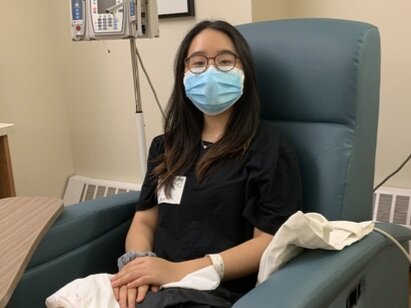
Here’s a picture of me before my treatment! A bit nervous, but hanging in there.

Here’s a picture of me before my treatment! A bit nervous, but hanging in there.

This past week, I received my very first dose of Stelara, my latest biologics treatment, at Mount Sinai in New York City! Unfortunately, even after a year on Humira subcutaneous injections, my Crohn’s symptoms have not subsided as we had originally hoped. After having seton drain placement done back in December 2020, along with another operation in June 2021, my healthcare team at Mount Sinai’s IBD Center decided that it may be best to try a new method of attack with a new set of biologics treatment.

Before starting the treatment, I had multiple healthcare workers stop by my room to explain what exactly Stelara was. I’m grateful that my mom was there to be by my side during this transition, but I also know what a blessing this is. When I was first diagnosed back in June 2020, I was completely alone in the hospital while COVID-19 infection and hospitalization rates were through the roof. The simple comfort of being surrounded by a loved one went a long way. 

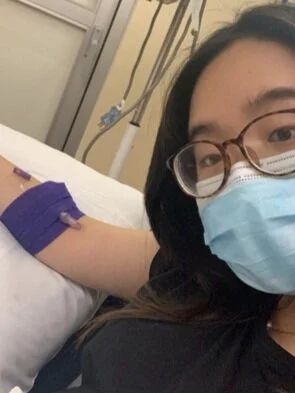
Here’s me while receiving my first dose of Stelara intravenously! The next dose will be done via injection, hopefully on my college campus.

Here’s me while receiving my first dose of Stelara intravenously! The next dose will be done via injection, hopefully on my college campus.

While I originally had a bit of trouble breathing in the first few minutes, my nurses assured me that this was not an allergic reaction to Stelara and that I was reacting well to the medication. It only took about an hour for the entire round of Stelara to be infused, but I did wait an additional 30 minutes to ensure that I would not experience any additional side effects. Truth be told, I was surprised at how efficient and fast-paced the entire infusion center at Mount Sinai was; I felt completely safe and well taken care of in their midst. Shoutout to the tireless effort of the amazing healthcare workers at Mount Sinai!

The day immediately after my first dosage of Stelara, my chronic fatigue kicked in, leaving me completely knocked out the morning after. Even after a year of living with Crohn’s disease, I’m still surprised by the ways that chronic fatigue manifests in my life. Although self-care admittedly goes a long way in understanding my body’s signals, I was most definitely caught off guard by how exhausted I was after the first dosage. 

Moving forward, it’s a bit terrifying knowing that my treatment plan may or may not work. However, I feel so grateful to have access to doctors that specialize in IBD care and surgery; all IBD patients deserve access to the most effective treatments for their specific condition. My first dose of Stelara was a reminder of not only how fortunate I was to have a second chance at a biologics treatment, but also of how much more work needs to be done to ensure that healthcare becomes equitable for all.