
NEWS
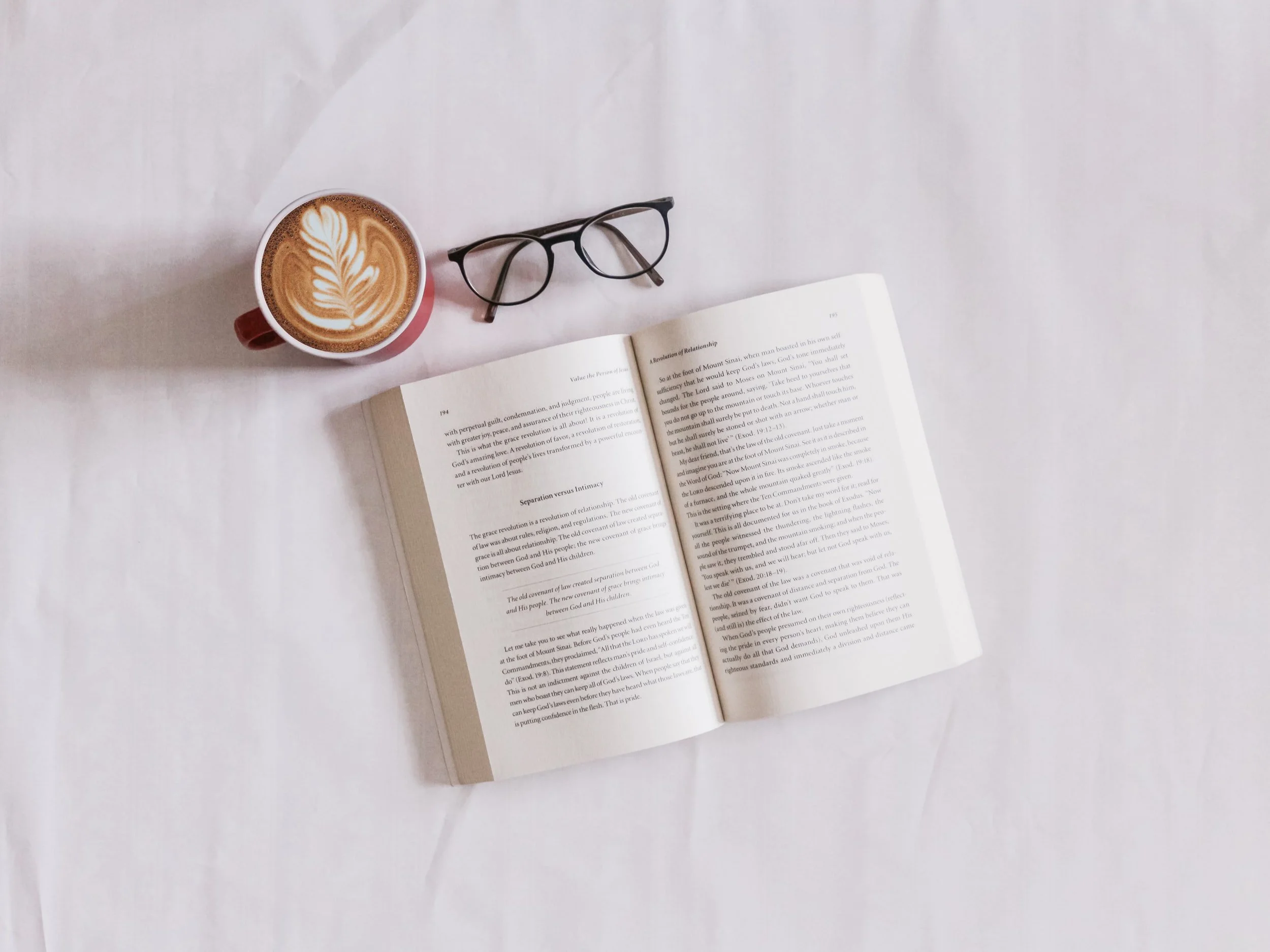
Book Recommendation: Exile and Pride: Disability, Queerness, and Liberation by Eli Clare
As I continue my journey navigating the ever-expansive world of chronic illness, I often find that I am always eager to learn more. I feel that increasing the amount of media and literature surrounding disability and chronic illness helps me understand more about myself and my personal journey. While on my search for sociological literature related to chronic illness, I stumbled across an exciting book recommendation, Exile and Pride: Disability, Queerness, and Liberation by Eli Clare. Upon getting this recommendation, I was so excited to delve into this subject matter since I have never been exposed to a book that so openly discussed disability and its intersection with many other identities.
To put it simply, Exile and Pride is a discussion of disability politics. Writing from a place of experience, Eli engages in a vast number of topics ranging from a lack of visibility to radical queer theory. Eli forces you to question your overall sense of self (in the best way possible) and tries to expand your understanding of what it's like to live with multiple intersecting identities. Grappling with the chronically ill portion of my identity has been an interesting and challenging process; this book gave me the space to self-reflect and better understand not only the different levels of my experience with chronic illness, but my perspective of the overall world in which we navigate.

“I often feel like an impostor as I write about disability, feel that I’m not disabled enough, not grounded deeply enough in the disability community, to put these words on paper.”
Here are some of my favorite quotes from the book:
“The non-disabled world is saturated with stories: stories about disabled people who engage in activities as grand as walking 2,500 miles or as mundane as learning to drive. They focus on disabled people “overcoming” our disabilities. They reinforce the superiority of the nondisabled body and mind. They turn individual disabled people, who are simply leading their lives, into symbols of inspiration.”
“Laugh and cry and tell stories. Sad stories about bodies stolen, bodies no longer here. Enraging stories about the false images, devastating lies, untold violence. Bold, brash stories about us reclaiming our bodies and changing the world.”“I often feel like an impostor as I write about disability, feel that I’m not disabled enough, not grounded deeply enough in the disability community, to put these words on paper.”
“The body as a home, but only if it is understood that bodies are never singular, but rather haunted, strengthened, underscored by countless other bodies. The body as a home, but only if it is understood that place and community and culture burrow deep into our bones. The body as a home, but only if it is understood that language, too, lives under the skin. The body as a home, but only if it is understood that bodies can be stolen, fed lies and poison, torn away from us. The body as a home, but only if it is understood that the stolen body can be reclaimed.”
There are countless quotes in the book that are salient to the chronic illness experience. I feel like inadequacy, infantilization, and many other concepts mentioned are felt throughout much of the community. Living with ulcerative colitis is like wandering through a maze, the path will never be clear, but some parts of the journey will be less confusing than others. This book reinforced this idea. We often don't have the luxury or privilege to have access to literature specifically for our community, especially intersectional literature. If you’re looking to understand more about body identity, disability history, personal experiences, oppression, power, and liberation with a few laughs along the way, I highly recommend this book!
This article is sponsored by Connecting to Cure.
Connecting to Cure Crohn’s and Colitis is a grassroots, volunteer organization that brings together the IBD community with a focus on caregivers and families. Connecting to Cure Crohn’s & Colitis provides community and support for those coping with these chronic illnesses, while raising awareness and funds for research as well.

Healing Looks Different for Everyone
This article is by Nathalie Garcia from the United States.
Photo by Spencer Selover from Pexels.
It feels so strange to think just a couple of years ago, I was just a confused kid who didn’t understand their diagnosis or where it would have led me. I’ve had a lot of time to reflect on how far I’ve come in terms of healing.
I feel like something that isn’t talked about a lot is how differently we all heal. I wish I could say I navigated my chronic illness with patience and grace but it just wouldn’t be true.
Some of us heal in multiple stages, take a step backward, maybe skip a few steps forward or go in circles for some time. Somehow, I feel as though there is an expectation for those of us who are disabled to be a vision of a warrior that people without disabilities have created.
Even hearing the word healing, I picture softness, warmth, and calm. As soon as I reflect on it, I see something completely different; I see isolation, cold concrete and stiffness. To have an invisible disability is an entirely different kind of isolation I have ever felt in my life. It’s like people can see me but their eyes just pass through me.
Healing a struggle people can’t see can make you bitter. Angry. Angry at the world. Angry at yourself. Sometimes healing turns into a never ending cycle of anger and guilt for feeling so much hatred for a world who can’t possibly understand you when they cannot even see you.
At one point, healing turned into a lot of reflection and self-forgiveness. It’s strange because somehow having a warmer perspective on what disability was like for me shocked others. How can you be happy after that? I couldn’t live like that. I still don’t know how to feel about some of these words. The more I think about them, the more I realize just how hurtful they are.
Because somehow, no matter what perspective I had of my disability, I could never satisfy anyone. And that was okay.
Recognizing that maybe others were just healing differently or at different stages of healing was so incredibly comforting. It made me realize I was angry once too and that I can’t possibly know if I’m seeing right through others like they saw through me.

Healing…
Because somehow, no matter what perspective I had of my disability, I could never satisfy anyone. And that was okay.

This article is sponsored by Lyfebulb.
Lyfebulb is a patient empowerment platform, which centers around improving the lives of those impacted by chronic disease.
Experiencing Change with IBD
This article is by Savannah Snyder from Canada.
Photo by Nothing Ahead from Pexels.
My life has been changing so insanely fast – from moving out of my childhood home to school three hours away, from living with six other people to now living alone, to a new city, apartment, school, and friends. Change can be amazing – pursuing your goals, growing as a person, and finding your place in this world. But, with change, also brings feelings of anxiety, nervousness, and stress. Change and stress often wreak havoc on my body and cause my Crohn’s Disease to make noticeable little flare-ups. With change comes unknowns, and as a very organized person, this causes my mind to wander. I try to remind myself that everything happens for a reason, and if I enter this new experience with a good and hopeful attitude, I’ll have a great experience.
I moved several weeks ago and am remembering how important self-care is to ensure my body feels safe, calm, and happy. These past few weeks, I’ve noticed my stomach pains starting to increase along with feelings of fatigue and nausea. Whenever I notice negative changes with my stomach, my stress skyrockets and I become petrified that a flare will take over my life. Although I do have an upcoming doctor’s appointment to address these issues, I am focusing on caring for my body with self-care measures in the meantime. To ensure I protect my stomach at all costs and continue to nourish my body, I am treating it with insane kindness in thanks for carrying me around each day and allowing me to live a life with so much love and happiness.
Today, I’ll share some self-care tips that I have undertaken while experiencing change.
Self-Care Tips
Sleep 8+ hours
A refreshing and long sleep helps my body feel so much better. I always try to get a long sleep in once a week!
Nourishing Foods
Eat foods that help you feel your best, this differs for everyone, but I always make sure to focus on eating enough of the foods I know best settle with my sensitive stomach!
Friends and Family
Making time for talking to friends and family is so important. No matter how busy you are, having an outlet is so important. Whether that be venting, doing activities together, or just hanging out.
Journaling
Whenever I’m undergoing change, I love to pour out all my thoughts onto paper. This helps me clear my head and feel refreshed. Although I procrastinate journaling beforehand, I love how I feel afterwards.
Activities
What makes you feel good? Getting your nails done, putting on a face mask, going for a walk, or doing some yoga, whatever activity you enjoy and feel relaxed doing, do it! These activities normally switch up for me and I try to be intuitive with how my mind and body are feeling. Whether that be sometimes going for a walk or doing a yoga flow and others I’m throwing on a movie and laying on the couch in my sweats!
“To ensure I protect my stomach at all costs and continue to nourish my body, I am treating it with insane kindness in thanks for carrying me around each day and allowing me to live a life with so much love and happiness.”

Negative Body Image
This article was written by Saravanan Nagappan from Malaysia.
Photo by Ismael Sanchez from Pexels.

Choose to do nice things for yourself.
Care about yourself and your happiness.
Don’t let anyone judge and give unsolicited advice on how your body should be.
Surround yourself with happy things.
Believe in yourself.
Start to build your confidence.
Have you ever thought your nose looks a bit wider than it should be or felt your body could afford to gain some weight or simply thought you don’t like the shape of your toes? If you do, then you might have issues with your body image. Most people have issues with their body image and it is also true for IBD patients.
What is body image, you may ask. Body image is the way we feel, think or perceive our own body. It could be a positive or negative body image and it involves one’s weight, shape, and even individual body parts. Most often, IBD patients similar to many other people face negative body image issues. IBD, as you all know, is a life-altering diagnosis. Whoever suffers from IBD, goes through the changes in their body. They might lose weight, suffer from fatigue, experience hair loss and may even have to live with surgical scars for the rest of their life. These could create a sense of loss and dissatisfaction with one’s “new” body. Negative body image also affects your self-esteem, changes your view of a happy life, create conflicts and may lead you into a depression. Having a negative body image is detrimental to us and we need to know why it may happen and how to break out from this negative cycle.
First and foremost, a reason for negative body image is having high expectations. Although, there’s nothing innately wrong with setting up high standards for oneself, sometimes it may bring more damage than good to us. In reality, it’s not easy to achieve body perfection especially for those who are sick and are going through physical changes due to their sickness. If you need or must have a standard to feel good about your own body, then set realistic and achievable standards.
As an IBD patient, there are limitations on what your body can do and can’t do. Therefore, acknowledge the limitation and accept yourself as who you are to break out from this negative cycle. Setting up high standards will hurt you whenever you fail to achieve it. Go slow with your expectations and push up those expectations as you achieve your previous targets.
Another cause for negative body image among IBD patients is comparison. Comparing your body before and after IBD or comparing yourself with others will create negative thoughts saying that you are not the best. We often compare our own body parts or features to others who seem to have a better body. This may lead you to look down on yourself and definitely lowers your confidence and self-esteem. To break from this, you need to actively and consciously stop yourself from comparing your body. Whenever you start comparing, you need to stop and remember that it is unnecessary to do any sort of comparison because you are doing what is already best for you and your body. Try to channel the energy that you were going to spend on comparison to focus on your happiness and mental health.
Negative energy around us is another reason for us to have a negative body image. Oftentimes we are surrounded by negative energy, such as, social media, advertisements and people around us. Social media platforms and advertisements often show and idolize perfect bodies with slim features for females and sculpted bodies for males and they even show unmarred flawless skin, ideal face and body shape, healthy looking skin, hair, and etc. This allows the general population to think that perfect bodies are the only way a person should be and they should desire and achieve that perfection. People around us like our friends and relatives sometimes tend to talk about our less desirable appearance and may even give suggestions and unsolicited advice. These situations often discourage and demotivate us from being happy with the way we look. In order to break from this negativity, we should learn to turn negative energies into positive energies. One of the usual ways is to avoid or remove yourself from being in the negative surrounding. Engage with people who are always supportive of our life, encourage when we need it and recognize us as a better person. Actively avoid any kind of media that possibly makes you feel negative about your body. Surround yourself with people and things that make you happy and feel accepted as who you are now.
Self-isolation is one of the reasons you to get negative body image. Isolation processes start to happen to you when you always feel ashamed with your own appearance and slowly try to hide your body from others and like to be alone. In this case, you start to avoid any social events, public places and may avoid to go to work or school. At one point, you may even try to avoid to look at yourself in a mirror.
To stop yourself from isolation you should brave to see yourself as a whole person and avoid not to focus on specific body parts. Don’t think about what people will think about your appearances, because there is no prefect human being in this world. Appreciate what your body looks like and try to accomplish yourself by celebrating it. Go out see more people and engage with them by talking, singing, dancing, and swimming. This will build your confidence in your body.
To sum up, choose to do nice things for yourself. Care about yourself and your happiness. Don’t let anyone judge and give unsolicited advice on how your body should be. Believe in yourself, start to build your confidence and surround yourself with happy things. This will create positive energy to your life.
“Engage with people who are always supportive of our life, encourage when we need it and recognize us as a better person.”

Overcoming Fear
“I must not fear.
Fear is the mind-killer.
Fear is the little-death that brings total obliteration.
I will face my fear.
I will permit it to pass over me and through me.
And when it has gone past, I will turn the inner eye to see its path.
Where the fear has gone there will be nothing. Only I will remain."
Frank Herbert, Dune
It is funny how the older we get, the less “scary” the things we fear are. When I was five, I used to be afraid that dinosaurs would march down my street and come eat me and my family. I used to fear the demons in the dark, or the being abducted by strangers. As we grow older, we realize the unlikelihood of these grandiose things we feared as children actually happening. We begin to fear the realistic things we know have hurt us before or that are likely to hurt us in the future. For many of us with Inflammatory Bowel Disease, these fears center on the fear of the unknown. How long will I stay in remission? Is it food poisoning or am I starting to flare? Will my medication be shipped in time for me to take it? Can I live a normal life without my colon?

Sometimes fear comes from the unknown surrounding our medications
These past few years I’ve been afraid of a lot of things because of Crohn’s Disease. I’m afraid to look at the scale in case my weight is dropping. I am afraid to try new foods because I have a lot of food sensitivities. I am afraid of that little sharp pain I occasionally feel in the lower right part of my stomach that might mean my disease isn’t in remission. Fear can be all consuming. It can take a hold of your mind, and suppress any reason or logic that would challenge its grip.
Fear is an instinct, which means we don’t get to choose how or when it happens. I’ve found that fear likes to act in the background. It takes over our mind when we are so focused on the source of our fear that we forget the fear itself. The first step to overcoming fear is facing it. We have to identify and acknowledge that we are afraid.
Once we understand that we are afraid, we must then ask: Why? It is much more than just identifying the source of fear. It is easy for me to say: “I am afraid because the last time I ate pizza I had stomach cramps” and stop there. If I continue to dig deeper, I can come up with thoughts like:
“Am I 100% sure it was the pizza and not something else?”
“Was the last time I had pizza when I was in a flare?”
“Am I in a better position now where things might be different?”
“Did I get a lot of crazy toppings last time? Maybe I can try something simpler.”
“Am I willing to take the risk that pizza gives me cramps again”
Now, instead of fear, there is an informed dialog going on about the situation. It is no longer an emotional reaction, but an analysis of an event. I know the source of my fear, I understand the context, and I can make an informed decision moving forward. Fear may control the “how” or the “when”, but if we take a step back and try to understand the “why” behind our fears, we can overcome.
I want to circle back to the point I made earlier that a lot of the fear in Inflammatory Bowel Disease is of the unknown. There are two ways to learn something, you either do it yourself or somebody else teaches you. These are lived experiences and learned experiences.
One of the best ways to conquer the fear of the unknown is to learn from other people’s experiences. CCYAN consists of young adults who are overflowing with experience when it comes to living with IBD. If you are afraid of how your life will look after an ostomy, talk to a current ostomate. If you are afraid of switching medications, talk to somebody who has run the gauntlet of medications. If you are afraid you are entering a flare, talk to somebody who just got out of one.
It is so easy to feel isolated with IBD, and sometimes it feels like nobody else understands your fears. That is why it is so important to plug into groups like CCYAN and connect with people who can empathize and relate to the challenges and fears we face. You are not alone, somebody understands what you are going through. If we can identify our fears, understand the why behind them, and then connect to people who can remove the “unknown” factor, IBD can be a little less scary.


Thoughts about starting a new medicine
This article is by Vasiliki Rafaela Vakouftsi from Greece.
“How is your new medicine going?”
“It still needs time..”

Photo by Miguel Á. Padriñán from Pexels.
Starting a new drug is difficult, especially when you are trying to control a difficult disease. There is so much behind starting a drug that most people cannot think of.
First, it is scary. You hope this medicine does not interact with any of the other medicines you take - and they are a lot of medicines.
The following are the side effects. In other words, you are nervous to see if this new medicine will make you dizzy, drowsy, nauseous, etc. And, of course, there is always the possibility of more serious side effects.
Another problem is the possibility that the new medicine will not work. That’s the most difficult.
The adjustment period lasts some time before I start experiencing the benefits. It is a long way to go until things get better, where I have to remind myself that it is worth it and it will pass.
Adapting to a new medicine is difficult, but chronic illness is also difficult.
Medicines. My best friend and worst enemy. A love-hate relationship. I do not want to live with them, but I probably would not live without them.
Now for those who question western medicine and believe that all this is unnecessary and all I need are essential oils and yoga, I will stop you. I feel very lucky to have a very good medical team and a treatment plan.
Fingers crossed for my new medicine to work and for me to get a better quality of life…

Major Life Transitions: IBD and Starting Graduate School
As a young adult who lives with IBD, feeling safe and secure is almost as necessary as breathing air. Navigating the endlessly winding path of chronic illness has caused me to be more aware of my environment and how it affects me. Through this, I have come to find solace in my environment. After getting accustomed to this sense of safety, I finally found comfort. But, what happens when that sense of comfort and stability is challenged?
Recently, I just moved 500 miles away from home to attend grad school. This was probably one of the most impactful decisions I’ve ever had the privilege of making. While the process of moving for grad school is difficult for everyone, I want to emphasize the added barriers that chronically ill people face. After I received my acceptance letter from the University of Pittsburgh, I was overcome with joy. Finally seeing the fruits of my hard work, determination, and labor was extremely validating. Shortly after this period of elation, I immediately became overwhelmed with intrusive thoughts such as “Well, can I really move away from home with ulcerative colitis?”, “What happens if I flare again?”, “I don’t want to leave my doctor.” I tried to give myself space to feel my emotions, but it was still difficult. Ultimately, the decision to move was clouded by, what I like to call, health hesitation.
Not only did I have to deal with the social pressure of applying to grad school, I also had to cope with the idea of being away from my established support system. I’ve worked so hard to build meaningful relationships with my medical team, so how on earth would I manage to completely restart? Something that I found beneficial was being open and communicative with my doctors throughout the entirety of the grad school process. My GI doctor knew the second I was accepted, she knew when I took my first flight to visit campus, and she knew about every important date leading up to my departure. Being transparent allowed her to assist me with navigating insurance, finding new doctors, and recommendations. This significantly helped with my transition and it helped relieve some of my health related anxiety. For myself, stress and anxiety are triggers for my symptoms, so mitigation is salient. This emphasizes the importance of advocating for yourself and being open and honest with your doctor(s).
An important tip I would give someone moving for grad school is to be proactive about setting up doctors appointments before you move. Prior to moving, I made sure that I had the basics down, like dentist and eye doctor visits. Getting the lower priority appointments out of the way definitely eased some of my anxiety. This also extends to being proactive about finding doctors once you arrive. The process is very overwhelming, but I found that taking these steps helped mitigate some of that stress and anxiety. A second tip I would give is to check to see if the school you're attending has an on-campus pharmacy. I, like many others, have quite a few necessary medications and transferring to a new pharmacy can be a bit of an undertaking, especially when it’s out of state. For example, The University of Pittsburgh has an on campus pharmacy that takes care of insurance and the medication transfer process in a quick and efficient manner. Never hesitate to seek out local resources, especially through your campus disability resources center.
In summation, no one experience is going to be universal. We will all experience our own set of unique trials, anxieties, and stressors. With that being said, moving for grad school is a decision I will never regret. If I ever feel like second guessing myself or I get discouraged about having to restart everything, I always like to remember that this experience is an investment for my future, both professionally and personally. Always be vocal and advocate for yourself, especially when seeing new providers, give yourself space, try to quiet that health hesitancy, and enjoy your experience. If I can do it, anyone with IBD can do it. We are all capable of withstanding hardship!
This article is sponsored by Connecting to Cure.
Connecting to Cure Crohn’s and Colitis is a grassroots, volunteer organization that brings together the IBD community with a focus on caregivers and families. Connecting to Cure Crohn’s & Colitis provides community and support for those coping with these chronic illnesses, while raising awareness and funds for research as well.

Little Wins: Things that Keep you Going
This article is by Nandani Bhanot from India.
To be very honest, a little over a year ago, I had little to no idea about the presence of chronic illness patient-led advocacy efforts around the world. It is a real pity because as I look back, it would have helped me navigate many of my IBD experiences better. I would have been armed with more information to vouch for my safety, comfort and rights. However, I am glad I started now rather than later, and I look at the many things I have learned thanks to the Crohn’s and Colitis Young Adults Network (CCYAN) with great satisfaction. Yet, patient-led advocacy is harder than it seems, especially in the South Asian context.
When I was first diagnosed with IBD, I was at a stage in my life where taking up space felt complicated and wrong. So at moments where my illness conflicted with social plans, I would push my needs away rather violently in favor of not making other people uncomfortable or having to explain my uncertain situation. Sometimes, when I ignored my needs too often, I would bitterly burst open – they were highly volatile moments of trying to advocate with very little information. It was akin to a baby taking its first steps and learning how to walk on shaky ground. The feedback during these first years was overwhelmingly negative, with people underestimating the severity of my illness, disbelieving my experiences and ignoring my needs. I admit, the advocacy was ungraceful and thus perhaps, I received unfavorable feedback. Cut to now, I am still learning how to best advocate for myself, people with IBD, and the larger chronic illness community. Now, I’m starting to receive positive feedback.
Being vulnerable requires immense courage in the South Asian community. The society thrives on critiquing and scrutinizing everything that is a part of it, and with very rigid definitions of what success is and what the many shortcomings are, to put yourself right in the middle of it all is a courageous task. I started actively and unabashedly talking about my illness only after I joined CCYAN this past year. I did not expect to impact the social circles around me, even though part of my goal was to reach out to someone like me in the past and help with information and support. Unfortunately, every time I posted something, I was simultaneously fighting internalized shame from the vulnerability of allowing it to be shared. The society can make you feel like you are exaggerating your experiences, asking for attention, and can even make you question your own reality. Fighting your immune system, the ableist world system, people’s misunderstanding of your disability and your own thoughts can be exhausting and can make one feel demotivated easily and frequently. With basic rights not covered for the majority of the Indian population, raising awareness for invisible disabilities can seem completely pointless rather quickly, and like your efforts aren’t making a difference. But this is not true.
Ever since I embraced advocacy wholeheartedly, multiple people have approached me to say their thanks in helping them understand the chronically ill in their personal circles, or in helping them understand their own symptoms. Connections have been made where otherwise we would have remained strangers, and strong support systems have been established where before, people may have felt extremely alone in their struggles. And while there is no lack of unsolicited opinions and unhelpful feedback, the weight of the positive interactions is not to be underestimated. They make the whole thing worth it. Even if the posts impact one person positively, especially in knowing they are not alone, it can make a world of a difference. For instance, think back to when you felt alone with a certain aspect of your illness/significant life event. Coming across something that resonated with the most vulnerable part of you must have had an extreme impact. In my case, when an adult had opened up about navigating a life with ulcerative colitis, it changed my life. I’d previously thought that being diagnosed with IBD meant my life had basically ended. With all the restrictions and future health risks, this person showed me life could go on, just differently than we imagined. So in these moments, when I realize someone is actually impacted by what I’ve posted, that is what keeps me going.

Starting a New Treatment: My Experience with Humira and Stelara
This article is by Jennifer Lee from the United States.
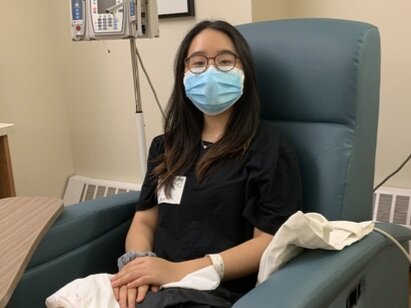
Here’s a picture of me before my treatment! A bit nervous, but hanging in there.
This past week, I received my very first dose of Stelara, my latest biologics treatment, at Mount Sinai in New York City! Unfortunately, even after a year on Humira subcutaneous injections, my Crohn’s symptoms have not subsided as we had originally hoped. After having seton drain placement done back in December 2020, along with another operation in June 2021, my healthcare team at Mount Sinai’s IBD Center decided that it may be best to try a new method of attack with a new set of biologics treatment.
Before starting the treatment, I had multiple healthcare workers stop by my room to explain what exactly Stelara was. I’m grateful that my mom was there to be by my side during this transition, but I also know what a blessing this is. When I was first diagnosed back in June 2020, I was completely alone in the hospital while COVID-19 infection and hospitalization rates were through the roof. The simple comfort of being surrounded by a loved one went a long way.
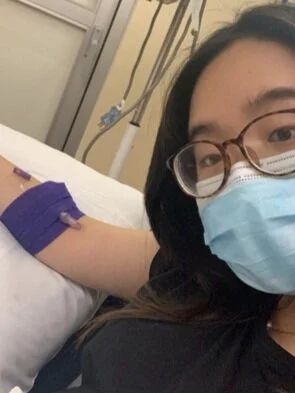
Here’s me while receiving my first dose of Stelara intravenously! The next dose will be done via injection, hopefully on my college campus.
While I originally had a bit of trouble breathing in the first few minutes, my nurses assured me that this was not an allergic reaction to Stelara and that I was reacting well to the medication. It only took about an hour for the entire round of Stelara to be infused, but I did wait an additional 30 minutes to ensure that I would not experience any additional side effects. Truth be told, I was surprised at how efficient and fast-paced the entire infusion center at Mount Sinai was; I felt completely safe and well taken care of in their midst. Shoutout to the tireless effort of the amazing healthcare workers at Mount Sinai!
The day immediately after my first dosage of Stelara, my chronic fatigue kicked in, leaving me completely knocked out the morning after. Even after a year of living with Crohn’s disease, I’m still surprised by the ways that chronic fatigue manifests in my life. Although self-care admittedly goes a long way in understanding my body’s signals, I was most definitely caught off guard by how exhausted I was after the first dosage.
Moving forward, it’s a bit terrifying knowing that my treatment plan may or may not work. However, I feel so grateful to have access to doctors that specialize in IBD care and surgery; all IBD patients deserve access to the most effective treatments for their specific condition. My first dose of Stelara was a reminder of not only how fortunate I was to have a second chance at a biologics treatment, but also of how much more work needs to be done to ensure that healthcare becomes equitable for all.

Tips to Improve Your Quality of Life with a Stoma
This article is by Saravanan Nagappan from Malaysia.
Photo by George Becker from Pexels
Many of my ostomy friends confided that their life has changed since they became an ostomate. They feel their quality of life has deteriorated after having a stoma. They are unable to enjoy their life as before they became an ostomate. They mention changes to their diet, workout, and their social activities not remaining the same as before. Yes, I have to agree with them, because what they say is a common fact for an ostomate to experience and I personally faced the same issue as well even a decade being an ostomate, still my life is not the same as before. I’m going to share with you a few tips on how I have managed to reduce the impact a stoma has on quality of life based on my experiences.
Accepting your new life as an ostomate
The first tip is acceptance. We need to accept that we are ostomates and prepare for it both mentally and physically. At the end of 2011, my surgeon approached me and suggested that I have to go for Ostomy surgery as it was the best way to heal my fistula. My surgeon informed me regarding the complications I would be facing. At that time, I was confused and worried. I took a few days to decide whether I want to do it or not. The decisions involved many considerations, especially the changes in my life that come from being an ostomate and living my entire life as one afterward. After a long discussion with my family, I finally agreed to go for the surgery. I psyched myself up mentally by listing the benefits of this surgery and the changes it would bring to my life especially the physical ones. Since I accepted my situation and geared up for it, post-surgery changes were not monumental. My goal at that point in my life was to heal my fistula and get my Crohn’s under control. It was more than enough for me.
Adapting to new norms
The next piece of advice is adapting to new norms. This is important for an ostomate because a new ostomate is like a newborn. We are reborn into a new physical self and the changes it brings to our routine are something we have to relearn all over again. Without a choice, we have to adjust to new norms. Common new norms are our diet, daily routine, and social activities. It’s impossible to change everything overnight, but focus on small changes in our daily life and we will be able to see the impact in the long term. Once we learn how to slowly accept and adapt to our new norms, we will find it easier to live our life as an ostomate. The problem occurs when we refuse to accept new changes or routines. Inability to accept the changes can lead to deterioration of life quality.
Pre-planning your days
The following tip is to pre-plan. Pre-planning everything you want to do is one of the ways to improve an ostomate’s quality of life. Pre-planning a daily routine or outing is common in anyone’s life. However, it could be an essential habit for an ostomate. For example, assume that you need to attend an event in a few days’ time. In order to attend this event, you need to pre-plan your diet so you can avoid any food that can cause gases. By doing this you may avoid visiting the washroom all the time in front of others and enjoy the event more. Not only diet, but you can also pre-plan for other matters such as your physical and emotional wellbeing as well. Remember pre-planning can help to prevent any last-minute mishaps or emergency withdrawal from a situation.
Physical exercise for a better quality of life
As a final tip, I personally suggest that ostomates perform some physical exercises. After my surgery, I thought that my workout routine had come to an end. However, my thoughts had changed after I met a few senior ostomates. They advised me to not abandon my workout and they guided and motivated me on how ostomates should do their workouts. I started again with basic workout routines and challenged myself to go for the harder level. So how do workouts improve our quality of life? Doing physical exercises help to build our body muscles, reduce unwanted fats, keep our body fit and flexible and also improve our blood circulation and digestive systems. Moreover, workouts help to remove toxins from our bodies. which will keep our bodies healthier. Exercises also help to keep our minds active and create more positive energy within us. All these could tremendously improve ostomates’ quality of life.
In a nutshell, ostomy surgery is a life-saving procedure for many patients. Therefore, it should not be treated as a burden. Rather, we must take our own individualized care and explore new choices to improve the quality of life after ostomy surgery. I hope these tips can help you in your ostomy journey.